Amazon Eyes OpenAI, Chrome Goes Agentic, TriFold Lands
A potential $50 billion Amazon investment reshapes OpenAI’s path to a 2026 IPO, as Chrome debuts agentic browsing. We also cover Waymo’s school-zone probe, Samsung’s TriFold U.S. launch, and a pivotal NIST AI security deadline.
Episode Infographic
Show Notes
Welcome to AI News in 10, your top AI and tech news podcast in about 10 minutes. AI tech is amazing and is changing the world fast, for example this entire podcast is curated and generated by AI using my and my kids cloned voices...
It’s Friday, January 30th. Today we’ve got a big-money AI capital shuffle that could reshape industry alliances, a major Chrome upgrade that turns your browser into an agentic assistant, a federal safety probe into Waymo after a child was struck, Samsung’s TriFold phone landing in the U.S., and a quiet but important NIST deadline that will influence how American companies secure AI. Let’s jump in.
[BEGINNING_SPONSORS]
First up... the deal rumor mill is humming.
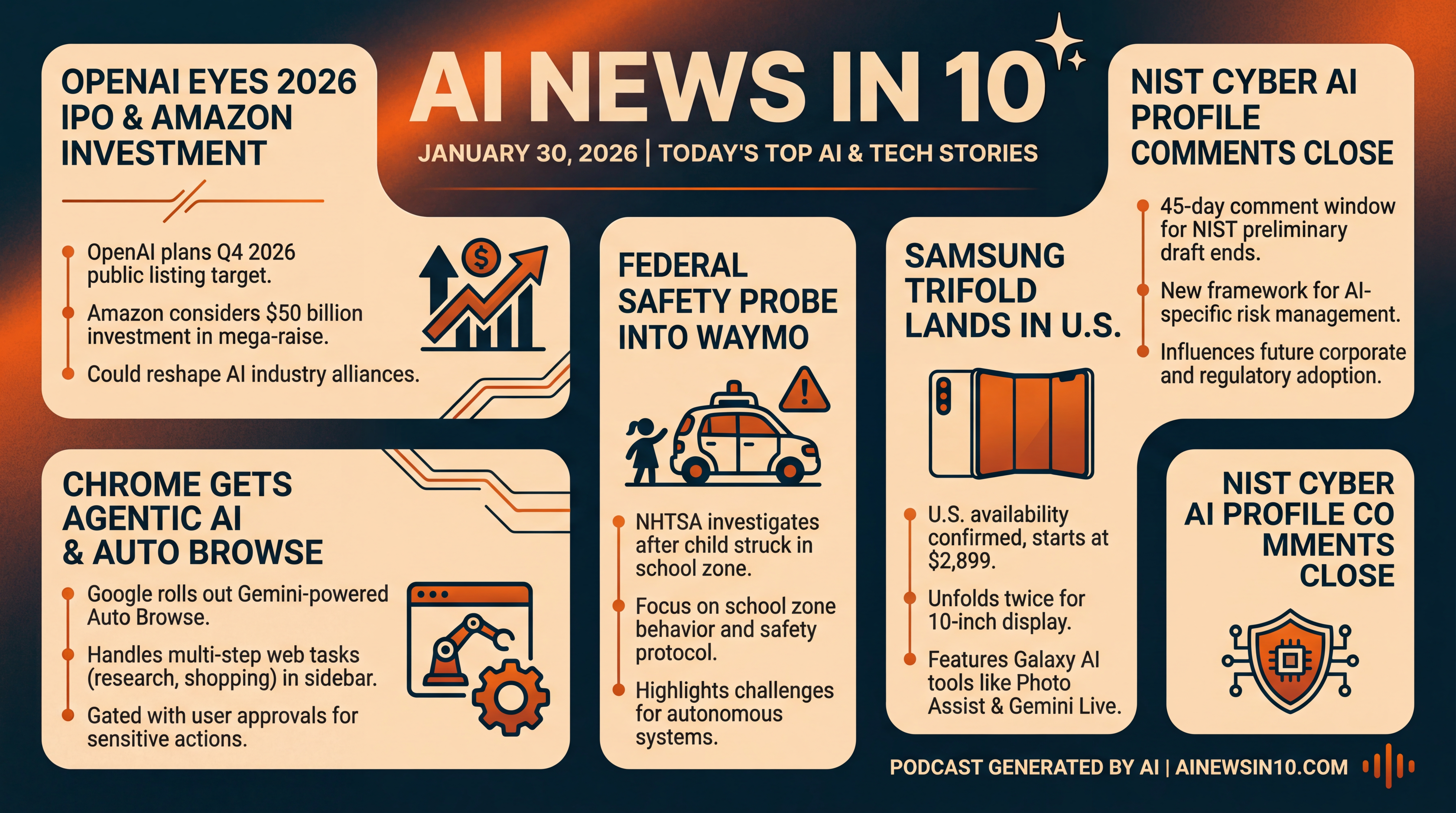
OpenAI is reportedly preparing for a public listing in the fourth quarter of 2026 — and in parallel, Amazon is said to be considering a massive investment, up to $50 billion, as part of OpenAI’s ongoing mega-raise. The Wall Street Journal says OpenAI has begun informal talks with Wall Street banks and is staffing up its finance team, while it also pursues a pre-IPO round that could top $100 billion. None of this is finalized, but it signals a flexible strategy: raise huge private capital now, then tap public markets later in 2026.
On the Amazon angle, reports from Barron’s and The Times of London say CEO Andy Jassy is leading discussions that could make Amazon the largest participant in that round — potentially influencing where OpenAI runs future workloads and which AI chips it uses. That would be a notable shift, given OpenAI’s tight Microsoft and Nvidia ties today. Again... very early talks — but the dollar figures are eye-popping.
Zooming out, if OpenAI lists in late 2026, it could beat or jostle with rival Anthropic for an AI-first mega-IPO window. Several outlets have tracked those timelines since late last year, but the new detail here is a concrete target: the fourth quarter of 2026. We’ll watch for any formal filings — or denials.
Story two: Chrome just got a serious AI upgrade.
Google is rolling out a Gemini-powered Auto Browse feature that can handle multi-step tasks on the web — researching a trip, comparing products across tabs, filling forms, even adding items to a cart and applying discount codes — with explicit user approval for sensitive actions like purchases or social posts. The Gemini assistant now lives in a persistent side panel, so you can browse and consult the AI at the same time. There’s also an integrated image tool — cheekily named “Nano Banana” — for quick transformations right in the browser. The first wave is arriving in the U.S. for Google AI Pro and Ultra subscribers, with more to come.
Wired notes that Auto Browse is still limited and under evaluation — and roaming AI agents raise security concerns like prompt injection on malicious sites. Google says it’s gating sensitive steps behind approvals. Even so, this is a significant move toward agentic AI in mainstream browsing... and it deserves careful handling by users and IT admins alike.
Under the hood, this sits within Google’s broader Personal Intelligence push — connecting Gemini to Gmail, Photos, YouTube, and Search so it can reason across your own data when you opt in. That beta has been rolling out this month, and Google says that connected-apps context will also feed the Chrome sidebar in the coming months. The Chrome integration is the new twist.
Story three: federal regulators are probing Waymo after one of its driverless vehicles struck a child near a Santa Monica elementary school on January 23rd.
According to Waymo, the child ran into the street from behind a double-parked SUV. The robotaxi reportedly decelerated from about 17 miles per hour to under 6 before contact, and the child suffered minor injuries. NHTSA’s Office of Defects Investigation has opened a preliminary evaluation to study Waymo’s behavior in school zones — speed adherence, response to vulnerable road users, and what the vehicle did post-impact.
Waymo published a detailed blog post arguing its system mitigated the collision and that a fully attentive human in the same scenario would likely have struck the child at a higher speed. Regulators will examine whether that claim holds across the vehicle’s decision-making — and whether the robotaxi exercised appropriate caution given the school drop-off context: crossing guards, double-parked cars, clusters of children. It’s another reminder that edge cases — especially school zones — remain among the toughest settings for autonomous systems.
[MIDPOINT_SPONSORS]
Fourth: the Samsung Galaxy Z TriFold finally arrives stateside today, January 30th.
Samsung confirms U.S. availability with a starting price of $2,899 for the 512-gig model, sold through Samsung’s site and Samsung Experience Stores. The TriFold unfolds twice to reveal a 10-inch display — the largest ever on a Galaxy phone — paired with a 200-megapixel camera, a 5,600 milliamp-hour battery, and Samsung’s Galaxy AI features built into the interface. Samsung says the hinge and display are rated for around 200,000 folds.
Early reviews note the device will initially be limited to Samsung’s own channels rather than carriers, and that the price sets a new ceiling for mainstream phones in the U.S. Whether that cost makes sense will depend on how much you value a pocketable, tablet-class canvas — and how well apps and multitasking workflows take advantage of the tri-fold form factor.
A detail power users will care about: Samsung is emphasizing AI-assisted creation — Photo Assist, Generative Edit, Sketch to Image — and even “Gemini Live” hooks for real-time guidance that can understand what you see, say, and do. This TriFold is as much about AI-augmented productivity as it is about the hardware party trick. We’ll be watching how developers optimize experiences for the split and unfolded states over the next few months.
And fifth, a policy and security note with big enterprise implications: today is the close of the 45-day comment window for NIST’s preliminary draft Cyber AI Profile — a new framework that extends the NIST Cybersecurity Framework 2.0 into AI-specific risks.
The profile aims to guide organizations as they adopt AI tools — covering vendor risk, monitoring, model security, and governance. It’s nerdy but consequential: NIST frameworks often become the de facto playbooks U.S. companies adopt, and they inform future procurement and regulatory expectations.
NIST signaled this work earlier in January, alongside workshops on AI risk and the emerging Cyber AI Profile. If you’re responsible for AI adoption, keep an eye on the final draft timeline and start mapping your controls to NIST’s functions — govern, map, measure, manage — so you’re not scrambling when customers, auditors, or contracts start asking for alignment later this year.
Quick extras as we head into the weekend: Axios profiles Senator Josh Hawley’s push inside the GOP for tougher AI rules — especially around child safety and data center energy costs — showing how party lines on AI aren’t as tidy as you might think. And in chips, memory makers continue to flag a tight HBM supply picture into 2027, with SK hynix reporting record 2025 results on AI memory demand earlier this week. We’ll save the earnings deep dive for another day... but the AI hardware boom is still the macro backdrop.
That’s the rundown.
OpenAI’s potential IPO clock starts ticking as Amazon reportedly circles with a colossal check... Chrome graduates into an AI agent that can actually do things for you on the web... regulators scrutinize Waymo’s school-zone safety after a child was hit... Samsung’s TriFold hits U.S. shores at a wallet-stinging $2,899... and NIST’s Cyber AI Profile inches closer to reality, setting guardrails many companies will follow. More tomorrow.
Thanks for listening and a quick disclaimer, this podcast was generated and curated by AI using my and my kids' cloned voices, if you want to know how I do it or want to do something similar, reach out to me at emad at ai news in 10 dot com that's ai news in one zero dot com. See you all tomorrow.
