Orbital AI, Opt-Outs, and Power Plays
SpaceX proposes up to a million orbital AI data-center satellites as Starlink updates its privacy policy with an AI training opt-out. We also hit Web Summit Qatar’s opening, Colorado’s delayed AI law, and Google’s bet on battery storage for the AI grid.
Episode Infographic
Show Notes
Welcome to AI News in 10, your top AI and tech news podcast in about 10 minutes. AI tech is amazing and is changing the world fast, for example this entire podcast is curated and generated by AI using my and my kids cloned voices...
It's Sunday, February 1st, and we've got a big mix of space, privacy, policy, and power.
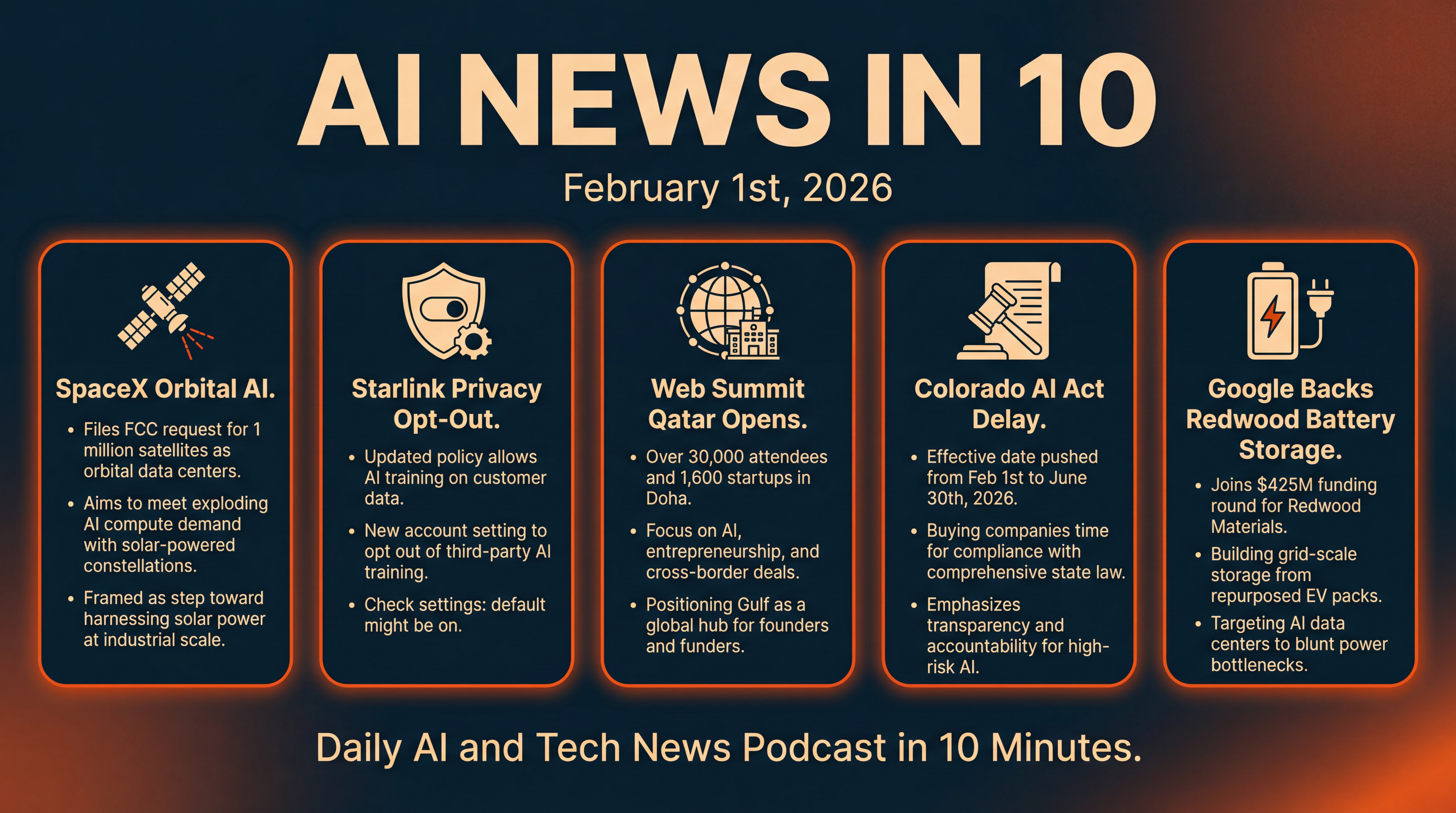
Here's what's on deck... SpaceX just filed an audacious request with the FCC to launch up to one million solar-powered satellites — yes, one million — to act as orbital data centers for AI. Starlink quietly updated its privacy policy in mid-January to allow training AI on customer data, with a new opt-out toggle. Web Summit Qatar opens today in Doha with a projected 30,000 attendees and more than a thousand startups. In U.S. policy, Colorado's AI Act — originally slated to kick in today — was pushed to June 30, buying companies time but not a pass. And Google has joined Redwood Materials' 425-million-dollar round to build battery-derived energy storage for... you guessed it... AI data centers.
Let's get into it.
[BEGINNING_SPONSORS]
First up — SpaceX wants to move the AI compute race... off the planet. The company filed an application with the FCC seeking approval to deploy a constellation of up to one million satellites — solar-powered and laser-linked — to operate as orbital data centers. In the filing, SpaceX calls this the most efficient way to meet exploding demand for AI compute, even framing it as a step toward a Kardashev Two civilization — basically, harnessing the sun at industrial scale. Bold doesn't begin to cover it.
Reporters note the FCC is unlikely to approve anything close to a million, and they point out that Starlink already dominates the global satellite population, while space-debris concerns keep mounting. Still, the application shows SpaceX's appetite for reshaping AI infrastructure is as big as space itself. Industry outlets flagged the request, and the FCC docket filed in January confirms the move.
Context matters here. There are roughly fifteen thousand active satellites today, and collisions and debris are no longer science-fiction headaches. It's unlikely the ask gets approved outright... but this looks like a classic SpaceX move — ask for the sky, negotiate for less. Whether orbital compute becomes a real alternative to land-based, water-hungry data centers — or stays a moonshot marketing pitch — the filing is a signpost for where AI infrastructure ambitions are headed.
Story two — Starlink's privacy policy. On January 15th, Starlink updated its global privacy policy to say it may use customers' personal information to train machine learning or AI models, and it now offers a way to opt out of sharing data with third-party collaborators for AI training via your account settings. That's new, and it's raising questions from privacy advocates about what counts as model training and which data categories are in play. Earlier versions didn't reference AI training at all. If you're a Starlink user, check your settings today and toggle off sharing for third-party model training.
One more nuance: the page says you can opt out of use of your data for AI model training by third-party collaborators — which draws a line between Starlink's internal use and third-party use. Until Starlink provides more specifics on categories and retention, the safe play is to opt out now, review your app permissions, and revisit your settings after any future updates.
Third — Web Summit Qatar 2026 opens today in Doha, with more than 30,000 attendees from over 120 countries and more than 1,600 startups. Officials say prior editions delivered hundreds of millions of Qatari riyals in economic impact. This year leans heavily into AI, entrepreneurship, and cross-border dealmaking. The prime minister is slated to speak at the opening, and the show is positioning the Gulf as a gathering place for founders and funders from Europe, Asia, and Africa. If you're fundraising, recruiting, or scouting partnerships in the MENA region, today through February 4th is a heavy-hitter week in Doha.
[MIDPOINT_SPONSORS]
On to policy — Colorado's landmark AI Act, often described as the most comprehensive state law governing high-risk AI in employment, lending, housing, education, and more, was scheduled to take effect today, February 1st, 2026. Lawmakers passed — and Governor Jared Polis signed — a bill during last year's special session moving the effective date to June 30th, 2026. The state's official bill page confirms the delay. For developers and deployers, that's five extra months — time to document risk management, disclosures, and impact mitigation plans — but not an excuse to punt. Expect further tweaks this session, yet the direction of travel is clear: more transparency and accountability for consequential AI systems.
A bit of practical guidance if you operate in or sell into Colorado: use the runway to inventory high-risk use cases, align governance to your model lifecycle, and get your disclosures, appeal processes, and audit trails production-ready. Watch the interplay with other state rules — California's new AI transparency regime took effect January 1st — and with federal actions that may challenge or preempt some state provisions. A solid roundup of 2026 tech laws is a handy map of what else is changing across states this year.
Finally — power for the AI age. Redwood Materials, JB Straubel's battery circularity company, extended its Series E to 425 million dollars, adding Google as a new investor. That brings total private capital raised to about 2.3 billion dollars and reflects a pivot beyond recycling. Redwood Energy is building grid-scale storage from repurposed EV packs to backstop AI data centers and industrial sites. With GPU farms pushing grids to their limits, long-duration storage is becoming strategic infrastructure. Redwood says it could deploy 20 gigawatt-hours of storage by 2028, and it already handles a majority of used battery packs in North America. For hyperscalers and AI-heavy enterprises, these second-life systems could blunt power and resiliency bottlenecks — especially near constrained substations.
Taken together, today's stories trace the same curve. SpaceX is testing the bounds of where AI compute can live — literally, by putting it in orbit. Starlink's policy shift spotlights the data needed to teach the models that run that compute — and the rising expectation that users can opt out. In Doha, Web Summit is a reminder that AI's center of gravity is global and mobile. In Denver, policymakers are tightening the guardrails. And in Nevada, Redwood and its backers are trying to solve the physics — how we power all of this — sustainably and at scale.
That's AI News in 10 for February 1st. See you tomorrow.
Thanks for listening and a quick disclaimer, this podcast was generated and curated by AI using my and my kids' cloned voices, if you want to know how I do it or want to do something similar, reach out to me at emad at ai news in 10 dot com that's ai news in one zero dot com. See you all tomorrow.
