Waymo Megaround, GPT Changes, Kuiper Delay, Tariffs
From Waymo’s $16B raise and OpenAI’s ChatGPT model sunset to Amazon’s Kuiper extension request, the Coursera–Udemy merger, and new White House chip tariffs—we break down what it means for teams, budgets, and roadmaps. A fast, practical briefing with tips on staying ahead of model changes and infrastructure shifts.
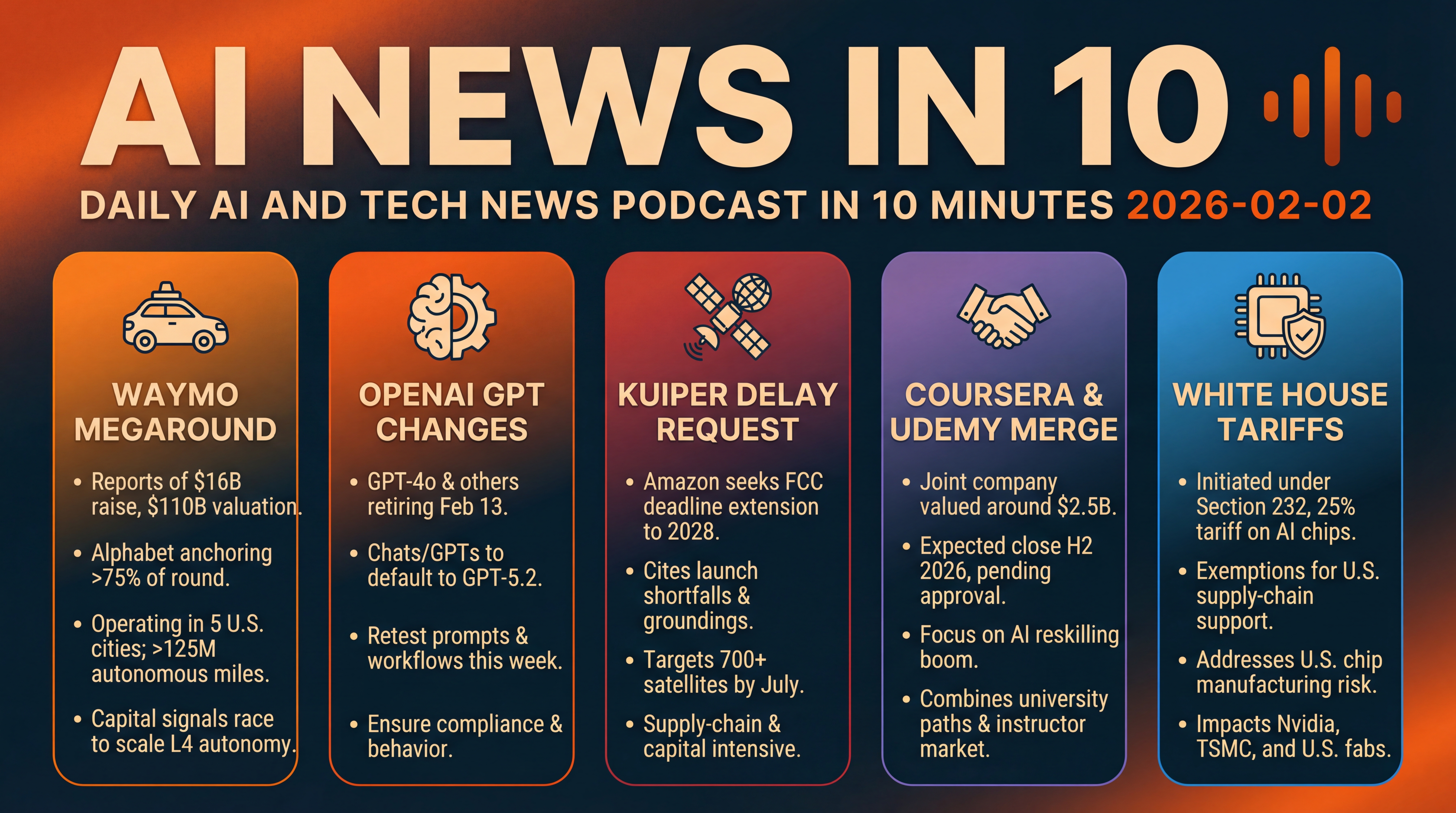
Episode Infographic
Show Notes
Welcome to AI News in 10, your top AI and tech news podcast in about 10 minutes. AI tech is amazing and is changing the world fast, for example this entire podcast is curated and generated by AI using my and my kids cloned voices...
Here’s what’s happening today in AI and tech... Waymo is reportedly locking in a massive funding round that more than doubles its valuation. OpenAI is sunsetting several popular ChatGPT models this month. Amazon wants more time from the FCC to get its satellite internet constellation in orbit. The online learning giants Coursera and Udemy are combining forces to tackle the AI reskilling boom. And the White House is moving ahead with tariffs on select AI-related chips—a policy with big implications for Nvidia, TSMC, and U.S. fabs. Let’s dive in.
[BEGINNING_SPONSORS]
First up, Waymo’s megaround. Multiple outlets report Alphabet’s autonomous-driving arm is finalizing a $16 billion raise that values the company at roughly $110 billion—up from around $45 billion in late 2024. The Financial Times says Alphabet is anchoring more than three-quarters of the round, alongside Dragoneer, Sequoia, DST, Mubadala, and others.
Barron’s adds why this matters for markets: at a $110 billion valuation, investors are reassessing how much of Tesla’s market cap rests on robotaxi hopes versus Waymo’s increasingly tangible metrics. Waymo is now operating in five U.S. cities, clocking hundreds of thousands of paid rides weekly, and has accumulated more than 125 million autonomous miles. Those unit economics questions—fleet size, utilization, safety records, and city-by-city approval—are starting to look less theoretical. The Financial Times reports annualized revenue has pushed past $350 million, with plans to reach one million weekly rides as fleet partners including Hyundai and Zeekr come online. It’s still early, and the service remains geographically constrained... but capital of this size signals a race to scale. Sources: Financial Times and Barron’s.
A quick lens on the strategic backdrop... Waymo’s model is Level 4 autonomy—no human supervision within defined service areas—while Tesla is working to evolve camera-only systems from driver assist toward unsupervised service over time. If Waymo can maintain its safety and cost curves while expanding into more cities, that $110 billion marker could become a reference point for every investor handicapping the robotaxi landscape. But it also raises policy questions—city permitting, incident transparency, and data sharing—that will shape how fast this category moves in 2026. Source: 24/7 Wall St.
Second, big housekeeping news from OpenAI that will affect many day-to-day users. In ChatGPT, OpenAI is retiring GPT-4o and several other models on February 13. Conversations and custom GPTs will roll over to newer defaults—OpenAI says they’ll default to GPT-5.2—while the deprecated models remain accessible via the API for now. If your team depends on a specific model’s behavior, this is the week to regression-test prompts, update automations, and confirm voice or image workflows still behave as expected after the switch. This is one of those practical changes where you don’t want to get caught flat-footed—especially for customer-facing chat flows or compliance-sensitive outputs that were tuned on 4o. Source: OpenAI Help Center.
A quick tip... export the prompt libraries and conversation logs you’ll need for reference, and re-run your evaluation suites—latency, refusal rates, hallucination screens, and cost profiles—against the successor models. For teams with SLAs, consider a temporary fallback model in production the week of the changeover. Source: OpenAI Help Center.
Third, Amazon’s satellite internet ambitions face a timing crunch. Amazon has asked the FCC for two more years—pushing a key milestone from July 30, 2026 to July 30, 2028—to get half of its low-Earth-orbit constellation deployed. In its filing, Amazon cites a global launch capacity shortfall, new-vehicle groundings, spaceport bottlenecks, and re-engineering after early tests.
According to GeekWire’s Alan Boyle, Amazon says it can manufacture roughly 30 satellites per week—over 1,500 annually—but had to modulate production because rockets weren’t available fast enough. It still expects around 700 satellites aloft by July, and says it’s reserved more than 100 launches across ULA, SpaceX, Ariane 6, and Blue Origin’s New Glenn. The request underscores how capital intensive and supply-chain sensitive these mega-constellations are—and how much catching up there is to do with Starlink’s head start. Sources: GeekWire and Bloomberg Law.
If the extension is granted, the program formerly known as Project Kuiper—Amazon calls it Amazon Leo in its request—would have until mid-2028 to hit the halfway deployment mark, with full deployment still due by mid-2029. For enterprise buyers, this means more uncertainty on when broad coverage and capacity will be available beyond pilot regions. For investors, it’s a reminder that launch cadence—not just satellite manufacturing—dictates go-to-market. Source: GeekWire.
[MIDPOINT_SPONSORS]
Fourth, the AI-skills land grab... Coursera and Udemy are merging. Announced in December, the all-stock combo values the joint company around $2.5 billion, and aims to close in the second half of 2026, pending approvals. Strategically, it knits together Coursera’s university and industry certificate backbone—with names like Google, IBM, and top academic partners—and Udemy’s massive instructor marketplace and enterprise footprint.
Both companies are clear about the why: the AI reskilling wave. They’re pitching a single platform that can cover discovery, hands-on practice, assessment, and verified credentials—augmented by generative AI for personalized learning paths, role-play, and code review. If you lead L&D or run a workforce transformation program, expect to hear from this combined sales force soon, with bundles that cross consumer, enterprise, and degree-path catalogs. Sources: Coursera investor relations, Business Wire, Reuters, and ITPro.
There’s also a market signal inside this deal. Scale and distribution are becoming as important as content. AI makes content creation cheaper, but outcomes—job placement, certifications with employer pull, and measurable skill uplift—are what CFOs will fund as AI agents start changing workflows. Watch for the merged platform to lean hard into enterprise analytics: time-to-proficiency dashboards, skill coverage maps, and completion-to-promotion correlations.
Fifth, policy that could reshape the chip stack. The White House has initiated a two-phase plan under Section 232 to adjust imports of semiconductors, semiconductor-manufacturing equipment, and derivative products. Phase one includes a 25% tariff on a narrow category of chips tied to AI and strategic tech, with exemptions when imports directly support U.S. tech supply-chain buildout. Broader tariffs could follow after negotiations conclude, alongside a proposed tariff-offset program for companies investing in U.S. manufacturing. The administration’s findings: the U.S. manufactures only about ten percent of the chips it consumes; over-reliance on foreign supply is a strategic risk; and AI-enabling semiconductors are central to both data centers and defense. What to watch... how this interacts with CHIPS Act incentives, whether narrow category definitions widen over time, and how foundry customers hedge—think dual sourcing, packaging shifts, and onshoring of certain dies or I/O chiplets. Source: White House presidential action.
There’s already chatter that some U.S. buyers could route non-core or lower-tier silicon to domestic nodes later in the decade, even if leading-edge compute stays at overseas fabs. Reports have flagged Apple and Nvidia exploring limited Intel foundry engagements around 2028 for select components or packaging—framed more as diversification against tariffs and geopolitics than a near-term tech leap. Treat those as early feelers, not commitments, but they illustrate the hedging mindset this policy encourages. Sources: Tom’s Hardware and Times of India.
Quick round-up before we go... Nvidia’s next-gen Rubin platform previewed at CES continues to put pressure on data center total cost of ownership—especially for mixture-of-experts training—and that dovetails with Washington’s push to localize more of the compute supply chain. The model sunsetting at OpenAI is your nudge to retest everything from prompts to guardrails this week. And in autonomy, Waymo’s capital raise signals a faster expansion cycle—watch for city permitting and safety transparency to be just as critical as fleet size. Source: The Verge.
That’s the download: Waymo’s megaround, OpenAI’s model shake-up, Amazon’s Kuiper delay request, a Coursera–Udemy bet on reskilling, and a White House tariff push that could redraw chip supply lines. We’ll keep tracking what it means for your teams, budgets, and roadmaps... more tomorrow.
Thanks for listening and a quick disclaimer, this podcast was generated and curated by AI using my and my kids' cloned voices, if you want to know how I do it or want to do something similar, reach out to me at emad at ai news in 10 dot com that's ai news in one zero dot com. See you all tomorrow.
