TikTok Scrutiny, Trillion Chips, Heroku's Pivot
Europe challenges TikTok’s engagement design, chips race toward a trillion-dollar 2026, Vista and Intel back SambaNova, the U.S. sets hard timelines for connected-car tech, and Heroku pivots to enterprise AI. A fast, focused brief with what matters and why.
Episode Infographic
Show Notes
Welcome to AI News in 10, your top AI and tech news podcast in about 10 minutes. AI tech is amazing and is changing the world fast, for example this entire podcast is curated and generated by AI using my and my kids cloned voices...
Here's what's making waves today — Saturday, February 7, 2026.
Europe says TikTok's infinite scroll and other sticky features may violate the Digital Services Act... The global chip industry just posted a record 2025 and is on track for a trillion-dollar 2026... Vista Equity Partners and Intel are piling into SambaNova with a big new round... The U.S. has finalized rules that force connected-car makers to phase out Chinese and Russian software and hardware on a set timeline... and Heroku, a beloved developer platform, is moving to a sustaining model while it refocuses on enterprise AI. Let's dive in.
[BEGINNING_SPONSORS]
Story 1: Europe's new shot across TikTok's bow
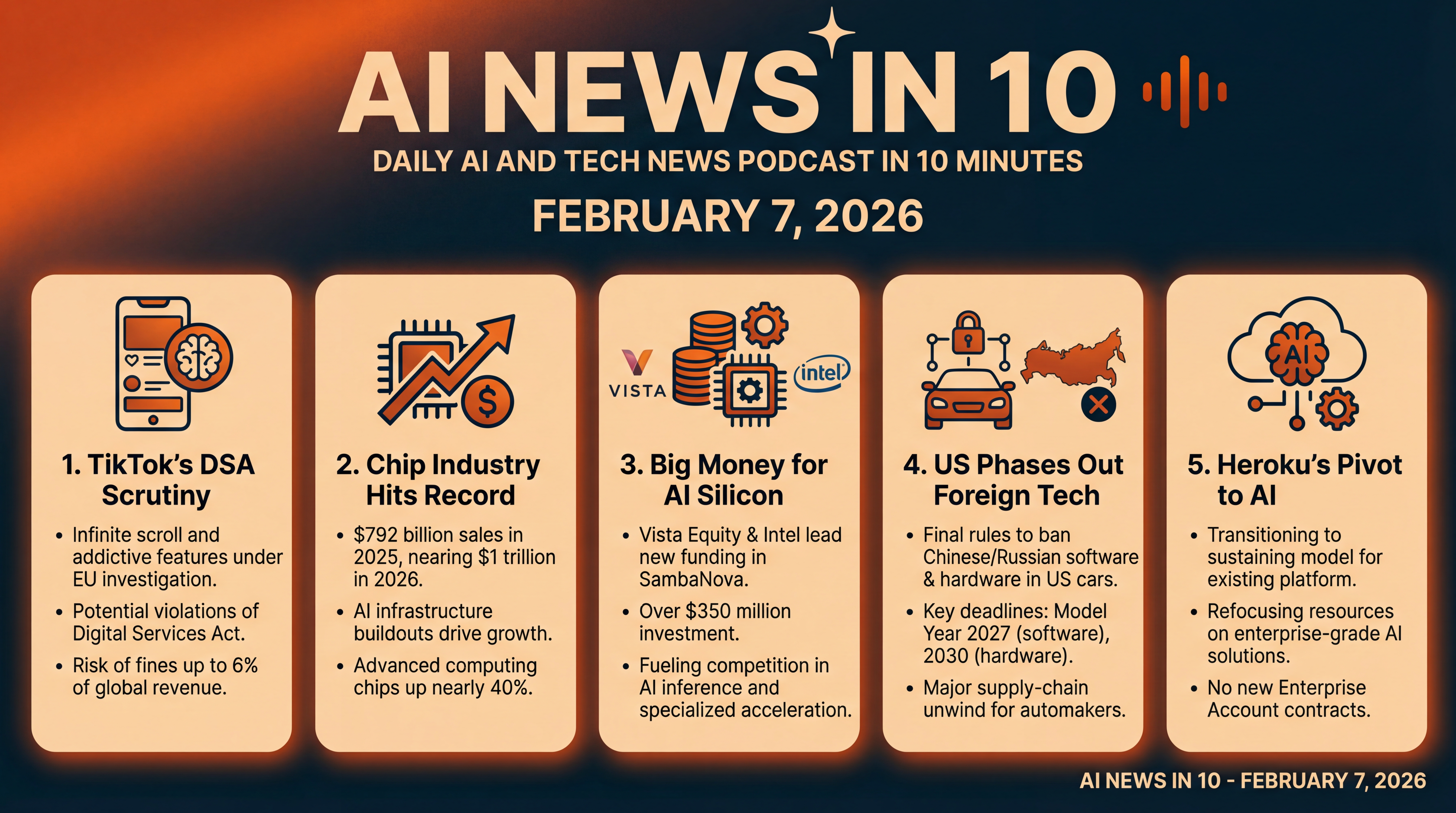
EU regulators issued preliminary findings that TikTok's addictive design — think infinite scroll, autoplay, push notifications, and a highly personalized recommender — breaches the Digital Services Act. The Commission says TikTok hasn't adequately assessed or mitigated the mental and physical health impacts of these features on users, especially minors. The proposed fixes aren't cosmetic — phase down or disable key addictive elements over time, implement real screen-time breaks, and adapt the recommendation system.
If Europe ultimately rules against TikTok, fines could reach up to six percent of global revenue. TikTok disputes the findings and plans to challenge them — but the message from Brussels is clear: design choices are now a regulated surface.
Why this matters: for product teams, this is a blueprint for risk. Engagement levers that once felt like table stakes now carry compliance exposure... Expect ripple effects across short-video and social platforms as DSA enforcement hardens.
Story 2: Chips just had a record year — and a trillion-dollar one could be next
The Semiconductor Industry Association says global chip sales hit about 792 billion dollars in 2025, up roughly 26 percent — an all-time high. And 2026? The industry is projected to approach one trillion dollars, driven by relentless AI infrastructure buildouts.
That surge isn't just GPUs. Advanced computing chips from players like Nvidia, AMD, and Intel accounted for about 302 billion dollars last year, up nearly 40 percent, while memory rose roughly 35 percent to around 223 billion as AI-driven demand squeezed supply. The AI era is no longer an outlook — it's on the income statement.
Two takeaways. First, capex from hyperscalers looks durable — supporting everything from foundries to power gear. Second, shortages can flip quickly... Expect volatility in memory pricing, and continued competition across compute, interconnects, and packaging as vendors chase total system performance per watt.
Story 3: Big money into AI silicon — Vista and Intel back SambaNova
Reuters reports Vista Equity Partners is leading a new funding round of more than 350 million dollars into SambaNova Systems, with Intel planning to chip in roughly 100 to 150 million. Vista is best known for enterprise software — so a deep dive into AI hardware is notable. The deal, still being finalized, would give SambaNova fresh fuel to compete in inference and specialized AI acceleration against the usual giants.
It also follows earlier reports that SambaNova sought sizable outside capital after acquisition talks didn't materialize. Translation: specialized silicon remains a magnet for late-stage dollars, as investors bet that AI compute demand isn't a one-cycle story.
[MIDPOINT_SPONSORS]
Story 4: The U.S. locks in connected-car rules that phase out Chinese and Russian tech
The Commerce Department's Bureau of Industry and Security has finalized its connected-vehicle rule — effective since March 17, 2025 — setting firm milestones to purge Chinese and Russian software and certain hardware from U.S. passenger cars. Key dates: bans on covered software start with model year 2027; covered hardware follows with model year 2030 — or January 1, 2029, for components without a model year.
The rule also requires annual Declarations of Conformity and establishes general and specific authorizations for low-risk or otherwise permitted transactions. For automakers and Tier 1 suppliers, this is a massive software supply-chain unwind — affecting cellular modems, Wi‑Fi and Bluetooth modules, and other vehicle connectivity systems — often called VCS — plus governance proof via attestations.
What's excluded? The final text narrows some scope — certain sensing functions like lidar and cameras aren't directly covered as VCS — and the rule currently applies to passenger vehicles under ten thousand and one pounds, with a commercial-vehicle rule to follow. Bottom line: compliance clocks are ticking, and engineering roadmaps need to reflect 2027 and 2030 as hard switchovers.
Story 5: Heroku pivots — steady state for today's apps, focus shifts to enterprise AI
Heroku says it's transitioning to a sustaining engineering model — prioritizing stability, security, reliability, and support over big new feature pushes. Day-to-day usage, pricing, and add-ons remain unchanged for credit-card customers, and existing enterprise subscriptions will be honored and can renew. However, Heroku will no longer offer new Enterprise Account contracts — and says the shift lets it invest more where it can deliver long-term value, specifically helping organizations build and deploy enterprise-grade AI in secure, trusted environments.
For developers, that means the Heroku you run in production isn't going away — but the platform's R&D spotlight is now squarely on AI workloads.
Quick take: Heroku's move mirrors a broader pattern we're seeing — mature cloud platforms anchoring around reliability and regulated-enterprise needs, while channeling net-new product energy into AI inference, agents, and data pipelines. If your roadmap leans on Heroku-managed AI services, watch their updates closely. If you're on vanilla platform as a service, expect a steadier, more conservative cadence.
Before we wrap, a couple of connective threads.
First, regulation on both sides of the Atlantic is shifting from abstract AI principles to concrete design and supply-chain mandates. TikTok's interface patterns are under the microscope in Europe, while the U.S. is treating connected-car software provenance as a national security issue.
Second, compute demand keeps compounding — from the SIA's trillion-dollar outlook to late-stage financing for AI chip startups — reinforcing the idea that we're in a multiyear infrastructure cycle, not a quarter or two of hype.
That's it for today.
Recap: Europe says TikTok's engagement mechanics may violate the DSA... the chip industry just logged a record 2025 and is barreling toward a trillion dollars this year... Vista and Intel are betting big on SambaNova... the U.S. locked in timelines to phase Chinese and Russian tech out of connected cars... and Heroku is steadying the ship while it refocuses on enterprise AI. See you on the next one.
Thanks for listening and a quick disclaimer, this podcast was generated and curated by AI using my and my kids' cloned voices, if you want to know how I do it or want to do something similar, reach out to me at emad at ai news in 10 dot com that's ai news in one zero dot com. See you all tomorrow.
