Moratoriums, Megarounds, and Chatbots in Your Car
States weigh data-center moratoriums as Anthropic eyes a $20B+ raise, Azure reminds everyone to design for resilience, India rewrites the deep-tech rulebook, and Apple opens CarPlay to third-party chatbots. We break down why each move matters now — for power, capital, safety, and the AI products you actually use.
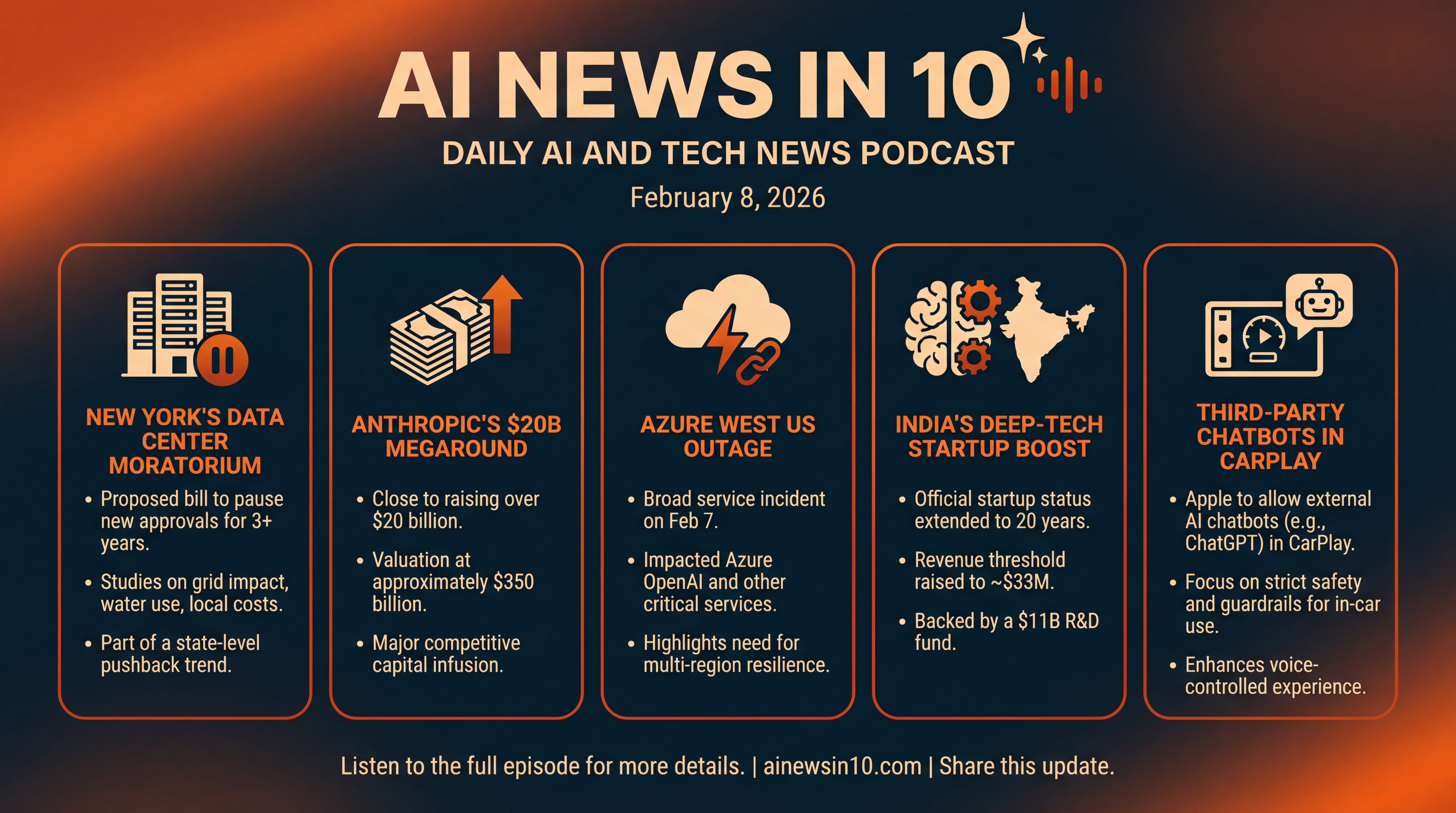
Episode Infographic
Show Notes
Welcome to AI News in 10, your top AI and tech news podcast in about 10 minutes. AI tech is amazing and is changing the world fast, for example this entire podcast is curated and generated by AI using my and my kids cloned voices...
It’s Sunday, February 8, 2026. Today we’re tracking a big state-level pushback against the AI data center boom, a truly massive funding round in the model wars, fresh proof that cloud resilience still matters after an Azure incident, India’s new playbook to nurture deep-tech startups, and Apple’s plan to bring outside AI chatbots into CarPlay... Buckle up — there’s a lot to unpack.
[BEGINNING_SPONSORS]
Let’s start in New York State, where lawmakers have introduced a bill to pause approvals for new data centers for at least three years.
The proposal — from State Senator Liz Krueger and Assemblymember Anna Kelles — would temporarily halt permits for construction and operations while the state studies grid impacts, water use, and local costs tied to the AI infrastructure boom.
Over 230 environmental groups recently urged Congress to consider a nationwide moratorium on new data centers, and New York could become a leading test case at the state level.
TechCrunch reports the measure would make New York at least the sixth state to consider a pause. Similar ideas have surfaced in Georgia, Vermont, Virginia, Maryland, and Oklahoma.
New York’s governor isn’t standing still either — last month she announced Energize NY Development, a plan to modernize how large power users connect to the grid, and to require them to, as she put it, pay their fair share.
The politics here are unusual — progressives like Senator Bernie Sanders have called for national limits, while Florida Governor Ron DeSantis has warned of higher home energy bills from data centers.
Bottom line: if this gains traction, it could influence where hyperscalers build AI capacity — and how quickly.
Source: TechCrunch, February 7, 2026.
Next up, one of the biggest potential cash infusions we’ve seen in AI: Anthropic is close to closing more than $20 billion in new funding at around a $350 billion valuation... possibly as soon as next week.
Bloomberg says the company initially sought about $10 billion but saw such intense demand that the round more than doubled.
That headline number would be stunning on its own — then consider the backdrop. This week, analysts tallied roughly $650 billion in 2026 AI capital spending planned by Alphabet, Amazon, Meta, and Microsoft — aimed at data centers, chips, and power.
Combine that capex wave with a model developer like Anthropic reportedly raising north of $20 billion, and you get a picture of an ecosystem financing both the factories of intelligence and the intelligence itself.
How might Anthropic deploy that capital? Expect a mix: compute procurement, talent, model training, enterprise tooling, and more partnerships to push Claude deeper into workflows.
The risk investors will watch is classic — can revenue scale anywhere near as fast as costs in a year dominated by infrastructure build-outs and fast-moving agentic features?
Source: Bloomberg, February 7, 2026.
Story three: Microsoft Azure had a tough Saturday.
Starting around 8 a.m. UTC on February 7, Azure reported a broad service incident in the West US region. The status page showed degraded or intermittent availability across a long list of services — including Azure Kubernetes Service, Cosmos DB, Storage, Service Bus, Azure Resource Manager, and the Azure OpenAI Service.
Microsoft posted rolling updates through the day as telemetry and performance recovered, but it’s a fresh reminder: the bigger your dependency on one cloud region, the more urgent it is to have failover and throttling plans ready.
If you’re running mission-critical AI workloads — vector databases, model endpoints, autoscaling inference clusters — build for multi-region resilience... test your chaos drills, and confirm your runbooks today, not after the next blip.
Sources: Microsoft Azure status page updates, February 7, 2026; The Verge noted West Coast data center issues the same day.
[MIDPOINT_SPONSORS]
To India, where the government just overhauled its startup framework to better fit deep-tech timelines.
The big changes: deep-tech startups — think space, semiconductors, biotech — can now retain official startup status for 20 years, doubled from the prior 10. And the revenue threshold for startup-specific tax, grant, and regulatory benefits rose to 3 billion rupees — about $33 million — up from 1 billion.
This aligns policy with reality: science- and engineering-led companies often need longer R&D horizons before commercial scale.
There’s also serious public capital forming around this strategy. India’s 1 trillion rupee Research, Development and Innovation Fund — about $11 billion — aims to provide patient capital across equity, credit, and grants, often routed via professional managers.
Venture firms including Accel, Blume Ventures, Celesta Capital, Premji Invest, Ideaspring, Qualcomm Ventures, and Kalaari have banded together as the India Deep Tech Alliance — with Nvidia advising — to catalyze private investment alongside the state’s push.
It’s early days, but the direction is clear: match the long gestation periods of deep tech with longer policy and funding tenors.
Source: TechCrunch, February 7, 2026.
And finally, Apple is preparing to let third-party, voice-controlled AI chatbots plug directly into CarPlay.
Bloomberg reports that within the coming months, Apple aims to support outside assistants — think ChatGPT, Claude, Gemini — through the CarPlay interface, which increasingly spans the center display, driver cluster, and some vehicle settings in CarPlay Ultra.
Two angles matter here. First, ecosystem — letting others’ assistants ride in CarPlay suggests Apple is comfortable making Siri just one of several in-car voices. Second, safety and policy — Apple will need strict guardrails to keep complex prompts from overwhelming drivers or stepping outside hands-free regulations.
Expect Apple’s Human Interface Guidelines — and vehicle OEM partners — to tightly constrain how these chatbots behave while a car is in motion: short responses, succinct navigation help, calendar actions, maybe vehicle-safe summaries... while deferring longer or sensitive tasks.
If executed well, this could make voice in the car actually useful... finally.
Source: Bloomberg, February 6, 2026.
Quick recap before we go.
New York moved to pause new data center approvals for three years — watch that as a bellwether for AI infrastructure policy.
Anthropic is reportedly closing a funding round topping $20 billion at a $350 billion valuation — a megaround that could reshape the competitive balance in 2026.
Microsoft Azure’s West US incident on Saturday disrupted a wide swath of services, including Azure OpenAI — resilience planning is not optional.
India just extended deep-tech startup status to 20 years and is mobilizing a trillion-rupee R&D fund to back it.
And Apple plans to let third-party AI chatbots into CarPlay — opening up your dashboard to a new class of assistants.
Sources: TechCrunch, Bloomberg, Microsoft Azure status page, and The Verge — all from February 6 through 8, 2026.
Thanks for listening and a quick disclaimer, this podcast was generated and curated by AI using my and my kids' cloned voices, if you want to know how I do it or want to do something similar, reach out to me at emad at ai news in 10 dot com that's ai news in one zero dot com. See you all tomorrow.
