HBM4 Arrives, Siri Stirs, Government AI Scales
From Washington to Seoul, we track the week’s biggest AI shifts: federal agencies expand deployments, Samsung readies HBM4 for Nvidia, and Ciena joins the S&P 500 as optical demand surges. Plus, Apple edges Siri toward public testing and Pakistan’s Indus AI Week puts Sovereign AI center stage.
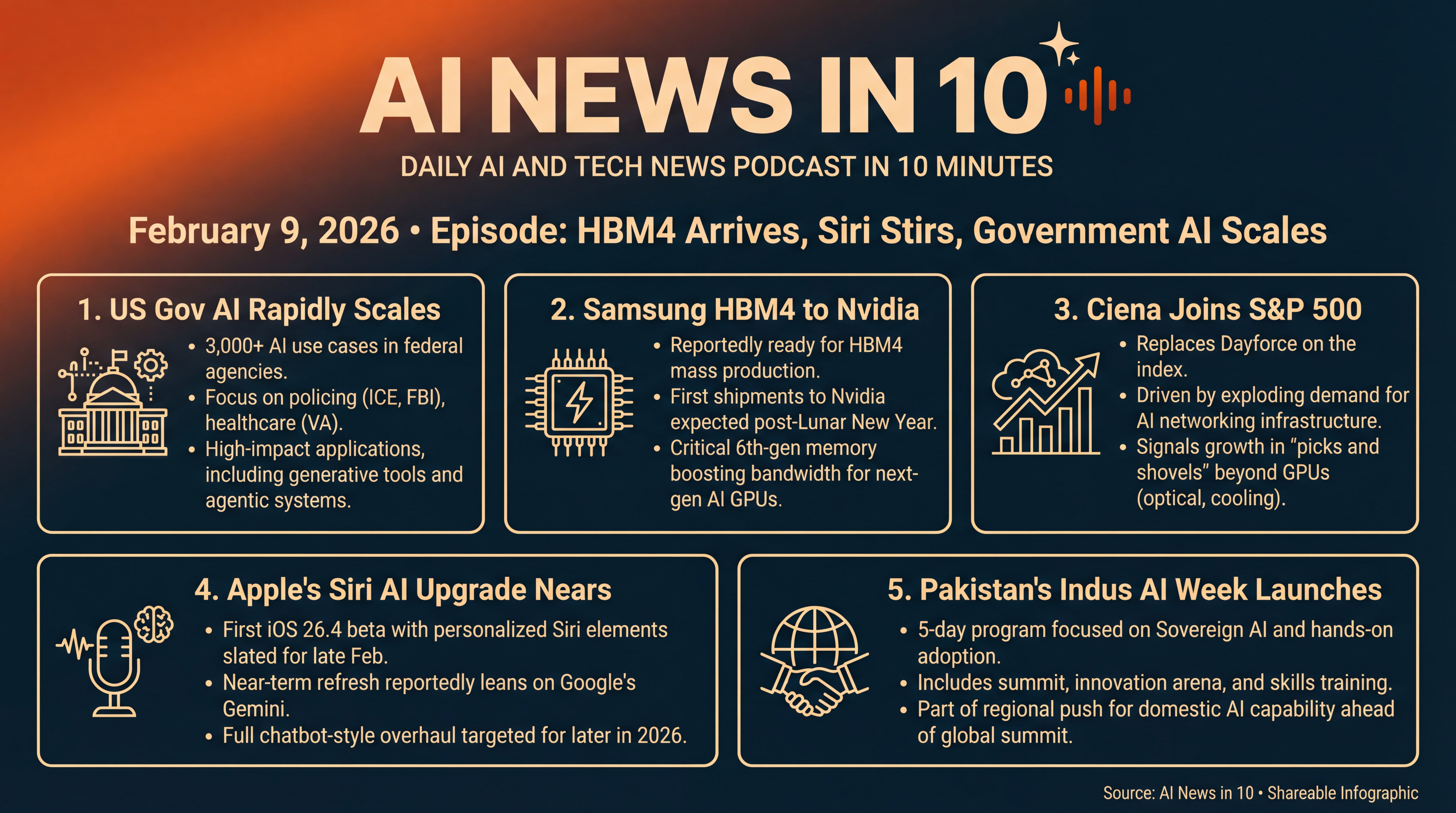
Episode Infographic
Show Notes
Welcome to AI News in 10, your top AI and tech news podcast in about 10 minutes. AI tech is amazing and is changing the world fast, for example this entire podcast is curated and generated by AI using my and my kids cloned voices...
It’s Monday, February 9th... Here’s what’s shaping the AI and tech world today.
We’ll start in Washington, where a new report shows federal agencies rapidly scaling AI across policing, healthcare, and veterans services. Then to Seoul, where Samsung is reportedly ready to ship next-gen HBM4 memory to Nvidia — a potential turning point in the AI chip race. On Wall Street, Ciena graduates to the S&P 500 as AI networking demand explodes. We’ll also look at Apple’s near-term Siri roadmap — yes, that long-delayed Apple Intelligence is finally nearing public tests. And we’ll close in Islamabad, where Pakistan’s Indus AI Week begins today with a big bet on Sovereign AI ahead of this month’s global summit in India.
[BEGINNING_SPONSORS]
Story one: the federal government’s AI footprint just got a lot bigger.
A Washington Post analysis out this morning says agencies reported nearly 3,000 AI use cases by the end of 2025 — up from 1,684 a year earlier — with hundreds labeled high impact. Examples range from Immigration and Customs Enforcement using facial recognition and Palantir-powered generative tools to surface deportation leads, to the FBI triaging citizen tips, and the VA piloting AI to flag suicide-risk signals in veterans’ records. The Pentagon — which isn’t required to disclose details — is pushing into agentic systems for combat scenarios.
Supporters say the shift boosts capacity and speed. Critics warn a deploy-first posture risks public trust and civil liberties without stronger guardrails. Expect looming legal and transparency fights as these tools move from pilots to production.
Source: The Washington Post.
Two: Samsung appears ready to flip the switch on HBM4 — sixth-gen high-bandwidth memory that will feed Nvidia’s next wave of AI accelerators.
Local reporting over the weekend says Samsung has cleared Nvidia’s qualification and could begin HBM4 mass production and shipments as early as the third week of February, after the Lunar New Year holiday. The Korea Times pegs those first customer shipments to Nvidia, and Samsung shares jumped on the headlines.
Why it matters: HBM is the chokepoint of AI. Moving from HBM3E to HBM4 boosts bandwidth and capacity per GPU — crucial for Nvidia’s upcoming Vera Rubin platform later this year. If Samsung is first to volume with 10-nanometer-class base dies and speeds around 11.7 gigabits per second, it tightens the three-horse race with SK hynix and Micron, even as overall supply stays scarce. Expect knock-on effects on accelerator launch timing, system pricing, and AI cluster build-outs through 2026.
Source: The Korea Times.
Let’s drill in for a moment — markets already reacted. Barron’s flagged roughly a 5 percent pop in Samsung Electronics on the HBM4 headlines, while Micron dipped in pre-market as investors handicapped share gains in AI memory. It’s just one data point... but it shows how component readiness can swing capex plans and stock narratives in this cycle.
Source: Barron’s.
Three: a networking stalwart just leveled up.
S&P Dow Jones Indices is adding Ciena to the S&P 500 before today’s open, replacing Dayforce after its buyout. The move crowns Ciena’s AI infrastructure pivot — hyperscalers are pouring billions into data center interconnect and optical transport to tie GPU clusters together, and Ciena’s footprint with cloud customers has grown sharply alongside that demand.
For passive investors and benchmarked funds, this triggers automatic buying. For the broader AI story, it’s another signal that the picks and shovels beyond GPUs — optical, routing, power, and cooling — are where a lot of 2026’s revenue growth will live.
Source: S&P Dow Jones Indices via PR Newswire.
[MIDPOINT_SPONSORS]
Four: Apple’s Siri is finally inching toward its long-promised AI upgrade.
According to MacRumors’ readout of Mark Gurman’s Power On newsletter, Apple plans to ship the first iOS 26.4 developer beta the week of February 23, with a public beta in March — bringing some components of the personalized Siri Apple previewed at WWDC 2024. The bigger, chatbot-style Siri overhaul is slated for later in 2026, and reporting says the near-term refresh leans on Google’s Gemini under the hood.
If Apple hits this timeline, it ends nearly two years of delay and kicks off broad, real-world testing ahead of a deeper iOS 27 push in the fall. For developers and users, watch how well on-screen awareness, personal context, and in-app control actually work — and how Apple navigates privacy and attribution as it pipes generative models through core experiences.
Source: MacRumors.
A quick reality check: Apple has shifted these goalposts before. Gurman previously reported the Siri revamp was pushed from 2025 to 2026, and executives acknowledged the delay as they re-architected the system. The current plan brings pieces in 26.4, with the fuller, chatbot-like Siri experience targeted for iOS 27 later this year. Execution — and user satisfaction — will determine whether Siri regains ground on rivals.
Source: Bloomberg.
Five: Pakistan launches Indus AI Week today — a five-day national program meant to move from AI policy talk to hands-on adoption.
The opening Indus AI Summit in Islamabad centers on Sovereign AI, with government leaders convening global experts to hash out infrastructure, institutions, and guardrails — plus a two-day innovation arena designed to pair practical deployments with skills training. It’s part of a broader regional arc that includes India’s AI Impact Summit in New Delhi next week, where the newly released International AI Safety Report 2026 will frame debates on risks and implementation. Together, these events spotlight how fast emerging markets are trying to stand up domestic AI capability while plugging into global supply chains.
Source: Yahoo Finance.
Before we wrap, two threads to watch as they weave through all five stories.
First, capacity: HBM4’s ramp, optical build-outs, and power constraints are still the gating factors for AI scale in 2026. Every announcement — from Samsung’s memory to Ciena’s index upgrade — ties back to those bottlenecks.
Second, governance: as the federal government accelerates AI use and countries pitch Sovereign AI, pressure will rise for transparency standards, red-team testing, and explainability — especially in policing, healthcare, and elections.
Source: The Washington Post and related reporting.
That’s it for today’s rundown — the federal government’s AI expansion, Samsung’s HBM4 leap, Ciena’s S&P 500 debut, Apple’s Siri finally entering beta season, and Pakistan’s Indus AI Week setting the tone ahead of India’s global summit. The throughline is clear: 2026 AI is about scale, stability, and real-world outcomes... and the race to deliver them responsibly.
Thanks for listening and a quick disclaimer, this podcast was generated and curated by AI using my and my kids' cloned voices, if you want to know how I do it or want to do something similar, reach out to me at emad at ai news in 10 dot com that's ai news in one zero dot com. See you all tomorrow.
