
Spotify Surges, AI Chips Rise, OpenAI Clarifies
Spotify pops on strong Q4 as AI-powered personalization pays off. We also unpack OpenAI’s hardware brand pivot, chip tariff relief chatter, Consensus Hong Kong’s AI tilt, and what to watch in Cloudflare’s earnings.
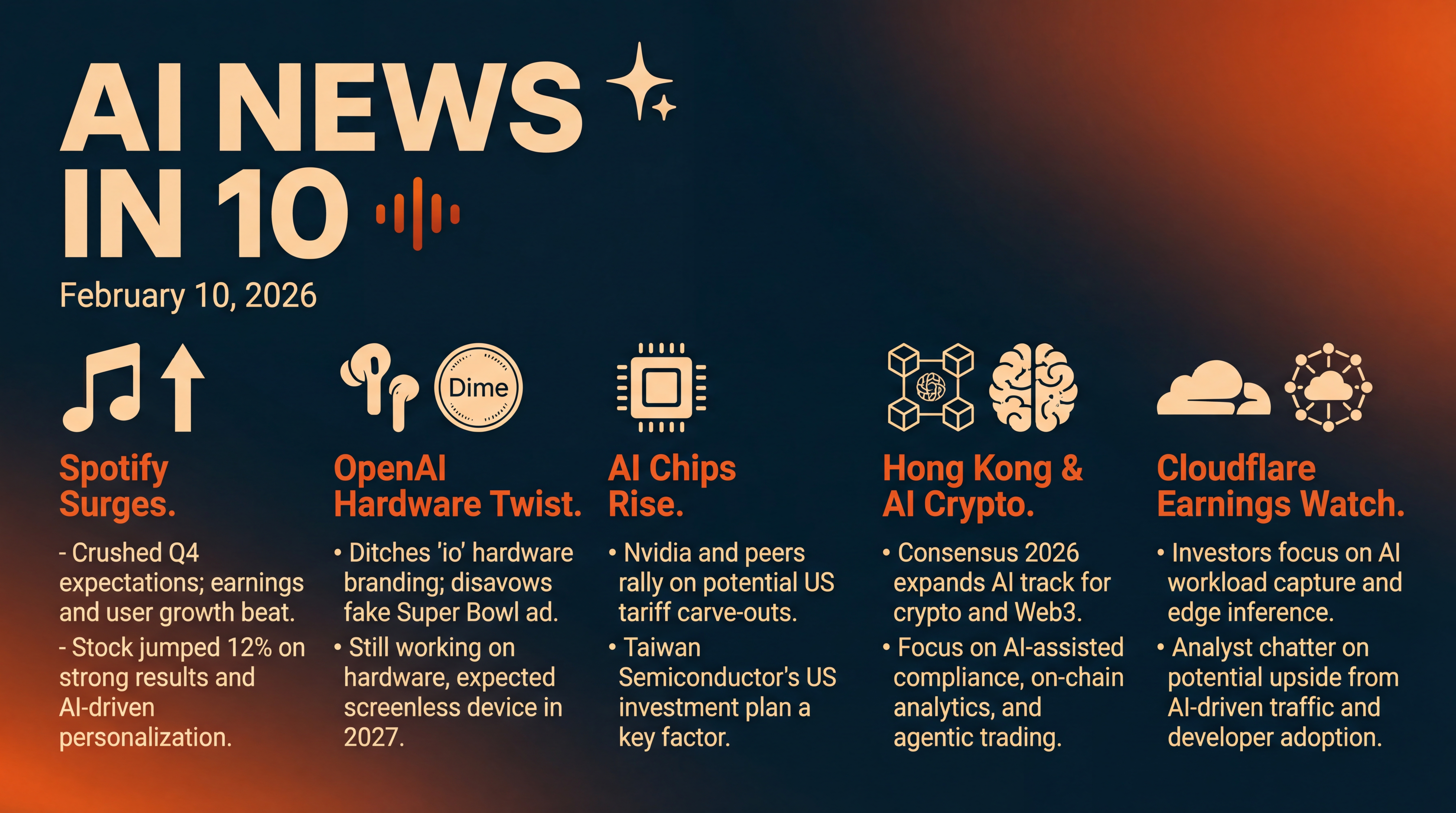
Episode Infographic
Show Notes
Welcome to AI News in 10, your top AI and tech news podcast in about 10 minutes. AI tech is amazing and is changing the world fast, for example this entire podcast is curated and generated by AI using my and my kids cloned voices...
It’s Tuesday, February 10, 2026, and here’s what we’re unpacking in about eight minutes... Spotify crushed Q4 and the stock ripped higher. OpenAI quietly ditched a planned hardware brand while swatting down a fake Super Bowl ad. Chip stocks caught a tailwind on talk of tariff carve-outs. Hong Kong is hosting one of crypto and Web3’s biggest gatherings — now with an expanded AI track. And Cloudflare steps up to the plate after the bell with earnings investors are watching for AI signals. Let’s jump in.
[BEGINNING_SPONSORS]
Story one: Spotify’s results hit all the right notes.
The audio giant topped expectations for the fourth quarter of 2025, and said user growth and margins are trending better than feared. Spotify reported about 4.43 euros per share in earnings on 4.53 billion euros in revenue, with gross margin at 33.1 percent. The company ended the quarter with 751 million monthly active users and 290 million premium subscribers — both ahead of guidance — and shares jumped about 12 percent in early trading. Analysts pointed to stronger pricing, audiobooks traction, and ongoing product expansion as key drivers. That’s a solid print for a platform that’s been pushing more personalization and AI-assisted discovery across music, podcasts, and books. Sources: Wall Street Journal, Barron’s, Investor’s Business Daily.
A couple of details worth calling out... that 33.1 percent gross margin came in a touch above expectations, and the company guided to slightly lower revenue next quarter but better margin — a trade-off Wall Street seemed happy with. And while Spotify didn’t make a new AI announcement today, the results add fuel to a theme we’ve been tracking: when platforms turn AI-driven personalization into engagement and paid conversion, the unit economics get healthier. Sources: Barron’s, Wall Street Journal.
Story two: OpenAI’s consumer hardware storyline took a twist.
Wired reports OpenAI has decided not to use the “io,” or I-Y-O, branding for its future devices — backing away from a name linked to a prior acquisition and a pending trademark dispute. Separately, a slick “leaked” Super Bowl ad making the rounds online — showing an alleged OpenAI earbud and a silver “Dime” orb — was called totally fake by the company. Business Insider says cofounder Greg Brockman and an OpenAI spokesperson both disavowed the video. Bottom line: OpenAI is still working on hardware, but today’s real news is brand housekeeping and myth-busting — not a surprise product drop. Sources: Wired, Business Insider.
Why it matters: naming and trademark decisions are table stakes, but they’re also a tell that OpenAI’s hardware push is progressing behind the scenes — even if timelines remain long. Wired pegs the first device as a screenless AI companion targeted for 2027, which gives rivals like Humane’s Ai Pin and Meta Ray-Ban a long runway to iterate. For consumers, take the fake-ad frenzy as a reminder that AI-generated marketing spoofing real brands is a growing headache — even for the companies building the tech. Sources: Wired, Business Insider.
Story three: a ray of sunshine for AI chips.
Barron’s reports Nvidia and peers got a lift as worries eased over potential U.S. tariffs on imported semiconductors. According to Financial Times reporting cited by Barron’s, the next wave of chip levies may include carve-outs that spare U.S. tech clients if Taiwan Semiconductor Manufacturing Company — Nvidia’s primary foundry partner — follows through on a massive U.S. investment plan. Markets read that as good news for the AI supply chain. Nvidia shares ticked higher in early trade, with AMD and Broadcom also up. Source: Barron’s, citing the Financial Times.
If the carve-out materializes, the read-through is straightforward: fewer price shocks on GPUs and accelerators flowing into U.S. cloud providers, and potentially cleaner planning for 2026 to 2027 capital-expenditure cycles. It doesn’t fix constraints like advanced HBM memory availability, or power build-outs for data centers — but it would take one policy overhang off the table while those other bottlenecks get addressed. Source: Barron’s.
[MIDPOINT_SPONSORS]
Story four: crypto’s “Super Bowl” returns to Asia — this time with even more AI on stage.
Consensus Hong Kong 2026, from CoinDesk, opens today at the Convention and Exhibition Centre and runs through February 12. Organizers and Invest Hong Kong say they’re expecting a larger crowd than last year’s sold-out debut, with programming that increasingly blends blockchain with machine learning — think on-chain analytics, AI-assisted compliance, and agentic trading. It’s another data point in a broader theme: the AI wave isn’t just hitting Big Tech — it’s becoming table stakes across fintech and Web3. Sources: Invest Hong Kong, CoinDesk’s event site, and conference releases.
Why Hong Kong? Policy clarity, and a bid to cement the city as a Web3 hub, have attracted developers and institutional capital — and this week’s agenda leans into that positioning. Expect panel chatter on how to harden exchanges against AI-boosted fraud, how to use models to police market manipulation, and whether LLMs meaningfully improve developer productivity in open-source ecosystems. Sources: CoinDesk’s event site, Invest Hong Kong.
Story five: all eyes on Cloudflare after the bell.
The edge network and security player reports earnings this afternoon, and beyond the headline growth rate, investors want to know how its network is capturing AI workloads — everything from model inference at the edge to security for agentic architectures. MarketBeat notes Cloudflare is slated to post Q4 results after the close today, with Street estimates in the high 580-million-dollar range for revenue. Meanwhile, recent analyst chatter has highlighted potential upside tied to AI-driven traffic and developer adoption on the Workers platform. Sources: MarketBeat, Investing.com.
A couple of metrics to watch on the call: large-customer additions, dollar-based net retention, and attach rates for Zero Trust and security bundles that ride along with AI-powered apps. If management talks about inference wins, or data-sovereignty advantages at the edge, that’ll feed directly into the 2026 story for how AI traffic patterns evolve beyond centralized hyperscale. Sources: MarketBeat, Investing.com.
Quick recap... Spotify’s blowout quarter reminds us that AI-fueled personalization can show up in the P and L. OpenAI tamped down device rumors while retiring a contested brand. Chipmakers got a breather as tariff carve-outs came into view. Consensus Hong Kong opened with a bigger tent for AI and Web3. And Cloudflare is set to test the market’s thesis that edge networks are an underappreciated AI play.
That’s your AI and tech rundown for Tuesday, February 10, 2026.
Thanks for listening and a quick disclaimer, this podcast was generated and curated by AI using my and my kids' cloned voices, if you want to know how I do it or want to do something similar, reach out to me at emad at ai news in 10 dot com that's ai news in one zero dot com. See you all tomorrow.
