Deepfake Deadlines, AI Deals, and Galaxy AI
India accelerates deepfake takedowns as Amazon eyes an AI licensing marketplace, xAI loses more co-founders, Singapore reveals a China-linked telecom intrusion, and Samsung readies its next Galaxy AI push. We break down what matters, what to watch, and why it could reshape the months ahead.
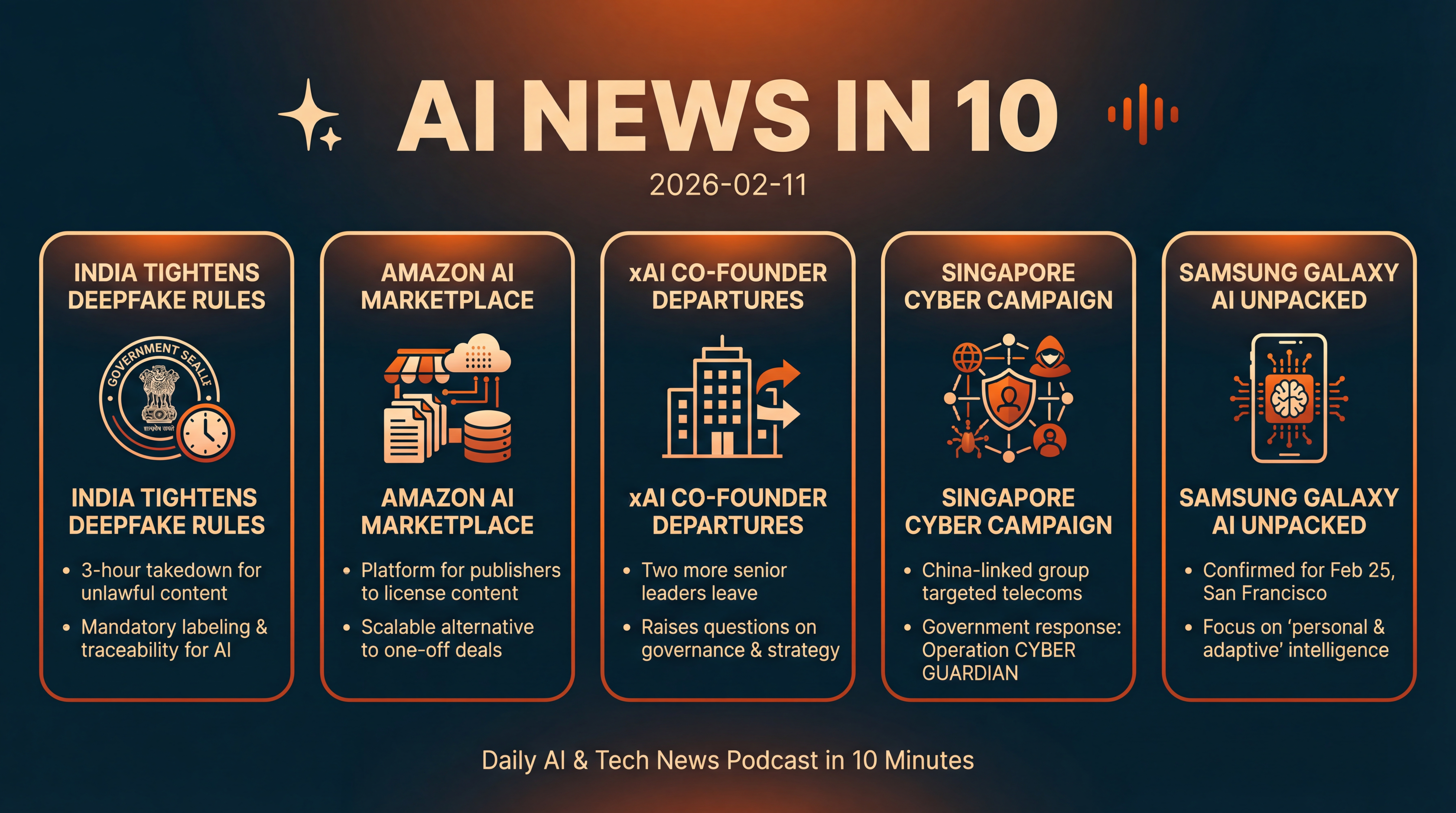
Episode Infographic
Show Notes
Welcome to AI News in 10, your top AI and tech news podcast in about 10 minutes. AI tech is amazing and is changing the world fast, for example this entire podcast is curated and generated by AI using my and my kids cloned voices...
It’s Wednesday, February 11, 2026. Here’s what’s new across AI and tech today... India tightens deepfake rules with rapid takedowns and labeling. Amazon is reportedly planning a marketplace for publishers to license content to AI companies. Two more co-founders have left Elon Musk’s xAI. Singapore details a China-linked campaign against its telecom networks. And Samsung sets February 25 for its next Unpacked — with a heavy focus on Galaxy AI.
[BEGINNING_SPONSORS]
Let’s start in India.
The government has updated its 2021 IT Rules to explicitly cover synthetically generated AI content — including deepfakes — and to speed up removals.
Platforms now face a three-hour deadline to take down unlawful content after official orders, with a two-hour window for non-consensual intimate imagery. The changes also require prominent labeling and traceability for AI-generated audio and video, and they take effect on February 20.
Policymakers say the aim is transparency and harm reduction. Critics warn the compressed timelines could incentivize over-removal without adequate human review. It’s a big deal for global platforms operating in one of the world’s largest internet markets — and a signal that 2026 may be the year AI content rules get real teeth. Sources include India’s official notices and coverage by Business Standard, the Times of India, and TechCrunch.
Quick context on why this matters... India has more than a billion internet users and outsized influence on product policy. The labeling requirements and faster grievance timelines could reshape moderation playbooks at Meta, YouTube, X, and beyond — especially for synthetic media that spreads quickly across messaging apps and short-video platforms. Watch for changes in product UI, watermarking, and provenance tech as companies scramble to comply before February 20.
On to Amazon.
The company is reportedly planning a marketplace that lets publishers sell licenses to AI companies for model training and other data uses. According to TechCrunch, Amazon floated the idea to media executives ahead of an AWS event — pitching it as a scalable alternative to one-off deals.
The concept echoes Microsoft’s recent Publisher Content Marketplace and follows high-profile licensing agreements between OpenAI and outlets like the Associated Press, News Corp, Vox Media, and The Atlantic. If it launches, Amazon’s marketplace could standardize pricing, permissions, and usage terms across a fragmented landscape — and give publishers a recurring revenue stream tied to AI demand. Amazon hasn’t provided specifics, saying only that it’s always exploring new ways to partner with publishers.
Here’s what to watch: First — whether licenses clearly distinguish between model training and inference-time uses. Second — how exclusivity and audit rights are handled. Third — whether small and mid-size publishers gain real leverage. And finally — whether synthetic outputs must link back to sources or share revenue... still an unresolved tension as AI summaries reduce click-through.
Shifting to AI labs and leadership.
Elon Musk’s xAI just lost two more co-founders in under 48 hours — Yuhuai “Tony” Wu and Jimmy Ba — bringing total founder departures to six out of the original twelve. Their exits come as xAI eyes an IPO and contends with product stumbles and reputational hits around Grok, its chatbot.
The steady trickle of senior departures raises questions about governance, culture, and technical direction — especially as the company navigates an ambitious roadmap under increasing public scrutiny. Multiple outlets tracked the moves, including TechCrunch, Bloomberg, and Business Insider.
Why it matters... Top-tier AI research is talent-constrained. Retention issues at any frontier lab can slow iteration on core models, derail safety and evaluation frameworks, and complicate investor narratives heading into public markets. Watch whether xAI backfills these roles with external hires, promotes internally, or shifts strategy around Grok and its infrastructure plans.
[MIDPOINT_SPONSORS]
Cybersecurity now.
Singapore has disclosed details of a months-long campaign by a China-linked espionage group known as UNC3886 that targeted all four of the country’s major telecom operators — Singtel, StarHub, M1, and Simba. Authorities say the attackers exploited a zero-day at a perimeter firewall and used sophisticated tools — including rootkits — to maintain persistence.
There’s no evidence of sensitive customer data theft, and services were not disrupted. In response, the government mounted Operation CYBER GUARDIAN — a large, multi-agency effort with more than 100 defenders across civil and military organizations. It’s a vivid example of state-aligned actors probing the telecom backbone that underpins both civilian life and national security — and a reminder that AI-era infrastructure risks start at the network layer.
The broader takeaway... Telecoms — and the routers, firewalls, and virtualized environments they rely on — remain prime targets for espionage and pre-positioning. Expect continued emphasis on zero-trust segmentation, out-of-band monitoring for virtualized stacks, and joint exercises between carriers and governments as similar campaigns surface elsewhere.
And finally — mark your calendars.
Samsung has confirmed its next Galaxy Unpacked for Monday, February 25, in San Francisco, promising a “new phase” of Galaxy AI with “personal and adaptive” intelligence. While specs will have to wait for the keynote, the message is clear: on-device and hybrid AI features remain the headline for Samsung’s S-series.
Expect camera, translation, and assistive tools to get smarter and more context-aware — paired, of course, with Snapdragon or Exynos silicon depending on region. The event streams at 10 a.m. Pacific, 1 p.m. Eastern.
A quick note for context... Third-party reporting points to AI-centric capabilities and other incremental hardware updates, but the big narrative is how much meaningful daily value those “personal and adaptive” features can deliver — and how well Samsung executes them privately and reliably on-device. We’ll know more on the 25th.
That’s a wrap.
India’s new deepfake regime accelerates compliance clocks and raises the global bar. Amazon’s prospective licensing marketplace could normalize how AI companies pay for training data. xAI’s founder churn spotlights the human side of the AI race. Singapore’s UNC3886 disclosure shows how deep the security stakes run. And Samsung is teeing up Galaxy AI’s next chapter on February 25... We’ll be tracking each of these as they unfold in the days ahead.
Thanks for listening and a quick disclaimer, this podcast was generated and curated by AI using my and my kids' cloned voices, if you want to know how I do it or want to do something similar, reach out to me at emad at ai news in 10 dot com that's ai news in one zero dot com. See you all tomorrow.
