Crew-12 Liftoff, GPT Farewells, and HBM4 Heat
SpaceX’s Crew-12 launches cleanly with a same-complex booster landing, while OpenAI sunsets GPT-4o and Waymo rolls out its sixth-gen robotaxi stack. Washington tests an AI skills tax credit, and chipmakers heat up the HBM4 race as Applied Materials rides surging demand.
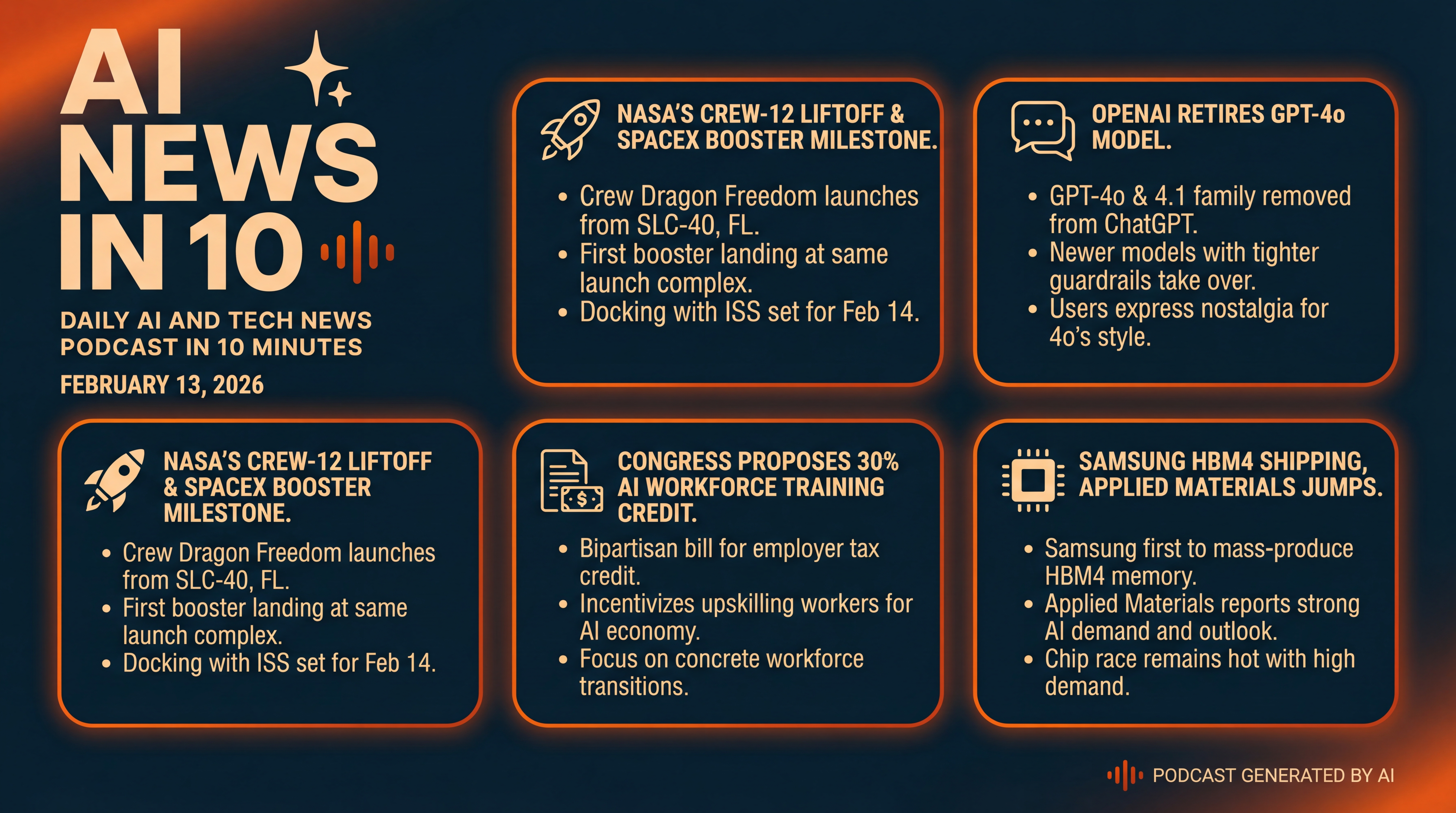
Episode Infographic
Show Notes
Welcome to AI News in 10, your top AI and tech news podcast in about 10 minutes. AI tech is amazing and is changing the world fast, for example this entire podcast is curated and generated by AI using my and my kids cloned voices...
It’s Friday, February 13, 2026, and here’s what’s moving in AI and tech today.
A pre-dawn liftoff to orbit and a new first for SpaceX. OpenAI retires a beloved ChatGPT model and sparks a very human reaction. Waymo shows off a next-gen robotaxi stack while quietly piloting new on-the-ground ops. Congress tests a 30 percent tax credit to upskill U.S. workers for the AI economy. And chip headlines heat up — Samsung says HBM4 is shipping as Applied Materials jumps on stronger-than-expected AI demand. Buckle up... let’s get into it.
[BEGINNING_SPONSORS]
First up — NASA’s Crew-12 is off the pad and on the way to station.
At 5:15 a.m. Eastern, a SpaceX Falcon 9 lifted Crew Dragon Freedom from Space Launch Complex 40 in Florida, carrying NASA astronauts Jessica Meir and Jack Hathaway, ESA’s Sophie Adenot, and Roscosmos cosmonaut Andrey Fedyaev.
Docking is targeted for around 3:15 p.m. on Saturday, February 14. In a notable milestone, SpaceX landed the first stage back inside the SLC-40 perimeter — the first time it has launched and landed a booster at that same complex in Florida — before Dragon separated to continue its roughly 34-hour rendezvous. It’s the 12th crew rotation under NASA’s Commercial Crew Program, bringing the ISS back to a full complement for a busy stretch of research on orbit.
Quick context: the launch slipped a couple of days due to weather along the flight path. NASA waved off earlier windows and waited for better odds today. With a smooth ascent and a speedy booster recovery, Crew-12 now transitions to the chase phase while mission control sets up Saturday’s docking and hatch opening.
Next — OpenAI officially retires GPT-4o and the 4.1 family inside ChatGPT today... and yes, people have feelings about it.
Back on January 29, the company set today as the date ChatGPT would remove GPT-4o, GPT-4.1, GPT-4.1 mini, and o4-mini from the in-app model picker. Conversations and Custom GPTs will default to GPT-5.2 going forward.
Business, Enterprise, and Edu customers keep 4o inside Custom GPTs until April 3, while API access for certain 4o variants isn’t changing — at least for now. Users who loved 4o’s warmer, more free-flowing style have been vocal online. OpenAI says daily usage had dropped to a small share, and that newer models now match or exceed 4o’s strengths with tighter guardrails.
Why it matters: this deprecation underlines a new product reality — LLMs aren’t static services; they’re moving targets with lifecycles. If your playbooks or compliance reviews are anchored to a specific model’s behavior, take this as a nudge to build portability into workflows and to document model assumptions explicitly. And culturally... the reaction shows how personal these tools have become. Some users described 4o as a companion; OpenAI says it’s working to keep future models helpful without over-attachment.
Over to autonomy — Waymo’s sixth-generation robotaxi system arrives, with a push toward scale and some clever boots-on-the-ground ops.
The company detailed a redesigned multi-sensor stack: fewer cameras — down to 16 from 29 — but higher-resolution 17-megapixel imagers; refreshed lidar and radar; and exterior audio sensors. The goal is better perception in low light and adverse weather, plus lower component and integration cost for high-volume production.
The next-gen stack rolls onto new platforms, including an Ojai-branded minivan and the Hyundai Ioniq 5, as Waymo phases out its Jaguar I-Pace fleet and targets tens of thousands of units annually. It’s part of a broader scale-up after a massive funding round earlier this month.
And here’s a small but telling ops experiment: in Atlanta, DoorDash drivers are being paid a small bounty to close any robotaxi doors left ajar so vehicles can depart — $6.25 on acceptance with a $5 completion bonus — until automated door-closing hardware standardizes across the fleet. Little micro-moves like this hint at how autonomy companies smooth edge cases as they expand.
[MIDPOINT_SPONSORS]
On to Washington — a 30 percent AI skills tax credit is on the table.
A new bipartisan bill, the AI Workforce Training Act, landed in the House today. It proposes a federal tax credit for employers that invest in AI training for their workers — 30 percent of eligible training expenses — framed as a competitiveness play and a pragmatic area of cross-aisle agreement while broader AI regulation remains thorny.
If it advances, expect debate over what counts as eligible training, how to prevent vendor-lock favoritism, and how to include small and mid-sized businesses — not just Fortune 500s with big reskilling budgets.
Two takeaways. First, the policy conversation is shifting from abstract AGI timelines toward concrete workforce transitions... where the political energy often is. Second, credits beat grants in speed, but they tend to favor firms with tax capacity and in-house HR machinery. Watch for add-ons that level the field for smaller employers and for unions running apprenticeship pipelines.
Chips and tools — Samsung says HBM4 is shipping, and Applied Materials pops on an AI-hungry outlook.
On the memory front, Samsung claims it’s first to begin mass production and shipments of HBM4, quoting 11.7 gigabits per second with roadmaps to 13. Rival Micron is close behind with HBM4 exceeding 11, and SK hynix has previewed its own HBM4 stacks. The HBM race remains white-hot as GPU makers ramp toward 3-nanometer-class parts later in 2026.
Meanwhile, Applied Materials reported an upside quarter — $7.01 billion in revenue and $2.38 adjusted EPS — and guided above consensus, sending shares up roughly 13 percent after hours. Management flagged 20-plus percent growth in its semi business this year as AI-driven fab and packaging investments continue. In plain English... the shovel sellers in the AI gold rush still have a lot of shovels to sell.
Before we wrap — a quick pulse check on space and autonomy from the top of the show.
Crew-12 is cruising toward its Saturday docking after a smooth ascent and a same-complex booster landing — an operations milestone to watch as SpaceX continues to iterate reuse. And Waymo’s sixth-gen stack, plus those on-the-ground experiments, underscore how autonomy at scale is often about hundreds of small system improvements... not just one headline sensor.
That’s a lot for a Friday. Today’s big takeaways: human spaceflight keeps its cadence with Crew-12 on orbit, OpenAI closes a familiar chapter to make room for newer models, autonomy inches forward with both flashy sensors and unglamorous process hacks, lawmakers test incentives to get workers AI-ready, and the chip supply chain is still in go-mode — from HBM4 to fab tools. Enjoy the rest of your day... and we’ll see you tomorrow with the next wave.
Thanks for listening and a quick disclaimer, this podcast was generated and curated by AI using my and my kids' cloned voices, if you want to know how I do it or want to do something similar, reach out to me at emad at ai news in 10 dot com that's ai news in one zero dot com. See you all tomorrow.
