India’s AI Summit, Airbnb’s Agent, Meta’s Glasses
India gathers top tech leaders and backs a 1.1 billion dollar deep-tech fund as students shift from computer science to AI majors. Plus, Airbnb scales an AI agent while Meta reportedly readies facial recognition for Ray-Ban glasses — raising fresh privacy questions.
Episode Infographic
Show Notes
Welcome to AI News in 10, your top AI and tech news podcast in about 10 minutes. AI tech is amazing and is changing the world fast, for example this entire podcast is curated and generated by AI using my and my kids cloned voices...
Here’s your quick tour of today’s biggest AI and tech stories.
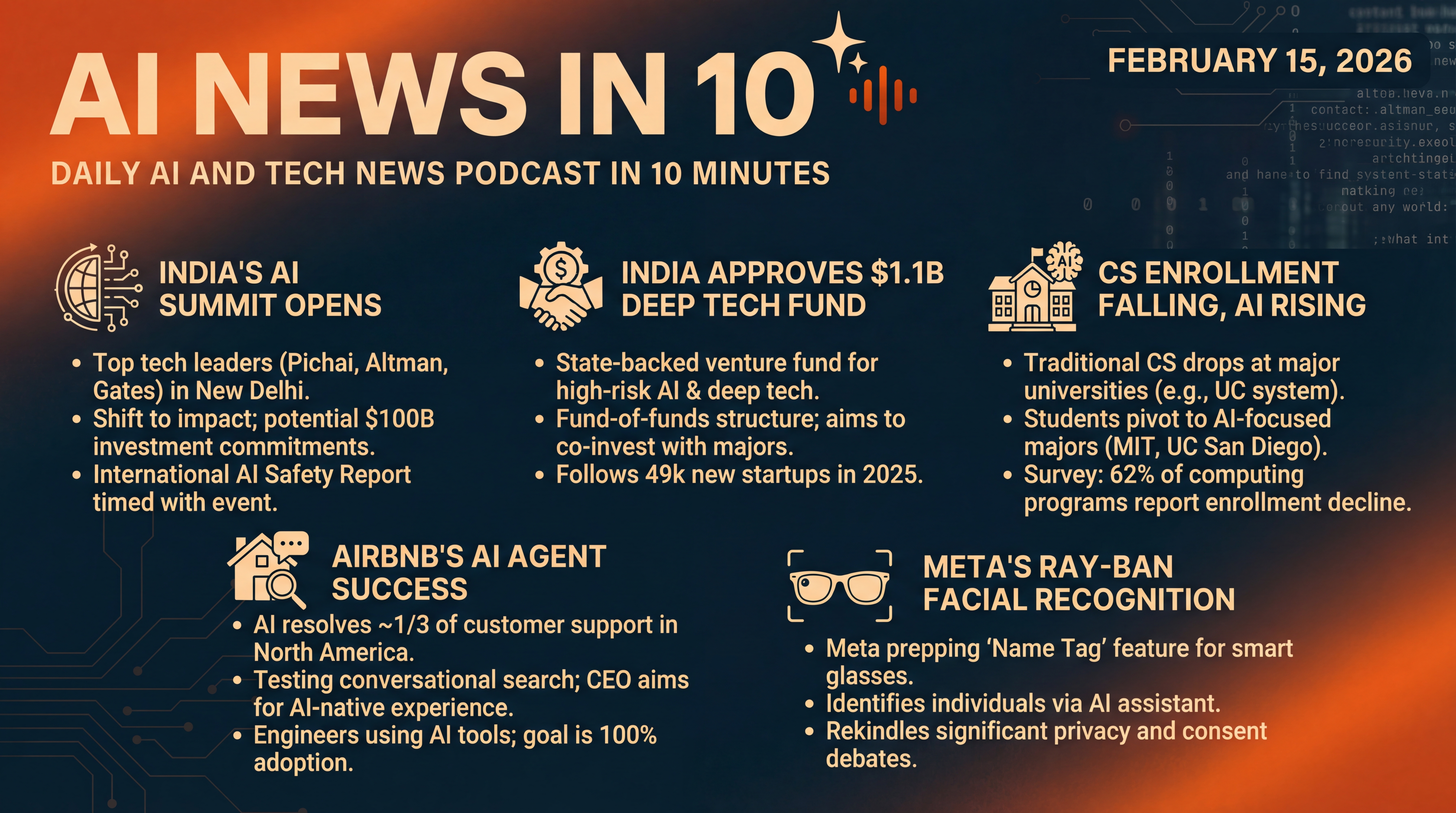
First, all eyes are on New Delhi... India’s AI Impact Summit opens tomorrow with a guest list that reads like a who’s who of global tech — and plenty of talk about massive investment commitments.
Second, right on cue, India just approved a 1.1 billion dollar state-backed venture fund to prime the pump for deep tech and AI startups.
Third, a new report says traditional computer science enrollment is falling at major U.S. universities as students pivot into AI-focused programs.
Fourth, Airbnb says AI already resolves about a third of customer support issues in North America, and it’s quietly testing conversational search.
And fifth, a report says Meta is prepping facial recognition for its Ray-Ban smart glasses — rekindling a big privacy debate around wearables.
[BEGINNING_SPONSORS]
Let’s start in India. The government-backed AI Impact Summit runs from February 16 through 20 in New Delhi, and it’s expected to draw dozens of top tech CEOs alongside heads of state. Confirmed marquee attendees include Sundar Pichai from Google, Sam Altman from OpenAI, Dario Amodei from Anthropic, and Demis Hassabis from Google DeepMind — plus Bill Gates. Local press outlets — including the Times of India — are calling it a landmark moment for the Global South, with chatter that the summit could catalyze up to 100 billion dollars in AI-related investment commitments.
If that sounds lofty... organizers say the point is to shift from broad AI safety talk to measurable impact and implementation — building on earlier summits in Paris, Seoul, and the U.K. Expect policy frameworks, big memorandums of understanding, and a lot of dealmaking around infrastructure, talent, and governance.
One more angle before we leave Delhi. The second edition of the International AI Safety Report dropped earlier this month to inform these talks — an expert-led assessment that tracks capability advances and risks. Its timing underscores how technical progress and governance are converging on the 2026 policy calendar.
Story two: just hours ahead of the summit, India approved a 1.1 billion dollar state-backed venture program aimed squarely at high-risk deep tech — think AI, advanced manufacturing, and other capital-intensive bets. It’s structured as a fund-of-funds that channels government money through private investors. Officials framed it as a more targeted follow-on to an earlier program, pairing the news with data showing India’s startup base has exploded to more than 200,000 — with 49,000 registered in 2025 alone.
The move comes as private capital tightened last year, and it positions India to co-invest in homegrown AI alongside the global majors arriving for the summit. TechCrunch first reported the details.
Third story: the great computer science exodus — or maybe more accurately, a migration. For the first time since the dot-com bust, computer science enrollment fell across the University of California system — down 6 percent this academic year after a 3 percent drop in 2024 — even as overall U.S. college enrollment rose 2 percent.
One notable outlier was UC San Diego, which added a dedicated AI major and bucked the slide. The broader picture suggests students aren’t leaving tech so much as choosing AI-centric tracks. Examples include MIT’s AI and decision-making program — now its second-largest major — and a new AI and cybersecurity college at the University of South Florida that already enrolls more than 3,000 students. A survey from the Computing Research Association found that 62 percent of computing programs reported undergraduate enrollment declines this fall — again, pointing to a shift rather than a collapse. TechCrunch pulled these threads together.
[MIDPOINT_SPONSORS]
Fourth: Airbnb is turning the AI dial up. The company says a custom AI agent now handles roughly one-third of customer support issues in the U.S. and Canada, with plans to expand globally and add voice support. CEO Brian Chesky told investors the aim is an AI-native experience that doesn’t just search — it knows you — planning the trip end to end and helping hosts run their businesses.
Under the hood, Airbnb says about 80 percent of its engineers already use AI tools, with a goal of reaching 100 percent. On the product side, a conversational AI search is live to a very small slice of traffic as the team refines the experience and ad formats like sponsored listings. On revenue, the fourth quarter came in at 2.78 billion dollars, up 12 percent year over year, and management guided to low double-digit growth in 2026 — while arguing AI could lift conversion and service quality. If they’re right, this is what AI as operations looks like at scale... less flashy than a headline model, more like a thousand small lifts across the funnel.
And fifth: a fresh privacy test for wearables. A new report says Meta is preparing to add facial recognition to its Ray-Ban smart glasses this year via a feature internally called Name Tag. The idea is simple: point your glasses at someone and, with Meta’s AI assistant, get identity and context.
The company has debated how to ship the feature — given obvious safety and privacy risks — and internal memos reported by TechCrunch describe a plan to time the launch during a dynamic political environment when advocacy groups might be focused elsewhere. Meta previously shelved facial recognition on the first-gen Ray-Bans in 2021. The rumored revival reflects both improving on-device AI and rising consumer comfort with assistant-powered eyewear. If this lands, expect immediate questions about consent, storage, and how robust opt-outs will be in public spaces.
Quick recap... Tomorrow’s India AI Impact Summit puts the Global South at center stage as policy and capital collide, and India’s 1.1 billion dollar deep-tech fund adds fuel to that fire. In the classroom, students are steering from broad computer science into AI-specific majors. On the product front, Airbnb is quietly proving how an AI agent can scale service and search in the real world. And on the edge of your face, Meta’s reported push for facial recognition on Ray-Bans could redraw the wearables privacy line... again.
We’ll keep tracking what ships, what’s hype, and what it all means for your work and your life.
Thanks for listening and a quick disclaimer, this podcast was generated and curated by AI using my and my kids' cloned voices, if you want to know how I do it or want to do something similar, reach out to me at emad at ai news in 10 dot com that's ai news in one zero dot com. See you all tomorrow.
