
India's Chip Rise, UN Panel, Dark Web Shutdown
Micron readies chip production in India as markets test AI valuations, Google shutters Dark Web Reports, and the UN forms a 40-member AI impact panel. Plus, Delhi stages its first AI Film Festival at Qutub Minar.
Episode Infographic
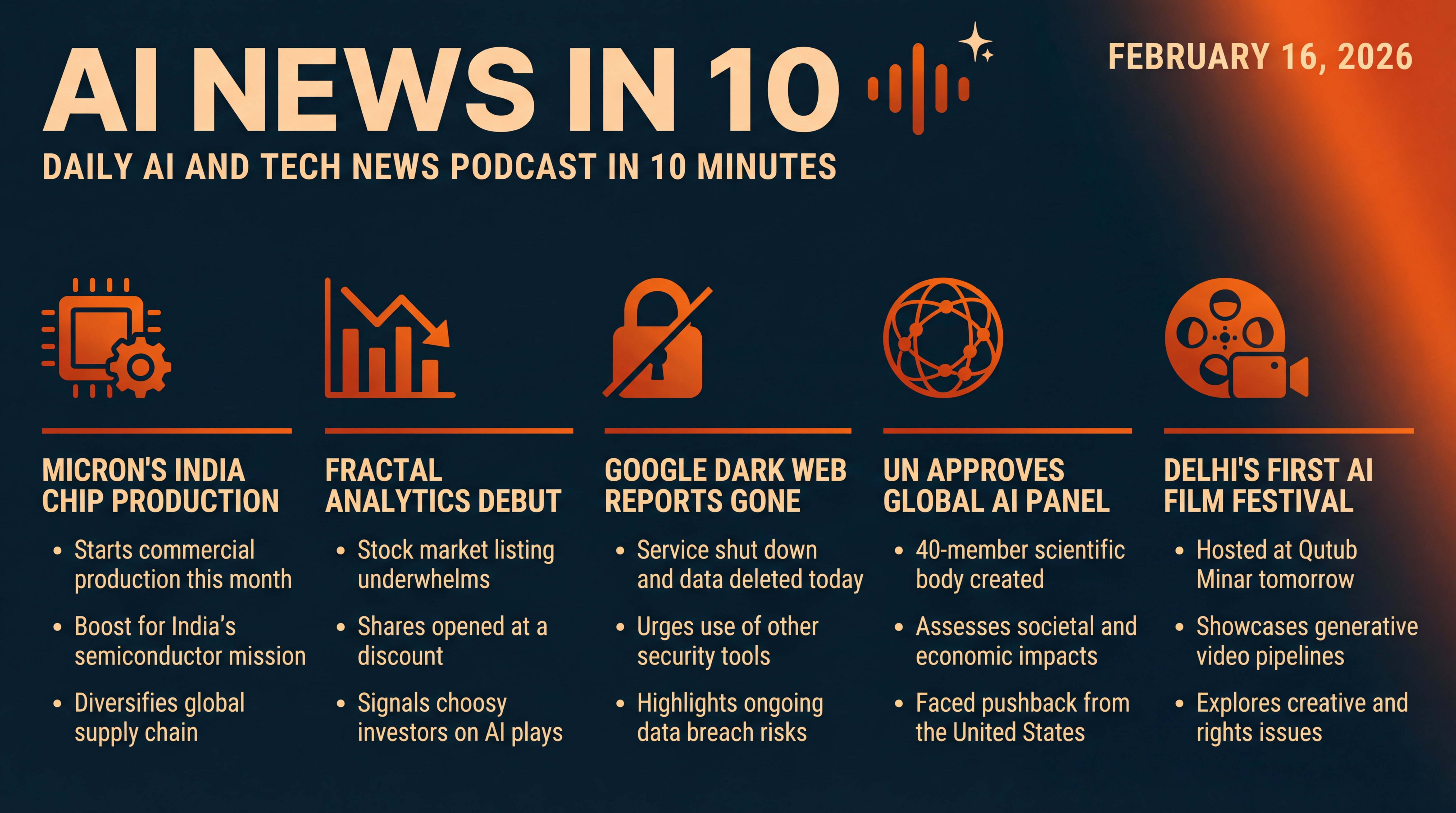
Show Notes
Welcome to AI News in 10, your top AI and tech news podcast in about 10 minutes. AI tech is amazing and is changing the world fast, for example this entire podcast is curated and generated by AI using my and my kids cloned voices...
Here’s what’s shaping the AI and tech world this Monday, February 16, 2026.
Micron is set to kick off commercial chip production in India before the month is out — big news for the country’s semiconductor ambitions. India also saw a major AI company go public today, and the debut... wasn’t quite the celebration many expected. Google is shutting down and deleting Dark Web Reports today, which could change how people keep tabs on leaked data. On the policy front, the United Nations has approved a 40-member scientific panel to assess AI’s global impact — despite pushback from the United States. And Delhi will host its first AI Film Festival tomorrow night at Qutub Minar, with help from NVIDIA. Let’s get into it.
[BEGINNING_SPONSORS]
Let’s start in India. Micron plans to begin commercial chip production by the end of February. A senior official at the Ministry of Electronics and Information Technology says Micron’s facilities will be the first from the India Semiconductor Mission’s initial phase to flip into production mode.
It’s both symbolic and practical — proof that India’s push to onshore parts of the chip supply chain is moving from memorandums of understanding and groundbreakings to real output. As the U.S. and its allies work to diversify packaging, testing, and eventually more advanced fab work away from a few concentrated hubs, even incremental capacity matters — especially for AI memory and storage that feed today’s massive model training runs.
The Economic Times reports the timeline is by month-end — not years away... just weeks. If that ramp holds, expect follow-on announcements around local talent pipelines, supplier ecosystems, and logistics corridors in Gujarat — plus fresh incentives as New Delhi tries to attract more advanced nodes in the next cycle. It also positions India to serve fast-growing AI infrastructure demand across Asia and the Middle East. Source: The Economic Times.
Now to India’s markets. Fractal Analytics — a long-standing enterprise AI and analytics firm — made its stock market debut today, and the listing underwhelmed.
On the National Stock Exchange, shares opened around 876 rupees versus an issue price of 900 — roughly a 3 percent discount. On the Bombay Stock Exchange, they were about flat at 900. The deal size had already been trimmed to roughly 2,834 crore rupees ahead of the listing, and overall subscription landed near 2.7 times — driven by qualified institutional buyers a little over 3 times, with retail and non-institutional participation just over 1 time.
Management says margin expansion and license-led revenue should support cash flows post-listing, leaning on demand in healthcare and consumer markets. But today’s muted debut signals investors are choosy — even on marquee AI plays — with valuation froth still very much a debate globally. Sources: The Economic Times and Business Standard.
If you’ve been using Google’s Dark Web Reports to see whether your personal data popped up on shady forums... today is the day the lights go out. Google announced late last year that it would wind down the service, and final deletion of past report data lands today, February 16, 2026. Scans stopped in January; from today forward, historic reports are removed.
Google’s read is blunt: the tool didn’t give people actionable next steps. The broader privacy picture hasn’t changed — credential stuffing, data leaks, and reuse of stolen logins remain rampant. Google is emphasizing other defenses, like passkeys, two-step verification, and its personal-information removal workflows in Search.
If you relied on the report as a nudge to rotate passwords, consider a password manager with breach alerts, or enable notifications from services like Have I Been Pwned and your identity-protection provider. Source: Ars Technica.
[MIDPOINT_SPONSORS]
A big governance story next. The United Nations General Assembly has approved creation of a 40-member global scientific panel to study the societal and economic impacts of AI. The vote was 117 to 2, with the United States and Paraguay opposed, and Ukraine abstaining.
Panelists — selected from more than 2,600 candidates through a process involving the International Telecommunication Union, UNESCO, and the U.N. Office for Digital and Emerging Technologies — span technical and social disciplines, and include figures like Nobel laureate Maria Ressa.
Washington’s objection centers on the panel’s mandate and process — arguing AI governance shouldn’t sit within the U.N. in this way, and warning about possible influence from authoritarian states. Backers say the group can provide independent evidence to countries that lack in-house capacity — particularly critical as AI policy touches election integrity, deepfakes, labor markets, and infrastructure planning. The significance here isn’t regulation — that remains splintered by jurisdiction — but agenda setting: which risks to prioritize, which measurements to standardize, and where limited public funds should go first. Source: The Associated Press.
And tomorrow evening, Delhi will host its first AI Film Festival at the historic Qutub Minar. The one-night showcase is organized by Invideo and sponsored by NVIDIA, timed to coincide with this week’s AI gatherings in the city.
Expect short-form demonstrations of generative pipelines — from text-to-video to AI-assisted editing — plus roundtables on rights, disclosures, and provenance. The location choice is theatrical, mixing centuries-old stone with bleeding-edge visual models — and that juxtaposition fits the moment. We’re moving from novelty clips to production workflows where directors, cinematographers, and VFX teams iterate with models as collaborators.
For creators, near-term issues are pragmatic: compute budgets, model licensing, watermarking, and distribution policies. For viewers, it’s about trust — what’s real, what’s permissible, what’s disclosed. Source: The Times of India.
Quick recap... Micron plans to kick off commercial chip production in India by the end of February — an early proof point for the country’s semiconductor mission and for diversifying the global AI supply chain.
Fractal Analytics listed today and slipped out of the gate — a reminder that public markets are still calibrating how to price AI revenue mixes.
Google is deleting Dark Web Reports data today and ending the feature — take it as a cue to tighten your own credential hygiene.
The U.N. approved a 40-member scientific panel on AI’s global impacts — a step toward common evidence even as geopolitics intrude.
And in Delhi, the first AI Film Festival hits Qutub Minar tomorrow — highlighting how creative industries are rewriting their toolchains with generative tech.
Sources: The Economic Times, Business Standard, Ars Technica, The Associated Press, and The Times of India.
Thanks for listening and a quick disclaimer, this podcast was generated and curated by AI using my and my kids' cloned voices, if you want to know how I do it or want to do something similar, reach out to me at emad at ai news in 10 dot com that's ai news in one zero dot com. See you all tomorrow.
