
Xbox Handoff, AI Memory Wall, Starlink Momentum
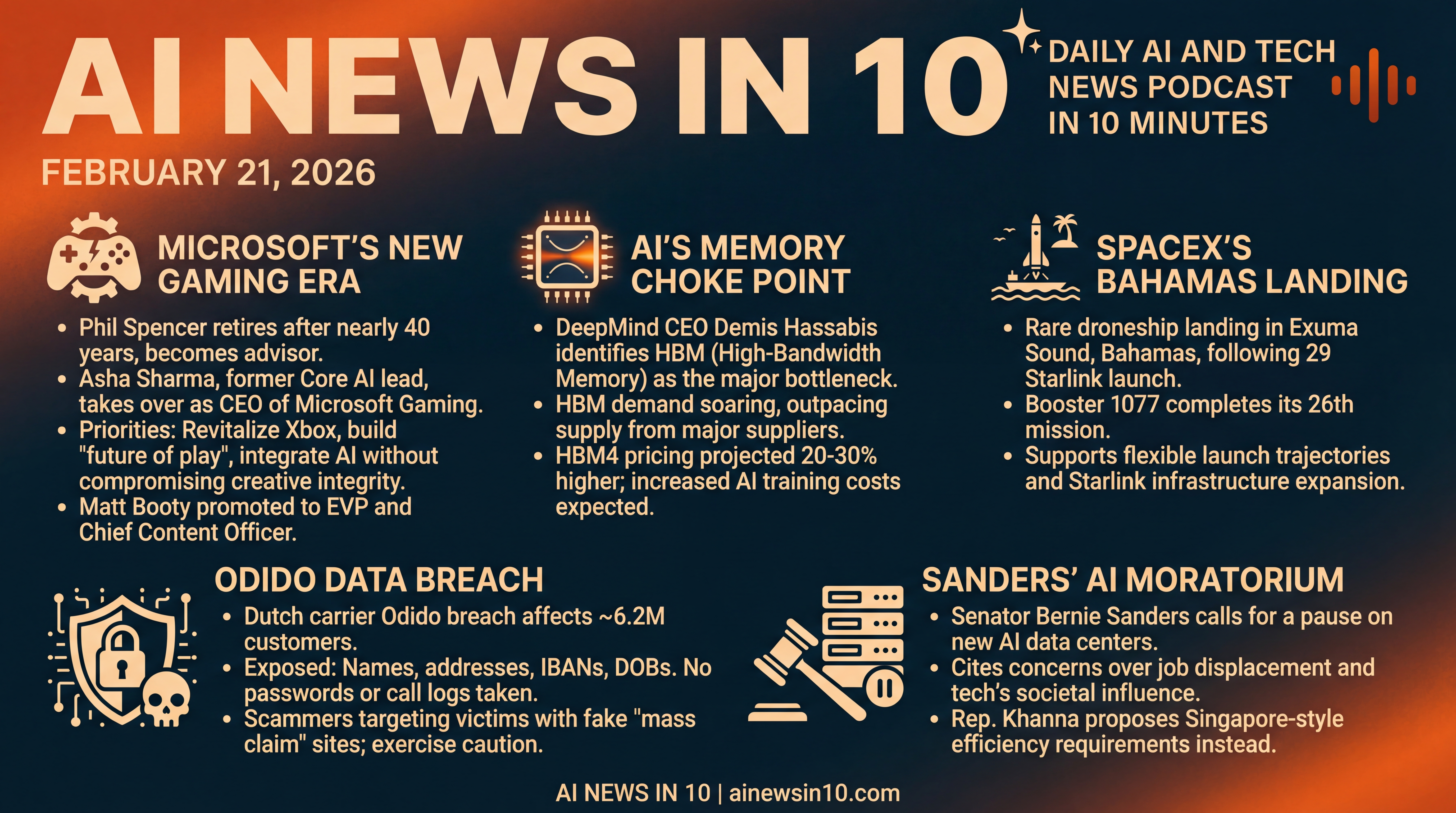
Microsoft taps Asha Sharma to run Microsoft Gaming as Phil Spencer retires, while DeepMind warns AI’s next gear is throttled by a memory crunch. Plus, SpaceX’s Bahamas landing boosts Starlink momentum, Odido’s breach fuels scams, and Sanders pushes to slow new AI data centers.
Episode Infographic
Show Notes
Welcome to AI News in 10, your top AI and tech news podcast in about 10 minutes. AI tech is amazing and is changing the world fast, for example this entire podcast is curated and generated by AI using my and my kids cloned voices...
Here’s what’s ahead today... Microsoft is shaking up Xbox leadership as Phil Spencer retires, and Asha Sharma — fresh from Microsoft’s Core AI — steps in to run Gaming. In chips, DeepMind’s Demis Hassabis says the AI boom is hitting a hard memory wall, even as HBM prices tick up. SpaceX nails a rare droneship landing in the Bahamas and lines up more Starlink launches today. In cybersecurity, Dutch carrier Odido’s breach touches 6.2 million people — and scammers are already circling. And on the policy front, Senator Bernie Sanders calls to... slow this thing down... pressing for a moratorium on new AI data centers. Let’s dive in.
[BEGINNING_SPONSORS]
Microsoft first... and it’s a big one. Phil Spencer — the face of Xbox for more than a decade, and a Microsoft veteran since 1988 — is retiring, capping nearly 40 years at the company. He’ll advise through the summer, while Asha Sharma becomes CEO of Microsoft Gaming.
Sharma previously led Core AI product. In her first memo, she laid out three priorities: make great games, revitalize the Xbox brand — starting with the console — and build toward the 'future of play.' She also drew a clear line around creative integrity — promising AI won’t compromise artistry — even as the team leans into new tools across PC, mobile, and cloud under 'Xbox Everywhere.' Matt Booty moves up to executive vice president and chief content officer.
That’s a lot of change... and fast. The subtext: Microsoft wants AI savvy operational leadership right where it intersects with consumer entertainment — and it’s willing to reframe Xbox’s identity to get there.
Why it matters: Xbox is more than boxes — it’s a subscription, a cloud, and a services business that increasingly blends AI-powered tooling into game development and community management. With Spencer’s era defined by Game Pass and blockbuster acquisitions, Sharma inherits the job of turning those bets into sustained creative hits... while threading AI through the pipeline without alienating creators or fans. Watch how quickly developer tools change — and whether first-party releases reflect that shift in 2026 and 2027.
To chips — and a constraint you can feel everywhere right now. DeepMind CEO Demis Hassabis says AI’s next gear is running headlong into a memory bottleneck. Not GPUs per se — memory for those GPUs: high-bandwidth memory, or HBM. He calls it a choke point. Google still depends on a few suppliers — Samsung, Micron, and SK Hynix — and demand for models like Gemini far outstrips what the memory supply chain can deliver. Alphabet is still pressing the gas with massive capital expenditures planned into 2026... but if you’ve wondered why model rollout pace and availability feel uneven, this is a big reason.
For context: industry analysts expect HBM demand to soar. TrendForce pegs 2026 growth at roughly 70 percent year over year, and HBM could consume nearly a quarter of all DRAM wafer output this year. That reallocation tightens supply for plain-vanilla DRAM and pulls pricing up across categories. Meanwhile, Samsung is reportedly setting initial HBM4 pricing 20 to 30 percent above HBM3E — a sign the cost curve isn’t easing anytime soon. For AI builders, that means availability constraints and a higher total cost of ownership for training and inference boxes... which can ripple into cloud prices and service tiers.
What to watch next: how quickly suppliers add capacity — and whether major buyers strike longer, more prescriptive supply agreements, like power purchase agreement-style contracts but for memory stacks. Also watch for system-level innovations — like model-parallel memory pooling and compression — that squeeze more effective capacity out of existing hardware while we wait for supply to catch up.
Over to orbit. SpaceX just pulled off only its second-ever Falcon 9 landing in the Bahamas — setting the booster down on the droneship Just Read the Instructions in Exuma Sound after a Cape Canaveral launch carrying 29 Starlink satellites. That unusual southern trajectory supports specific constellation slots and underscores how flexible SpaceX has become in threading launch windows, reentry corridors, and maritime operations. The booster, number 1077, logged its 26th landing on this mission. And there’s more on deck... today’s manifest includes additional Starlink launches out of Vandenberg and, late tonight Eastern, another from the Cape if weather and range cooperate.
Why this is notable beyond space fans: Starlink is infrastructure now — feeding back into terrestrial AI and cloud by backhauling data, standing up resiliency for remote sensors, and offering pop-up connectivity for edge computing. Every incremental batch expands coverage and capacity for those use cases — and repeated landings keep launch costs low enough to make that cadence possible. If you build products that rely on elastic connectivity, this drumbeat matters.
[MIDPOINT_SPONSORS]
Security sweep... and a cautionary tale. Dutch telecom Odido — formerly T-Mobile Netherlands — disclosed a breach impacting personal data tied to roughly 6.2 million current and former customers. Exposed fields include names, addresses, phone and customer numbers, international bank account numbers, dates of birth, and identity document details. Importantly, Odido says passwords, call logs, billing data, and location data were not taken, and core services kept running. The company says it cut off unauthorized access, brought in external forensics, and has been notifying affected users. It’s one of the largest telecom incidents in the Netherlands.
And now the second punch: scammers are already targeting victims with fake 'mass claim' compensation sites that harvest fees and fresh personal information. Dutch consumer groups flag classic red flags — upfront payment demands, missing legal identifiers, and false claims about what was stolen. If you or your customers were notified, treat any legal or refund offers with skepticism — go only through carrier-verified channels. Expect questions, too, about data retention: some former customers who left years ago also received breach emails, raising compliance concerns.
Policy to close... Senator Bernie Sanders, speaking at Stanford last night with Representative Ro Khanna, argued the U.S. is unprepared for the pace and scale of the AI revolution. He renewed his call for a moratorium on new AI data centers — at least until worker protections and broader safeguards are in place. Khanna didn’t back a pause, but pushed a Singapore-style approach that ties growth to stricter efficiency, water use, and clean-energy requirements. Sanders framed the moment as potentially the most dangerous in modern U.S. history if left unchecked — citing projections of widespread job displacement and tech’s growing influence over public life.
Why you should care, even if you’re not in policy: these debates shape siting, permitting, and energy contracts that determine where AI capacity gets built — and at what cost. If states and cities add water-use caps, recycled-water mandates, or minimum clean-power thresholds, that changes the economics of deploying inference clusters and the latency profiles your products can deliver. In short... policy choices today map directly to performance envelopes tomorrow.
Quick recap... Xbox leadership hands the controller to Asha Sharma as Microsoft leans into AI without losing the soul of great games. DeepMind says memory — not just GPUs — is today’s AI choke point, and HBM pricing supports that story. SpaceX keeps scaling Starlink with a rare Bahamas landing and more launches queued up. Odido’s breach shows how fast scammers exploit chaos — verify everything. And on campus in California, Sanders and Khanna spar over how fast to build the AI future... or whether to tap the brakes. We’ll be back tomorrow with what moves next.
Thanks for listening and a quick disclaimer, this podcast was generated and curated by AI using my and my kids' cloned voices, if you want to know how I do it or want to do something similar, reach out to me at emad at ai news in 10 dot com that's ai news in one zero dot com. See you all tomorrow.
