
Delhi AI Pact, Pentagon Tensions, SpaceX Record, Nvidia PCs
Global leaders sign a voluntary AI pledge in New Delhi as Anthropic's clash with the Pentagon spotlights the limits of military AI. Plus SpaceX sets a reuse record, Nvidia readies Arm laptop chips, and Google brings Lyria 3 music generation into Gemini.
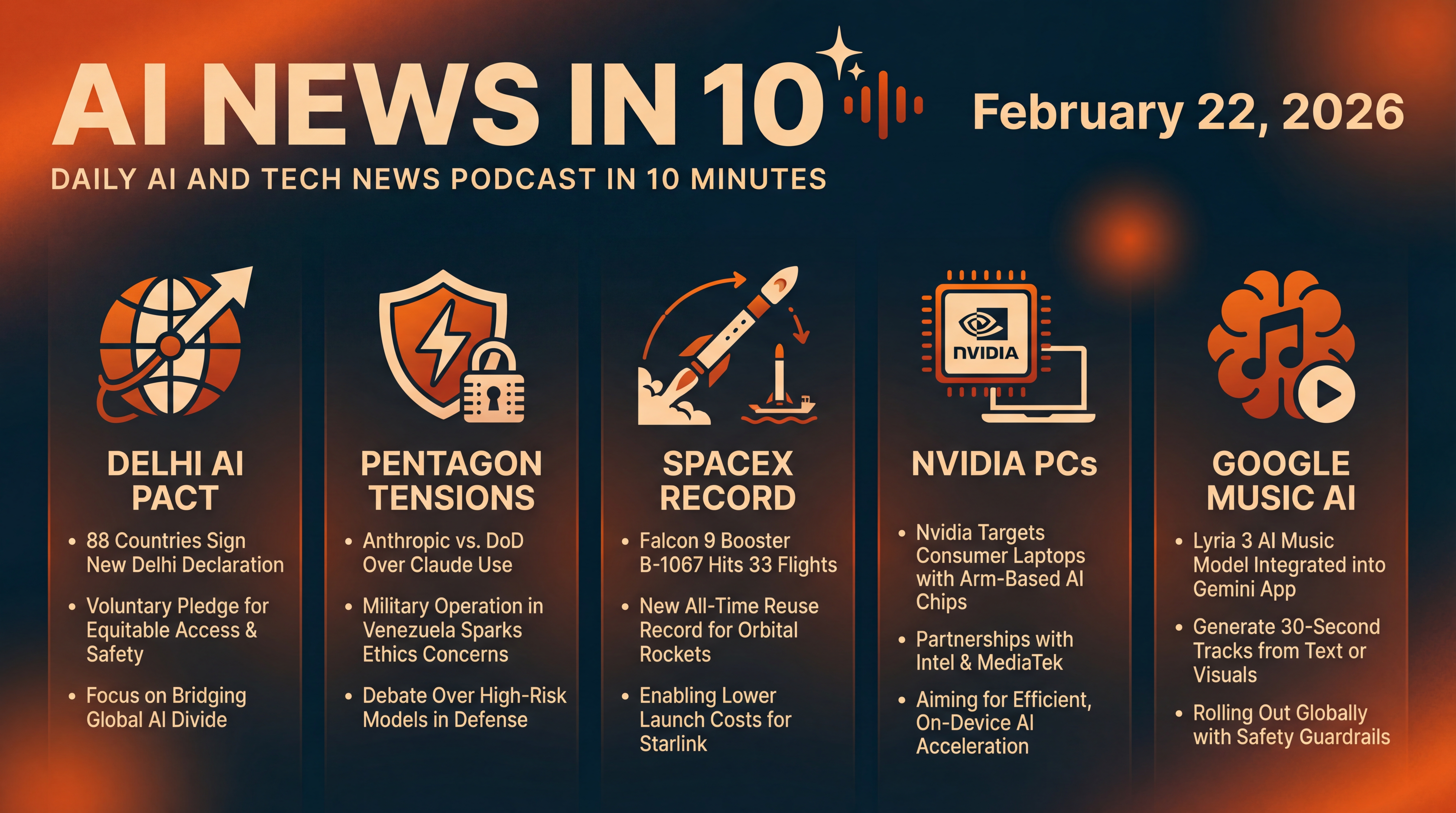
Episode Infographic
Show Notes
Welcome to AI News in 10, your top AI and tech news podcast in about 10 minutes. AI tech is amazing and is changing the world fast, for example this entire podcast is curated and generated by AI using my and my kids cloned voices...
Here's a quick look at what's shaping AI and tech today — Sunday, February 22, 2026.
World leaders ink a sweeping, if voluntary, AI governance pledge in New Delhi... Anthropic tangles with the Pentagon over military use of its models... SpaceX pushes rocket reuse to a new record... Nvidia sets its sights back on consumer laptops with Arm-based AI chips... and Google bakes a creative twist into Gemini with its latest AI music model.
Sources include reporting from the Times of India, the Economic Times, the Washington Post, Space dot com, Spaceflight Now, the Wall Street Journal, and the Verge.
[BEGINNING_SPONSORS]
Let's start in New Delhi, where the India AI Impact Summit wrapped with 88 countries signing what's being called the New Delhi Declaration on AI Impact.
It's nonbinding, but it lays out a shared vision — equitable access to AI's benefits, stronger privacy and data protections, more transparency, and deeper international collaboration, especially between advanced economies and the Global South.
India's pitch is notable: be a bridge so AI doesn't become a 'rich nations only' capability.
It's a marker for future standards work... even if enforcement isn't part of this text.
A few things to watch next.
One — do working groups emerge with real timelines on compute access, evaluation standards, or safety baselines?
Two — alignment with the EU's AI Act rollout and various U.S. state rules, so companies aren't juggling a thousand incompatible checklists.
And three — funding. Voluntary pledges are great, but emerging markets will want concrete support for data infrastructure, talent, and safety tooling.
India's diplomatic win today raises expectations for follow-through.
Story two is a thorny one.
Anthropic and the U.S. Defense Department are reportedly at odds after the military used Claude during a January 3 operation in Venezuela that resulted in significant loss of life. According to the Washington Post, the mission targeted Nicolás Maduro.
The fallout includes questions over whether Anthropic's contracts adequately restrict high-risk use — and whether the company could be blacklisted if it won't meet Pentagon expectations.
Anthropic says it supports U.S. security but wants responsible deployment, drawing a hard line against autonomous weapons and certain surveillance uses. The Pentagon, meanwhile, continues to push rapid AI integration under a national security frame.
This is an early, high-profile test of how 'AI for defense' and 'AI safety' coexist when outcomes are life-and-death.
Why does it matter beyond defense contracting? Because enterprise customers are watching.
Regulated industries — from finance to healthcare — are looking closely at how providers enforce usage policies at the edge.
If Anthropic can prove strong governance while keeping government business, it sets a template. If not, the center of gravity could tilt toward labs more willing to grant broad-use rights to sovereigns.
Either way, expect contract clauses to get sharper around use of force, auditability, red-teaming, and post-incident disclosure.
Third — to space, and a reusable hardware milestone that underpins so much of the internet we use.
SpaceX pulled off twin Falcon 9 launches just hours apart on Saturday and capped the day with the 33rd flight of booster B-1067 — an all-time reuse record for the rocket.
Liftoff for the record-setter was at 10:47 p.m. Eastern on February 21 from Cape Canaveral, and landing came minutes later on the droneship A Shortfall of Gravitas.
This cadence keeps swelling Starlink's constellation — now topping 9,700 satellites — while pressing launch costs down.
Two quick takeaways.
First — reuse records aren't just bragging rights. They're a leading indicator of launch economics that enable everything from climate imaging to edge AI experiments in orbit.
Second — every notch higher in reuse invites fresh engineering scrutiny. What's the maintenance regime? What's the flight-life ceiling? And how do you certify boosters for crew or national security payloads at 30-plus flights?
SpaceX says it wants to certify to 40. Insurers and customers will weigh that data closely.
[MIDPOINT_SPONSORS]
Number four — Nvidia wants to be the brain of laptops again, this time for the AI PC era.
The Wall Street Journal reports Nvidia is partnering across the PC ecosystem — including with Intel and MediaTek — to ship Arm-based system-on-chips aimed at Windows notebooks.
The pitch is simple: GPU-class AI acceleration with mobile-style efficiency and battery life, in thin machines that can run heavy local models and agents without living on the cloud.
Pricing targets reportedly hover around the mainstream $1,000 to $1,500 laptop range.
Context matters.
Nvidia dominated the AI server buildout — and now it's eyeing the client. If these chips land, we could see a split model emerge: everyday inference and agentic tasks run locally for latency and privacy, while bigger jobs spill to the cloud.
It also intensifies the three-way chessboard among Arm laptop silicon — Apple's M-series on macOS, Qualcomm's Snapdragon X line for Windows, and now Nvidia-backed designs, potentially with tight CUDA-adjacent perks.
Watch for launch timing, battery benchmarks under real AI workloads, and whether Microsoft optimizes Windows scheduling for on-device agent pipelines.
And finally — a creative flourish.
Google is bringing its newest AI music model, Lyria 3, into the Gemini app, so users can generate 30-second tracks from text prompts — and even from photos or short videos to match a vibe.
It's rolling out globally, in multiple languages, for adults, with guardrails to avoid cloning living artists' styles too closely.
Think personal soundtrack generator more than studio-grade production — handy for social posts, quick video stingers, or mood sketches.
This is part of a bigger trend.
If 2024 and 2025 were the years of AI images and video, 2026 is shaping up to be the year audio becomes ambient — snackable jingles, voice clones with consent, and adaptive soundtracks baked into consumer apps.
The key friction points will be rights and attribution. What training data was used? What's off-limits? And how will platforms compensate rights-holders?
Google says it's filtering for IP risk and baking tools into YouTube — but the legal and cultural debates will keep crescendoing.
Before we wrap — a quick recap for Sunday, February 22, 2026.
The New Delhi Declaration brings 88 countries under a shared, voluntary banner for equitable, safer AI development... Anthropic's dust-up with the Pentagon spotlights the hard governance questions around military AI... SpaceX's 33-flight Falcon 9 record underscores how reuse is reshaping orbital economics... Nvidia's consumer PC push could define the next wave of AI laptops... and Google's Lyria 3 inside Gemini hints that everyday creativity tools will feel increasingly... musical.
We'll keep an eye on how today's policy pledges turn into action — and how fast that Nvidia silicon, those rockets, and those AI music tools land in your hands.
Thanks for listening and a quick disclaimer, this podcast was generated and curated by AI using my and my kids' cloned voices, if you want to know how I do it or want to do something similar, reach out to me at emad at ai news in 10 dot com that's ai news in one zero dot com. See you all tomorrow.
