
Memory Crunch, Edge AI, and Hollywood Deals
From the global memory chip squeeze to Samsung’s Unpacked tease, we break down how edge AI is reshaping phones and wearables, why eVTOLs matter, and how OpenAI is wooing Hollywood. Clear takeaways on what to watch next.
Episode Infographic
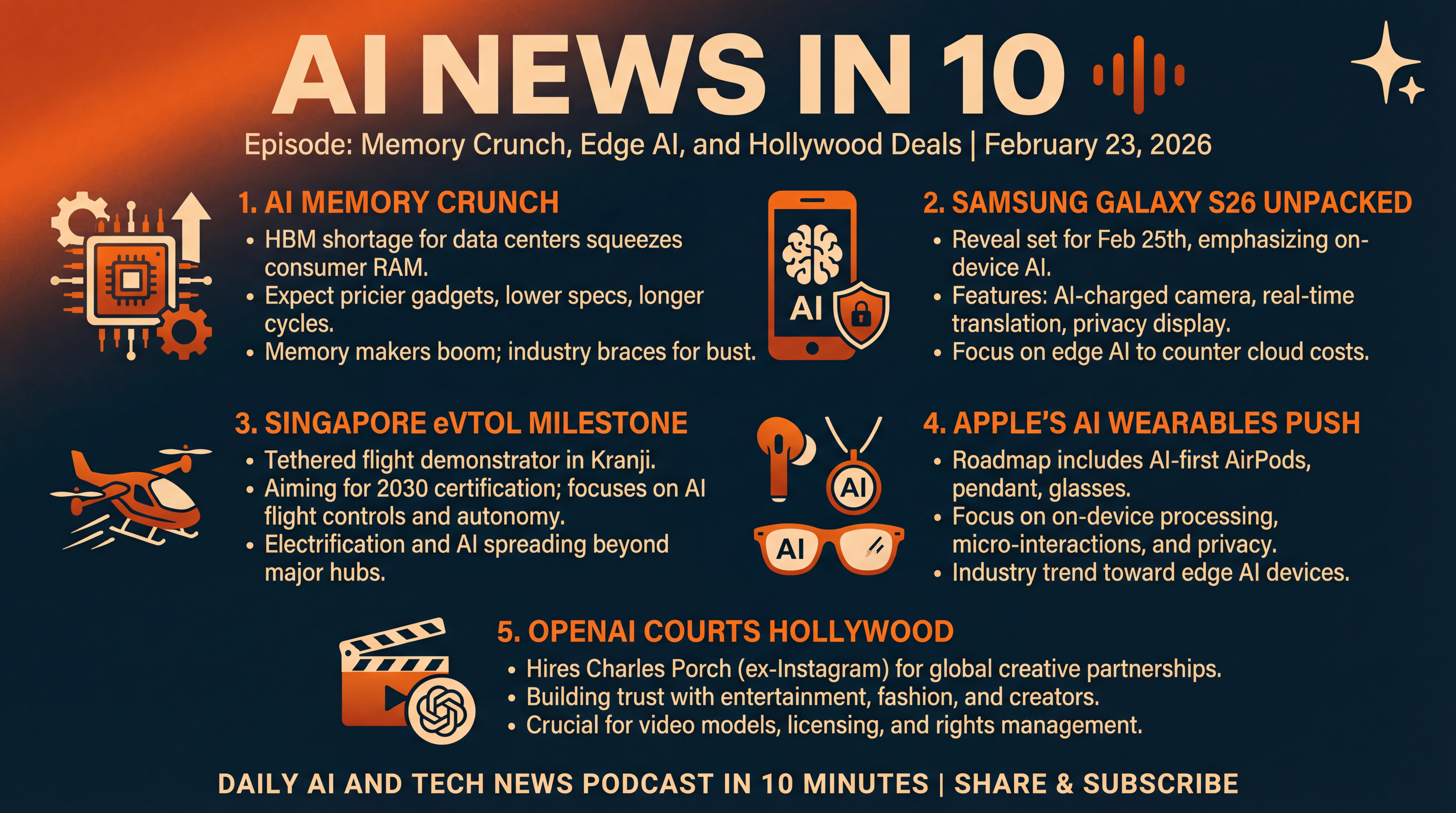
Show Notes
Welcome to AI News in 10, your top AI and tech news podcast in about 10 minutes. AI tech is amazing and is changing the world fast, for example this entire podcast is curated and generated by AI using my and my kids cloned voices...
It’s Monday, February 23rd, and we’ve got a packed slate. The AI boom is colliding with a global memory chip crunch that could make your gadgets pricier... Samsung is teeing up new AI-charged phones at Unpacked this week... Singapore just logged another electric air taxi milestone... Bloomberg says Apple is speeding up work on AI-first wearables — from camera AirPods to a pendant and lightweight glasses... and OpenAI just hired Instagram’s longtime celebrity whisperer to deepen ties with Hollywood and creators. Let’s dive in.
[BEGINNING_SPONSORS]
Story one — the AI memory crunch is real, and it’s heading for your wallet.
High-bandwidth memory, or HBM, is the fast, stacked DRAM big AI accelerators rely on. As hyperscalers pour billions into AI servers, chipmakers are shifting wafer capacity away from everyday DRAM and NAND for phones and PCs — and into HBM for data centers.
Think of it as a RAM-ageddon moment — AI data centers are outbidding consumer electronics, tightening supply and pushing up costs across smartphones, PCs, and consoles, according to reporting in The Times. In the near term, that’s great for memory makers — Barron’s says Micron’s revenue could more than double this year, with earnings up fivefold — but the industry’s boom-bust cycles mean today’s shortage could flip if 2027 capacity lands all at once.
TrendForce data, cited by Fortune, puts numbers on it: HBM demand up roughly 70 percent in 2026, with HBM consuming about 23 percent of total DRAM wafer output this year. Meanwhile, Nvidia’s newest rack-scale systems pack tens of terabytes of memory per rack, soaking up supply that would have powered thousands of phones.
Translation: fewer bargain upgrades, pricier mid-range devices, and manufacturers trimming specs to hit price points while the AI build-out hogs the fast memory.
So what should you watch for as a buyer? Expect more AI-ready marketing without big jumps in RAM at the lower tiers, longer replacement cycles, and a bigger emphasis on on-device AI efficiency rather than raw memory bumps. If you’re eyeing a phone or laptop, watch for seasonal promos... otherwise, waiting for late-year models could bring better balance as allocations settle.
Story two — Samsung’s next flagships are imminent.
Bloomberg’s consumer tech desk is flagging an Unpacked reveal for the Galaxy S26 lineup on Tuesday, February 25th. In India, local reports say pre-reservations are opening and highlight rumored features like upgraded cameras, a new processor, and even a privacy display concept that narrows viewing angles to keep prying eyes off your screen.
The overall pitch: more on-device AI, tighter integration between camera and generative features, and battery-savvy silicon tuned for AI tasks. Given Samsung’s recent focus on real-time translation, AI photo tools, and note-taking summaries, expect those to evolve — and watch for any hints of new guardrails around synthetic media and watermarking. We’ll have the official specs once the curtain lifts.
A quick take: with HBM scarcity pushing cloud AI costs up, handset makers are incentivized to show what edge AI can do locally. If Samsung leans into private, on-device features that feel fast and useful — without a data center round-trip — that’s a meaningful differentiator in 2026.
Story three — aerospace tech week starts with a quiet hover... literally.
Aviation Week’s roundup highlights Singapore’s Nanyang Technological University flying a tethered eVTOL demonstrator in Kranji. It’s subscale now, with a full-size four-passenger target aiming at 2030 certification — but it shows how electrification, autonomy, and AI-assisted flight controls are spreading beyond the usual U.S. and China hubs.
The coverage also spotlights how advanced networking, AI-enabled maintenance, and sustainable aviation fuel R&D are converging to make short-hop electric flight more practical. We’re still early — airworthiness, noise footprints, charging infrastructure, and per-seat economics all need work — but regional tech ecosystems are checking boxes: hover stability, energy-density trade-offs, and certification paths with regulators.
Keep an eye on teleoperation and guardian autonomy — AI that intervenes for envelope protection — as bridging tech on the way to higher levels of autonomy.
Why it matters beyond air taxis: the same sensor fusion and predictive control software driving eVTOLs feeds back into drones, robotics, and next-gen automotive ADAS. When you hear the phrase 'certifiable software' in aviation, that’s code for extremely mature, safety-vetted AI and control stacks... exactly the kinds of building blocks that tend to spill over into consumer and industrial automation a few years later.
[MIDPOINT_SPONSORS]
Story four — Apple is accelerating work on an AI-first wearables push.
Think camera-equipped AirPods, a pendant-style device, and lighter-weight glasses — all aimed at blending glanceable capture, AI context, and subtle assistance. That aligns with Apple’s pattern: start with controlled, lower-risk form factors, then iterate toward glasses as silicon, batteries, and displays shrink.
The product logic is compelling: short video or audio capture on the ear, on-device summarization and transcription, and AI-assisted recall could become daily-driver habits — if privacy and UX are nailed. Expect heavy emphasis on on-device processing and clear consent cues around cameras and microphones. Apple likely won’t ship anything that records by default without an obvious indicator.
For developers, the signal is clear: build for micro-interactions and context windows — ten seconds of video, a few sentences of audio, snapshots with metadata — rather than long sessions.
A note of caution: Apple hasn’t announced products here. This is roadmap reporting, not event news. But coupled with a March 4th special experience showcase — and the industry’s tilt toward edge AI — it’s a safe bet that 2026 is the year wearables get much smarter... even if true AR glasses remain a multi-year climb.
Story five — Hollywood, meet OpenAI’s new dealmaker.
OpenAI has hired Charles Porch — Instagram’s former global partnerships lead — as its first VP of global creative partnerships, per Vanity Fair. Porch is known for stitching together influencer and celebrity campaigns, from surprise Beyoncé drops to landing the Pope on Instagram.
His remit now: build trust with entertainment, fashion, music, and sports communities, and broker relationships that make AI tools safe, useful, and commercially viable for creators. That matters because the next wave of models — especially video — will live or die on licensing frameworks, likeness rights, attribution, and revenue shares that artists can accept.
Porch’s hire signals a shift from tech-first to ecosystem-first — with structured listening tours and playbooks for agencies and rights holders. If OpenAI can pair compelling tools with transparent usage controls and upfront licensing, it sets a template others will copy. If not... expect more lawsuits, opt-outs, and backlash.
Zooming out, here’s how today’s threads connect.
AI infrastructure is still hogging the world’s fastest memory, and that will squeeze device specs and pricing for a while. Phone makers like Samsung are responding by pushing more helpful, private, on-device AI — and if Apple’s wearables push lands, we’ll see the same playbook on your ears and around your neck.
Meanwhile, aviation’s cautious march toward AI-assisted flight shows how safety-critical autonomy matures, and OpenAI’s Hollywood outreach acknowledges that the most advanced models won’t matter without creative partnerships and trust.
That’s it for today’s AI News in 10 — a chip crunch shaping the gadgets you’ll buy, an Unpacked tease for AI phones, steady advances in electric air taxis, an Apple wearables bet taking shape, and OpenAI courting creators. We’ll be back tomorrow with the latest.
Thanks for listening and a quick disclaimer, this podcast was generated and curated by AI using my and my kids' cloned voices, if you want to know how I do it or want to do something similar, reach out to me at emad at ai news in 10 dot com that's ai news in one zero dot com. See you all tomorrow.
