From Semantic Fabrics to Space Force AI
Nvidia buys Illumex to ground enterprise AI agents, PayPal flags a coding-error exposure, the European Parliament pauses built-in AI, Space Force outlines its AI playbook, and Letter AI raises $40M. A fast, practical rundown with key takeaways on data quality, security, policy, and workflow-native AI.
Episode Infographic
Show Notes
Welcome to AI News in 10, your top AI and tech news podcast in about 10 minutes. AI tech is amazing and is changing the world fast, for example this entire podcast is curated and generated by AI using my and my kids cloned voices...
It’s Tuesday, February 24, 2026. Here’s what’s on deck today... Nvidia quietly snaps up an Israeli data semantics startup to fuel enterprise AI agents... PayPal discloses a months-long data exposure tied to its Working Capital loan app... the European Parliament tells staff to switch off built-in AI on work devices over security concerns... the U.S. Space Force runs an AI and ML Industry Day to pull in vendors for space operations... and a sales-tech upstart nabs forty million dollars to turn generative AI into practical coaching for reps. Let’s get into it.
[BEGINNING_SPONSORS]
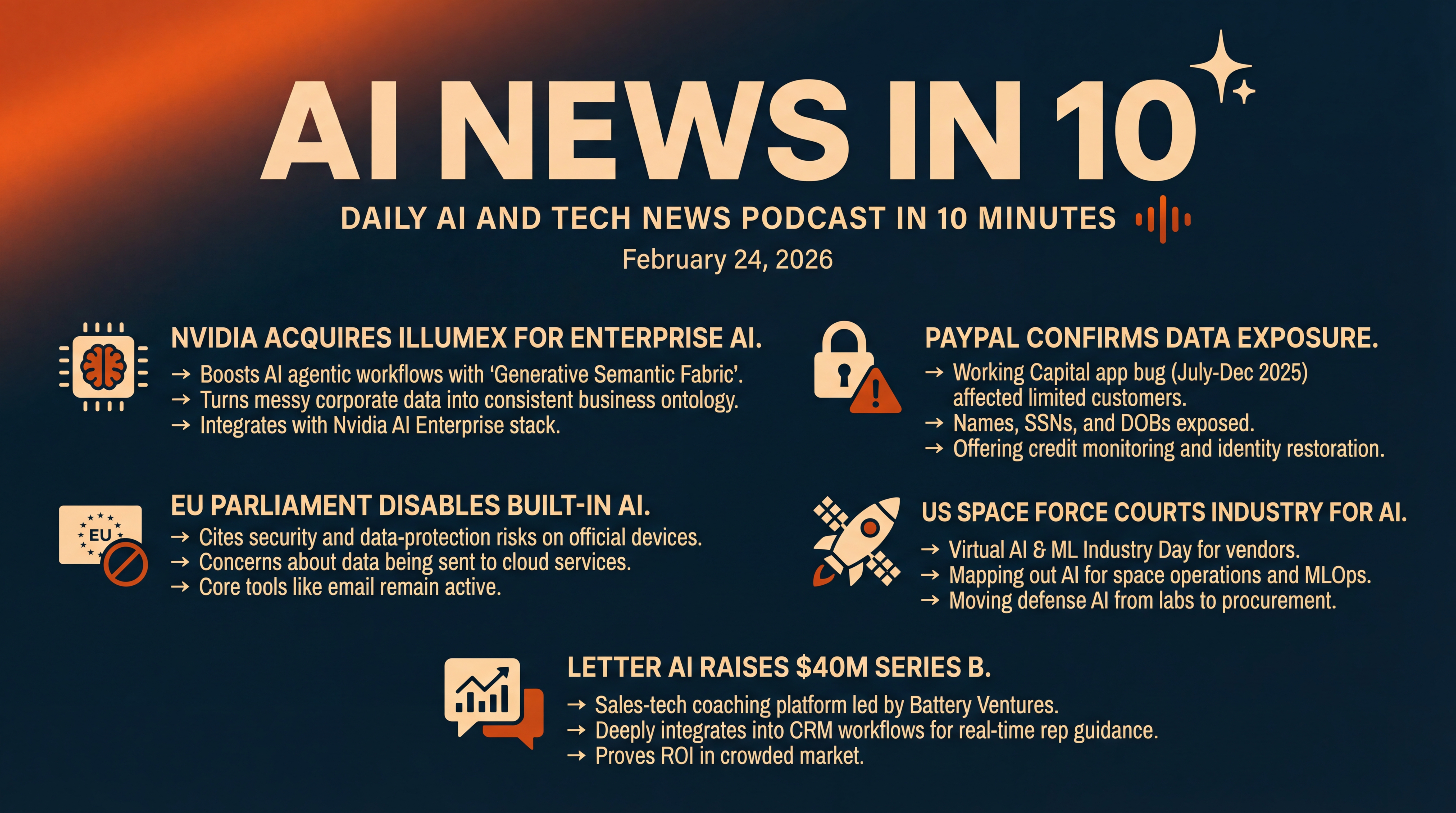
First up — Nvidia just added another piece to its enterprise AI stack by acquiring Illumex. It’s a small but strategic Israeli startup known for what it calls a Generative Semantic Fabric — technology that turns messy corporate data into a consistent business ontology... think of it as a shared language machines can actually reason over. Multiple Israeli outlets put the price between roughly sixty and seventy-five million dollars.
Illumex, led by founder and CEO Inna Tokarev Sela, had raised about thirteen million dollars and integrated with Nvidia’s AI Enterprise stack last year to help companies prepare data for agentic workflows. The move fits Nvidia’s pattern — buy targeted software talent that makes its accelerated computing more usable for big customers — this time by giving AI agents context they can trust across ERP and CRM silos. If you’re tracking the push into agentic AI — systems that plan, call tools, and execute multi-step business tasks — semantic grounding like this is gold. Reports in the Jerusalem Post say Nvidia confirmed the deal, and Calcalist first flagged it yesterday with similar numbers.
Two quick implications. One — enterprise buyers keep saying data quality and governance, not model horsepower, are their blockers. A semantic layer that maps terms like customer, order, and revenue consistently across dozens of systems is how you turn copilots into doers. Two — Nvidia’s ongoing expansion in Israel, after Mellanox and a string of local deals, keeps building its software bench to complement its GPU dominance. If the sticker price sounds modest for Nvidia... that’s the point — capability tuck-ins that compound its platform advantage.
Story two — PayPal has confirmed a data exposure affecting users of its PayPal Working Capital loan application. It wasn’t a breach of core systems, but a coding error that left sensitive fields accessible between July 1 and December 13, 2025. Exposed data may have included names, contact details, business addresses, Social Security numbers, and dates of birth for a limited set of customers.
PayPal says access is now revoked. Impacted users — about one hundred contacted so far — are being reimbursed for any unauthorized charges. Passwords were reset, the code was fixed, and two years of Equifax credit monitoring and identity restoration are being offered. Practical takeaway: watch for phishing that leverages accurate personal and business details, verify any PayPal support outreach through official channels, and consider a credit freeze if you were notified.
Number three — a notable policy signal from Brussels. The European Parliament has disabled built-in AI features on staff work devices, citing security and data-protection risks. An internal memo notes that many consumer-grade or app-embedded AI functions send data off-device to cloud services. Until the institution can fully vet what leaves and where it goes, generative AI access is suspended on official hardware. Core tools like email and calendars keep working — this is about the AI add-ons.
It also tracks a broader EU theme: pressing for trustworthy AI while reducing reliance on U.S. hyperscaler ecosystems that aren’t fully transparent to public-sector risk teams. Context worth noting... under the EU AI Act’s rollout, transparency rules and many high-risk obligations kick in on August 2, 2026. For anyone selling AI to European governments, expect more questions about on-device processing, logging, and provenance in the months ahead.
[MIDPOINT_SPONSORS]
Fourth — the U.S. Space Force is openly courting industry on how it wants to use AI. Space Systems Command is holding a virtual AI and ML Industry Day today — from 9 a.m. to 3 p.m. Pacific — covering everything from the SSC Chief Data and AI Officer’s vision to mission applications and program structures across the System Deltas. Translation: they’re laying out where vendors can plug in with AI for space domain awareness, satellite operations, threat detection, and enterprise processes.
It’s notable for a couple of reasons. First — defense AI is moving from lab demos to procurement roadmaps, and forums like this give contractors and startups clearer lanes to propose real capabilities. Second — the structure hints at where the service wants to standardize, from data fabrics and MLOps pipelines to decision-support tools that can meet cyber and accreditation requirements out of the box. If you’re building dual-use tech, pay attention... this is where requirements, security controls, and timelines get defined.
And rounding us out — funding is still flowing to focused, workflow-native AI. Letter AI, a Chicago-based sales-tech startup out of Y Combinator, just raised a forty million dollar Series B — its second round in four months — led by Battery Ventures. The company pitches a single command center for seller enablement that combines content, training, and buyer engagement, plus a new feature called Letter Compass that coaches reps with deal-specific next steps and messaging.
The startup says it serves customers in thirty countries, including Lenovo, Adobe, Novo Nordisk, and Plaid. The team plans to scale from a lean headcount of roughly two dozen. Why this matters in a crowded field with giants and well-funded rivals: buyers want AI that’s deeply wired into the daily system of action — CRM events, call notes, mutual plans — not another tab. If Letter can prove measurable lift in win rates or cycle time, it will find room even in belt-tightening IT budgets.
Quick recap... Nvidia’s latest buy shows how critical semantic context is for agentic AI in the enterprise. PayPal’s coding-error exposure is a reminder that first-party apps can leak just as badly as vendors — watch your inbox and credit, especially if notified. The European Parliament’s AI pause on work devices foreshadows stricter public-sector guardrails ahead of the EU AI Act’s August milestones. The U.S. Space Force is mapping out where it wants AI in space operations and inviting industry to help build it. And Letter AI’s fresh forty million shows investors still back AI that lives where work happens — and proves ROI fast. We’ll be back tomorrow with the next round of breakthroughs, policies, and the occasional curveball shaping AI and tech.
Thanks for listening and a quick disclaimer, this podcast was generated and curated by AI using my and my kids' cloned voices, if you want to know how I do it or want to do something similar, reach out to me at emad at ai news in 10 dot com that's ai news in one zero dot com. See you all tomorrow.
