Nvidia’s Test, Offline AI, and Apple’s Spring Play
A packed midweek: Nvidia faces a pivotal earnings test, Microsoft launches offline-capable Sovereign Cloud, and CrowdStrike warns attackers are moving at AI speed. Plus, Apple readies a March 4 hands-on blitz and NIST updates its generative AI evaluation challenge.
Episode Infographic
Show Notes
Welcome to AI News in 10, your top AI and tech news podcast in about 10 minutes. AI tech is amazing and is changing the world fast, for example this entire podcast is curated and generated by AI using my and my kids cloned voices...
It’s Wednesday, February 25, 2026… and the AI and tech world picked a busy midweek.
On deck today: Nvidia faces a closely watched earnings call with sky high expectations… Microsoft unveils a big Sovereign Cloud expansion built for fully disconnected AI… CrowdStrike says adversaries are moving faster than ever with AI… Apple invites press to a March 4 experience as multiple product launches line up… and NIST refreshes its generative AI evaluation program with new timelines. Let’s get into it.
[BEGINNING_SPONSORS]
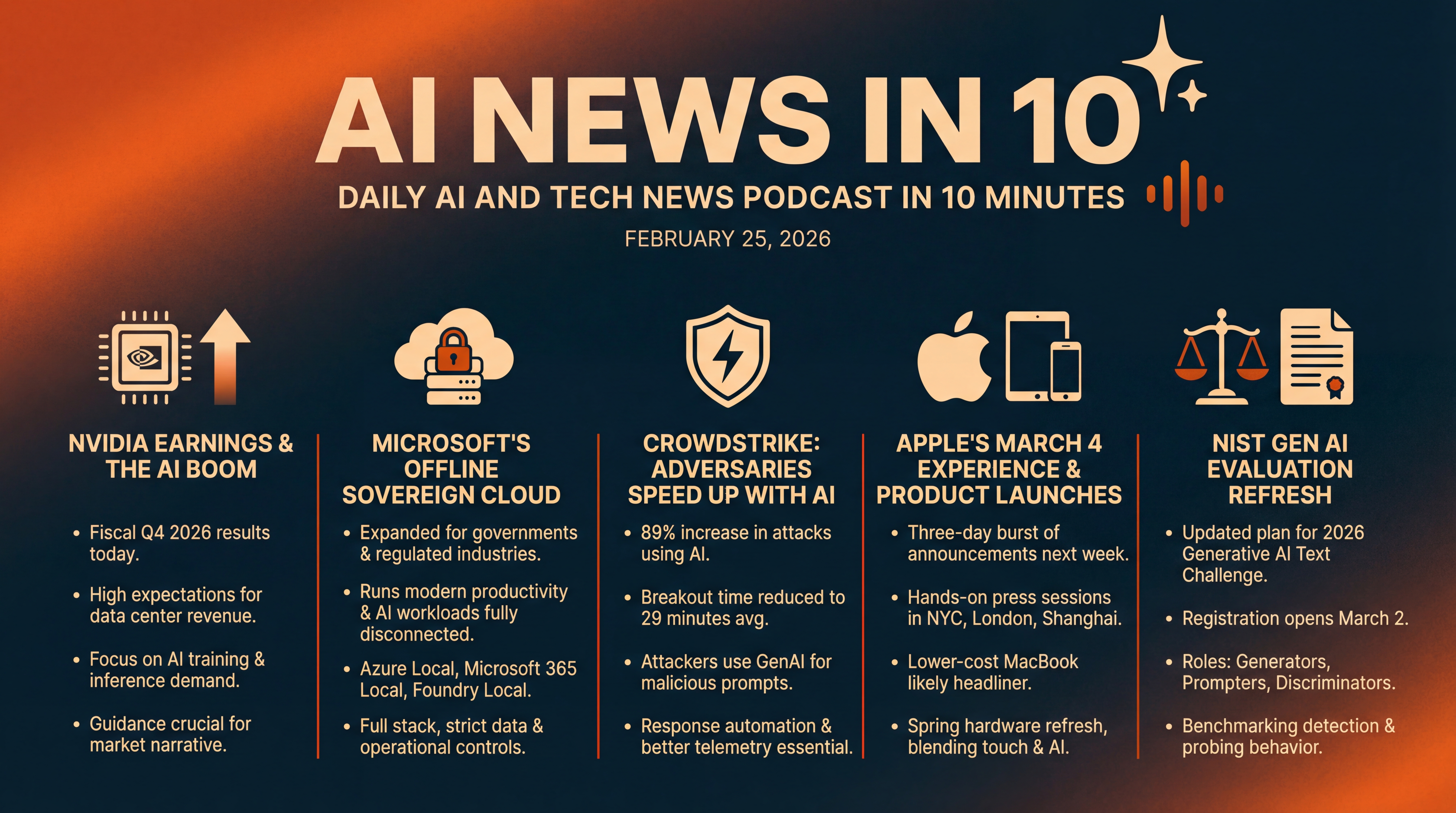
Story one. Nvidia’s earnings day is here — and Wall Street is focused on whether the AI investment boom still has legs.
The company reports fiscal Q4 2026 results this afternoon. The conference call is scheduled for 2 p.m. Pacific — 5 p.m. Eastern — a timing Nvidia flagged weeks ago.
Analysts expect another giant quarter driven by data center demand. FactSet puts revenue expectations around the mid 60 billion dollar mark for the November through January period, and some research desks think Nvidia could top that on continued GPU strength.
The bigger question is guidance — and whether training demand stays scorching as spending shifts toward inference. Previews suggest the Street still expects outperformance, but it’s laser focused on sustainability, customer concentration, and any signals about supply, margins, and the next platforms. We’ll watch for updates on the Blackwell and Rubin roadmaps, and on how quickly hyperscalers are converting capex into usable AI capacity.
Here’s why it matters. 2026 is shaping up to be the year AI capex meets accountability. Big Tech has telegraphed hundreds of billions in data center investment, and Nvidia sits at the center of that spend. If the company signals continued order visibility — and a smooth handoff from training to inference in both hardware and software — the broader market’s AI narrative gets more runway. If not… expect some volatility. Investors are already on edge after recent sector swings tied to competitive headlines.
Story two. Microsoft has expanded its Sovereign Cloud — aimed at governments and regulated industries — to run modern productivity and AI workloads even when completely offline.
Three notable updates. Azure Local with disconnected operations, to run governed infrastructure with zero internet connectivity. Microsoft 365 Local — also disconnected — for Exchange, SharePoint, and Skype for Business inside a sovereign boundary. And Foundry Local, to bring large multimodal AI models into fully disconnected environments on customer owned hardware — with Microsoft highlighting Nvidia powered stacks — so you can keep inference local under strict data and operational controls.
The pitch is simple: full stack, your boundary. Unified governance, consistent policy, and operational resilience whether you’re connected or air gapped. The implications land now for national security, critical infrastructure, and sectors like healthcare and energy where data cannot leave the perimeter.
Why this is interesting. For all the talk about AI in the cloud, a huge slice of sensitive work needs local guarantees — latency, survivability, and legal jurisdiction. By packaging offline capable infrastructure, productivity, and model hosting together, Microsoft is targeting the 'AI where it has to live' problem… and that could accelerate adoption in places that have been waiting on sovereignty grade controls.
Story three. Cyber adversaries are accelerating with AI — fast. CrowdStrike’s new 2026 Global Threat Report finds an 89 percent year over year increase in attacks where AI is part of the adversary toolset, and breakout time — how quickly intruders move from initial access to lateral movement — fell to just 29 minutes on average. The fastest observed breakout? Twenty-seven seconds.
CrowdStrike also documents attackers abusing legitimate generative AI tools at more than 90 organizations — including malicious prompt injection to generate data stealing commands — along with activity targeting AI development platforms themselves. In parallel, 82 percent of detections last year were malware free, meaning adversaries are living off the land with stolen credentials, SaaS integrations, and supply chain footholds. The takeaway: it’s an AI arms race that’s compressing defenders’ time to detect and respond.
What to do about it. If you run AI in production, treat the models — and the surrounding tooling — as a new attack surface. Monitor prompts and outputs where feasible, double lock your identity plane, and harden CI/CD, model registries, and vector databases the way you would crown jewel apps. CrowdStrike’s message is clear — the blend of identity abuse, SaaS sprawl, and AI assisted speed means response automation and better telemetry are not optional in 2026.
[MIDPOINT_SPONSORS]
Story four. Apple is lining up a three day burst of announcements next week, culminating in a March 4 Apple Experience hosted simultaneously in New York, London, and Shanghai at 9 a.m. Eastern. Don’t expect a classic livestream keynote — press invites point to hands on sessions while products drop via Newsroom posts. Reporting says at least five new products are slated between March 2 and March 4, with a new lower cost MacBook the most likely headliner.
Meanwhile, fresh chatter points to OLED touchscreen MacBook Pros later this year — including a smaller Dynamic Island style status area migrating from iPhone to Mac — though those are not expected next week. Taken together, it signals a substantial spring hardware refresh and continued blending of touch and AI assisted experiences across Apple’s lineup.
Why it matters. A budget friendly MacBook could push Apple’s AI era PC strategy deeper into the mainstream, especially as on device models and cloud assisted features mature. And if Apple is truly readying touchscreen Macs, that would mark a philosophical shift — likely tied to a more agentic, multimodal interface future. The unusual format — press experiences and rolling announcements — suggests a high volume slate rather than a single tentpole reveal.
Story five. The U.S. standards community is iterating on how we measure — and deter — risky behavior in generative AI. NIST just updated the evaluation plan for its 2026 Generative AI Text Challenge on February 23, and opens registration March 2.
The program sets up three roles: generators, prompters, and discriminators. One group builds text generators. Another crafts prompts for accurate as well as intentionally misleading narratives. A third builds detectors that score whether content looks AI or human authored — and how believable it is. It’s a structured testbed for red teaming prompts, probing model behavior, and benchmarking detection… groundwork that can feed both better guardrails and better measurement tools for industry and researchers alike. Details and the schedule are on NIST’s site.
Stepping back… today’s themes rhyme: governance, measurement, and proof. Nvidia’s results will test whether massive AI spend is translating into durable value. Microsoft’s Sovereign Cloud addresses the need to prove it’s safe here — even offline. CrowdStrike’s report quantifies how quickly AI is changing the threat tempo. Apple’s March 4 experience hints at a pragmatic, multi product push. And NIST’s challenge pushes the ecosystem to back up claims about robustness and detection. We’ll keep tracking the signals as they land.
That’s it for today’s wrap. Nvidia’s call is at 2 p.m. Pacific, Apple’s week kicks off Monday, and NIST opens registrations next Monday. We’ll see you tomorrow with the results — and the reactions.
Thanks for listening and a quick disclaimer, this podcast was generated and curated by AI using my and my kids' cloned voices, if you want to know how I do it or want to do something similar, reach out to me at emad at ai news in 10 dot com that's ai news in one zero dot com. See you all tomorrow.
