Chips, Agents, and Red Lines Collide
Meta reportedly rents Google TPUs as labs push shared red lines, Microsoft previews Copilot Tasks, Block trims nearly half its staff for an intelligence-native reset, and the DMA pressures Google to elevate rivals in EU search. Eight fast minutes on the chips, agents, and policies reshaping AI.
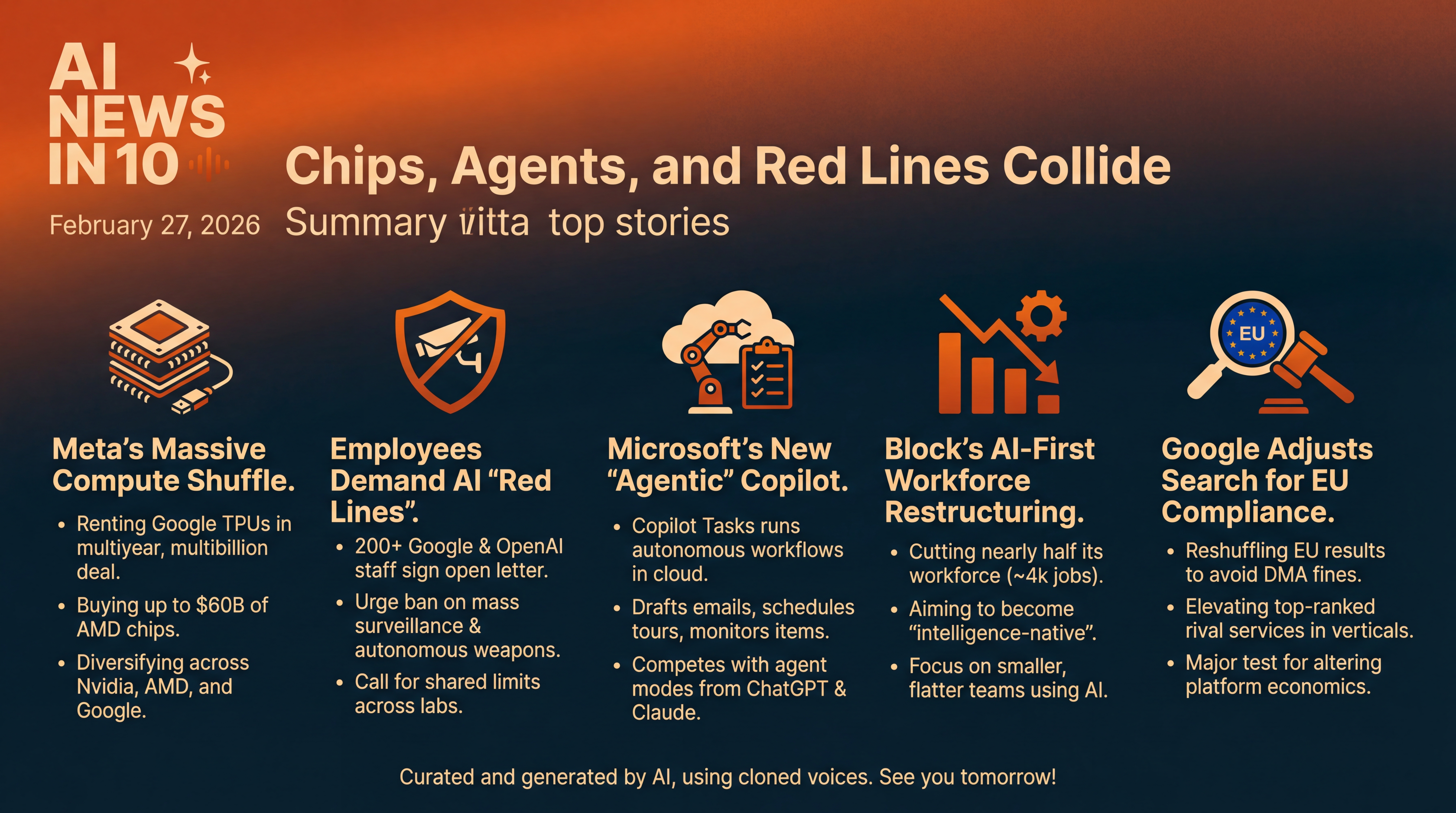
Episode Infographic
Show Notes
Welcome to AI News in 10, your top AI and tech news podcast in about 10 minutes. AI tech is amazing and is changing the world fast, for example this entire podcast is curated and generated by AI using my and my kids cloned voices...
It’s Friday, February 27. Here’s the plan for the next eight minutes... We’re starting with a major compute alliance: Meta is reportedly renting Google’s TPU chips in a multiyear, multibillion-dollar deal — and yes, this comes days after Meta’s blockbuster AMD purchase.
Then a rare cross-company moment: more than 200 workers at Google and OpenAI sign an open letter urging hard limits on military uses of AI.
We’ll move to product news with Microsoft’s new Copilot Tasks — an agent that uses its own cloud computer to get things done for you.
In business shake-ups, Jack Dorsey’s Block says it’s cutting nearly half its workforce to become "intelligence-native."
And we’ll close with policy: Google is preparing to reshuffle certain EU search results to avoid fines under the Digital Markets Act. Let’s dive in.
[BEGINNING_SPONSORS]
Story one — compute musical chairs, with billions on the line.
Meta has reportedly signed a multiyear, multibillion-dollar agreement to rent Google’s Tensor Processing Units — TPUs — to train and run its next-gen AI models. Multiple outlets have corroborated the story, and both companies declined to comment.
Reports also say Google set up a joint-venture financing arrangement with a large investment firm to lease TPUs to other customers — and that Meta is even exploring outright TPU purchases as early as next year. Earlier this week, Meta inked a deal to buy up to sixty billion dollars of AMD’s next AI chips over five years. That package includes a performance-based warrant that could grant Meta up to a ten percent equity stake in AMD if milestones are hit. That’s on top of Meta’s ongoing Nvidia orders.
So, if you’re keeping score... Meta is diversifying across all three chip suppliers, while Google pushes TPUs as a credible alternative to Nvidia’s GPUs — and as a growth engine for Google Cloud. Bottom line... capacity first, price later.
Quick note on what TPUs bring. They’re tightly integrated with Google’s software stack and interconnects, built for large-scale matrix math — great for training and serving large language models and multimodal systems. For Google, renting out TPUs monetizes years of custom silicon work. For Meta, spreading workloads across Nvidia, AMD, and Google reduces supply risk while it races toward bigger Llama releases and AI features across Facebook, Instagram, and WhatsApp.
Story two — an ethical line in the sand from inside the labs.
More than 200 current and former employees at Google and OpenAI signed an open letter supporting Anthropic’s red lines — no domestic mass surveillance of U.S. citizens, and no fully autonomous weapons — and urging their employers to adopt similar commitments. Organizers say they verified signers, and reporting points to over 160 signatures from Googlers and more than 40 from OpenAI staff as of last night.
The letter follows Google’s 2025 move to lift an internal ban on certain military AI work, and it lands amid government pressure on labs to adapt models for defense needs. This is unusual not because tech workers haven’t spoken up before, but because it’s cross-company and explicitly calls for shared limits — a kind of industry-wide solidarity plea. Whether leaders formalize those limits now becomes a reputational and recruiting question, not just a policy debate.
Signers argue that pitting one lab against another under threat of being "left out" is a divide-and-conquer tactic. They want consistent lines across labs so no single company becomes the weak link on surveillance or autonomous weapons. For customers and developers, the practical takeaway is uncertainty — if firms draw firmer red lines, some government or defense use cases could shift providers... or pause.
Story three — Microsoft’s Copilot Tasks: think of it as a background agent with its own cloud computer.
Microsoft is previewing an AI that can autonomously run routine workflows — from turning emails and images into a slide deck, to combing your inbox for urgent items and drafting replies, to monitoring new apartment listings and even scheduling tours — then reporting back when it’s done.
Crucially, it runs in Microsoft’s own cloud browser session to reduce permissions headaches on your device, and it asks for explicit consent before meaningful actions like sending messages or making payments. For now, Tasks is a limited research preview with a small test group, and there’s a public waitlist. The subtext is clear: Microsoft wants to compete directly in agentic AI, where products like ChatGPT’s agent mode, Perplexity’s computer-use feature, and Claude’s coworking tools are converging on the same idea — AI that not only writes, but acts.
There’s a governance angle here, too. As these agents read the web, click buttons, and interact with services, expect more attention on guardrails, audit logs, data provenance, and the security model for computer-use agents. Enterprises will ask for dashboards that show what the agent did, when, and why — and they’ll want easy kill switches. Microsoft’s "report of actions" is a smart start; rivals will tout similar oversight.
[MIDPOINT_SPONSORS]
Story four — a seismic bet from Jack Dorsey’s Block.
The fintech company behind Square and Cash App is cutting nearly half its workforce — more than four thousand jobs — taking headcount from more than ten thousand to under six thousand. Dorsey, in his shareholder letter and a post on X, frames this as an offensive move, not a retreat: "We’re not making this decision because we’re in trouble... the intelligence tools we’re creating and using, paired with smaller and flatter teams, are enabling a new way of working."
In short, Block wants to run leaner and more automated — an intelligence-native company. It’s a bold, controversial experiment: if efficiencies show up quickly in product velocity, margins, and new tooling for merchants, Wall Street will cheer. If they don’t, it’ll underline how hard it is to cash in AI productivity gains at company scale.
Context matters. Across software, investors are reassessing the so-called "AI scare trade" — the idea that agentic AI will gut incumbents. Nvidia’s Jensen Huang argued yesterday that markets have overreacted, suggesting AI agents will augment — not annihilate — enterprise platforms. He pointed to ServiceNow as one beneficiary. Block is effectively stress-testing that thesis inside a payments and consumer-finance stack. We’ll be watching key performance indicators like support costs per ticket, fraud-detection precision and recall, and seller onboarding time to see if the "smaller, faster" mantra delivers.
Story five — in Europe, Google is preparing to reshuffle search results to address DMA concerns... and avoid hefty fines.
According to new reporting, Google will test changes that elevate top-ranked rival services in categories like hotels, flights, restaurants, and transport — rather than defaulting to Google’s own verticals such as Google Flights.
The change will roll out in phases across Europe after the European Commission’s finding last year that Google violated the Digital Markets Act, which carries penalties up to ten percent of global revenue for non-compliance. Google had previously argued that early tests worsened user experience and raised prices... but with the DMA’s teeth, the calculus appears to be shifting. If implemented broadly, this could redirect significant traffic — and ad dollars — to aggregators and booking sites that compete with Google’s verticals.
Let’s talk implications. For developers and startups in travel and local discovery, more visibility on page one is oxygen — especially on mobile. For regulators, this is a marquee test of whether the DMA can actually alter platform economics without breaking consumer utility. And for Google, it’s another example of compliance-driven product design in Europe that may or may not spill over elsewhere. Watch for data over the next quarter on click-through shifts in EU markets.
Quick recap before we go.
Meta’s multibillion-dollar TPU rental pact with Google underscores a "use every fab and every chip" strategy for 2026’s model race. Inside the labs, Google and OpenAI employees are urging leadership to adopt Anthropic-style red lines against surveillance and autonomous weapons. Microsoft is pushing harder into true agents with Copilot Tasks, while Jack Dorsey’s Block is taking a dramatic, AI-first restructuring bet to get smaller... and faster. And in Brussels’ orbit, the DMA is nudging Google to elevate rivals in search categories that matter.
Same theme across all five: AI isn’t a single product — it’s compute strategy, culture, org design, and regulation... all moving at once.
Thanks for listening and a quick disclaimer, this podcast was generated and curated by AI using my and my kids' cloned voices, if you want to know how I do it or want to do something similar, reach out to me at emad at ai news in 10 dot com that's ai news in one zero dot com. See you all tomorrow.
