Barcelona Breakthroughs and a Washington Showdown
6G steps out with real demos at MWC as Lenovo’s modular dual-screen PC and Motorola’s Razr Fold turn heads. Plus, MediaTek aims from edge to core — and Anthropic collides with Washington in a high-stakes national-security fight.
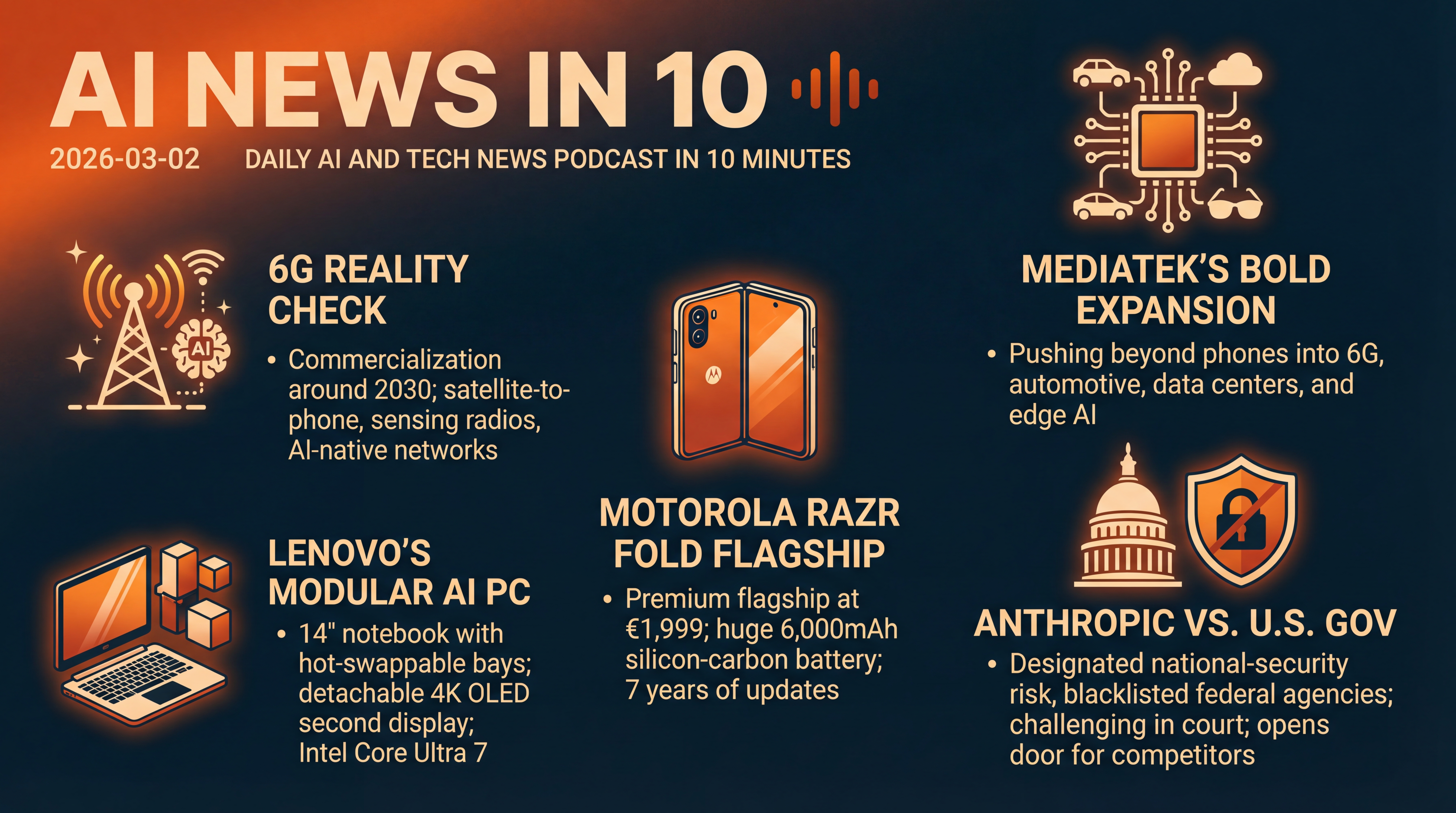
Episode Infographic
Show Notes
Welcome to AI News in 10, your top AI and tech news podcast in about 10 minutes. AI tech is amazing and is changing the world fast, for example this entire podcast is curated and generated by AI using my and my kids cloned voices...
It's Monday, March 2, 2026, and Mobile World Congress is underway in Barcelona. Today's show leans into what's breaking on the ground: 6G stepping out of the lab and into real demos... Lenovo showing a wild modular AI PC concept with a snap-on second screen... Motorola taking the gloves off with a premium Razr Fold... MediaTek staking a claim beyond phones into data centers and 6G... and back in Washington, the Anthropic–U.S. government standoff is intensifying after a national-security designation late last week. Buckle up — MWC runs March 2 through 5 this year, and there's a lot to unpack.
[BEGINNING_SPONSORS]
Let's start with the big network story: 6G. Yes, the next G is arriving... at least in prototype form.
At MWC, the conversation is shifting from slides to working hardware. Ericsson and Qualcomm say they've aligned on key 6G radio building blocks and validated them in lab prototypes — paving the way for items headed into 3GPP Release 20 during the 6G study phase. Think a 400 megahertz component carrier and new physical-layer techniques designed for wider spectrum and denser compute at the edge. Live demos are on the show floor this week — the clearest sign yet that standards work is coalescing into something you can actually see. Link in the show notes.
What might 6G feel like for the rest of us? The Verge has a solid reality check: commercialization still points to around 2030, but expect three themes — satellite-to-phone baked right into the network, sensing radios that can detect objects, and AI-native networks that use onboard intelligence to route traffic and services in real time. It's less sci-fi than 5G's early hype, and more about practical connectivity everywhere — plus a bunch of privacy debates as sensing meets the real world. Link in the show notes.
Story two: Lenovo's ThinkBook Modular AI PC concept might be the most head-turning laptop at the show. Picture a 14-inch notebook with two hot-swappable module bays — M.2-style ports where you slide in different I/O blocks like USB-A, USB-C, or HDMI. And then, the party trick... a detachable 14-inch 4K OLED second display that magnetically latches to the lid, or replaces the keyboard deck for a dual-screen setup.
Both panels run at 120 hertz and 500 nits. Inside, Lenovo is eyeing an Intel Core Ultra 7 255H, up to 32 gigabytes of RAM, and a one terabyte SSD. Wild concept — with one caveat: a 33 watt-hour battery trying to feed two power-hungry OLEDs. Even for a concept, battery life is going to be the question. But as a direction — modularity plus AI PC silicon — it's a compelling swing. Link in the show notes.
Sticking with hardware, Motorola just put serious pressure on the book-style foldable market by unveiling the Razr Fold. This is no budget play — it's a flagship — launching first in Europe at one thousand nine hundred ninety-nine euros... roughly two thousand three hundred fifty dollars... with North American availability to follow.
Specs to watch: a huge six thousand milliamp-hour silicon-carbon battery — rare on a foldable — a Snapdragon 8 Gen 5, 80-watt wired and 50-watt wireless charging, and a 50-megapixel main camera with a stabilized three times optical zoom. There's also an ultrawide lens with a one hundred twenty-two degree field of view that doubles as a macro. Motorola's also committing to up to seven years of software and security updates — table stakes, and then some, for a device this pricey. If you've been waiting for a non-Samsung, pen-friendly big foldable, this is the most credible alternative we've seen in a while. Link in the show notes.
[MIDPOINT_SPONSORS]
Next up, a strategic pivot that could reshape the chip pecking order. MediaTek used day one of MWC to lay out ambitions well beyond phones — 6G research with AI baked into the fabric of the network, new 5G-Advanced CPE — those home and enterprise gateways — alongside Wi-Fi 8, automotive platforms, AI glasses, and... a push into data center infrastructure. For a company best known for smartphone systems on chips, that's a notable scope expansion — especially as carriers, carmakers, and cloud vendors look for suppliers who can straddle edge devices and the core. The timing is savvy too — vendors like Ericsson are convening 6G demos with device and silicon partners this week, underscoring how the ecosystem is shaping up. Link in the show notes.
If you're wondering why everyone's suddenly talking about on-device and edge AI alongside 6G, it's because the next decade of connectivity is less about raw downlink speeds and more about local intelligence — squeezing latency, personalizing experiences, and avoiding back-and-forth with the cloud when it's not necessary. In that world, a company that can ship phone-class silicon, automotive platforms, and edge boxes has a shot at outsized influence. MediaTek clearly wants that shot. Link in the show notes.
And finally, the policy story dominating U.S. tech headlines as we start the week: Anthropic versus the federal government. Late Friday, the administration designated Anthropic — maker of the Claude models — a national-security supply-chain risk, immediately blacklisting its tech across federal agencies and cutting it off from defense work. Anthropic says it will challenge the move in court, calling it unprecedented and legally unsound.
The crux of the dispute: the company's stance against letting its AI be used for fully autonomous weapons or mass surveillance without human oversight — positions that clash with the Pentagon's push to deploy adaptable AI tools under its own rules. Over the weekend and into today, commentary has sharpened on both sides, and investors and rivals are gaming out what comes next. Link in the show notes.
Practically, the designation is a very big deal. It freezes Anthropic out of federal procurement, complicates work with defense contractors, and could reverberate into commercial accounts that mirror federal standards. It also opens room for competitors — OpenAI, Google, and xAI among them — to scoop up displaced contracts if they're willing to meet the government's terms. Expect court filings soon, and watch how enterprise customers react this week — many have compliance policies linked to federal lists. Link in the show notes.
Quick recap before we go. 6G is moving from concept to hardware demos at MWC — with AI-native networks, satellite links, and sensing on the roadmap. Lenovo's modular, dual-screen ThinkBook concept hints at a more flexible, AI-forward PC future. Motorola's Razr Fold arrives as a true flagship with a giant silicon-carbon battery and long-term support. MediaTek is expanding from phones to cars, edge devices, and even data center infrastructure. And in Washington, an unprecedented national-security designation has put Anthropic on a collision course with the U.S. government. We'll keep tracking the fallout — and everything else breaking in Barcelona — throughout the week. Link in the show notes.
Thanks for listening and a quick disclaimer, this podcast was generated and curated by AI using my and my kids' cloned voices, if you want to know how I do it or want to do something similar, reach out to me at emad at ai news in 10 dot com that's ai news in one zero dot com. See you all tomorrow.
