M5 Macs, Crisper ChatGPT, and Power Pledge
Apple rolls out M5-powered Macs as OpenAI makes ChatGPT more direct, Microsoft brings Build back to San Francisco, the White House pushes a data center power pledge, and Congress sharpens its focus on China’s AI moves. A fast, clear rundown with key dates, prices, and why it matters.
Episode Infographic
Show Notes
Welcome to AI News in 10, your top AI and tech news podcast in about 10 minutes. AI tech is amazing and is changing the world fast, for example this entire podcast is curated and generated by AI using my and my kids cloned voices...
It’s Wednesday, March 4th. Here’s what’s shaping the AI and tech landscape today... Apple’s new Macs land with fresh silicon and bigger on-device AI claims. OpenAI tweaks ChatGPT’s default model to feel less stiff — and more to the point. Microsoft shifts its Build developer conference back to San Francisco. The White House convenes tech giants on a pledge to keep AI data center power costs off consumer bills. And on Capitol Hill, a new letter presses the Pentagon to probe China’s AI playbook. Let’s dive in.
[BEGINNING_SPONSORS]
First up, Apple’s Mac lineup just took a sizable leap.
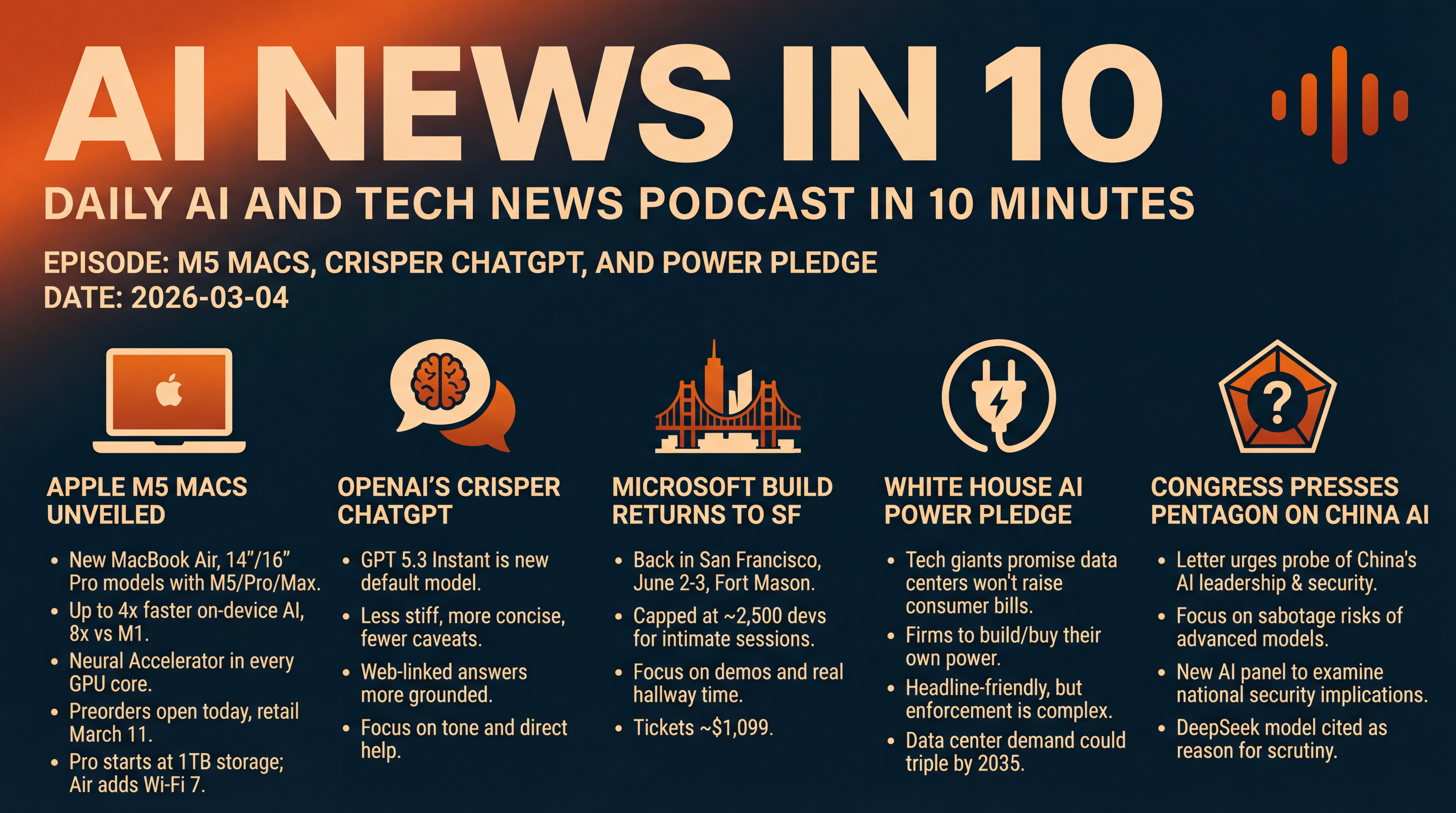
Apple unveiled a new MacBook Air with the M5 chip, plus refreshed 14- and 16-inch MacBook Pro models running M5 Pro and M5 Max — both with an 18-core CPU architecture, next-gen GPUs, and what Apple calls a Neural Accelerator baked into every GPU core. Apple’s positioning is all about on-device AI: it’s claiming up to 4x faster AI performance versus last generation on the Pro and Max — and up to 8x versus early M1-era machines. The Pro models now start at 1TB of storage — 2TB if you step up to M5 Max — while the Air doubles its base storage to 512GB and adds Wi-Fi 7 and Bluetooth 6 via a new N1 wireless chip. Preorders open today, March 4th, with retail availability on March 11th. The 13-inch Air starts at $1,099, and the 14-inch MacBook Pro with M5 Pro starts at $2,199. Apple wants “AI laptop” to mean “a Mac that can run heavy local models and creative workflows without the cloud” — and today’s faster SSDs and higher memory bandwidth are meant to back it up.
If you’re wondering how this plays in day-to-day use, Apple’s talking up things like local LLM prompts, faster video enhancement, ray-traced 3D work, and app launches under load. It reframes the Mac not just as a thin-and-light productivity box, but as an AI workstation you can carry... Again — preorders today, units next Wednesday, March 11th.
Second, OpenAI has quietly — but meaningfully — changed the feel of ChatGPT. The company rolled out GPT 5.3 Instant as the new default model, focused less on benchmark fireworks and more on tone, refusals, and web-linked answers that don’t meander. In OpenAI’s words, this update trims the long caveats and dead ends people complain about, with responses that are more accurately grounded when search is involved — and smoother in conversation. TechRadar summed it up with a promise to “reduce the cringe” — fewer unnecessary disclaimers, more direct help. If you use ChatGPT daily, you may notice it simply feels less preachy and more concise.
Zooming out a bit, OpenAI has also been experimenting with faster, specialized models on alternative hardware. Two weeks ago it previewed GPT 5.3 Codex Spark running on Cerebras wafer-scale chips for real-time coding — signaling a broader push to diversify inference compute beyond Nvidia for certain workloads. That won’t change your chat experience today, but it hints at a future where speedier, purpose-built models power specific tasks alongside the big general models.
Third, Microsoft’s Build developer conference is on the move — again. After years in Seattle, Build 2026 returns to San Francisco on June 2 and 3 at Fort Mason, with attendance capped around 2,500 developers for a tighter, demo-heavy vibe. Microsoft is angling for intimate sessions and real hallway time with engineers and speakers — rather than a sprawling product announcement circus. In-person tickets are set at about $1,099. It’s another sign of the Bay Area’s gravitational pull around AI tooling and startups — and a chance for GitHub and Azure teams to meet devs where the energy is hottest.
[MIDPOINT_SPONSORS]
Fourth, energy politics meets AI scale. The White House is hosting major tech companies today — Amazon, Google, Meta, Microsoft, OpenAI, Oracle, and xAI — to formalize a “Ratepayer Protection Pledge.” The idea: as AI data centers mushroom, these firms would build, bring, or buy their own power so residential electricity bills don’t climb to subsidize hyperscaler demand.
It’s a headline-friendly promise, and it comes as federal officials pump billions into new generation and grid upgrades to handle the surge in load. But here’s the nuance: analysts caution that pledges alone won’t untangle how costs flow through state-regulated utilities. Industry estimates say data center electricity demand could roughly triple by 2035 — to more than 100 gigawatts — raising tough questions about natural gas turbine supply, siting, and timelines for nuclear or renewables. So, today’s signatures may be more political signal than binding solution... but they set the tone for how Big Tech will be pressed to shoulder the power tab for AI.
We’ve seen this drumbeat building for days. Coverage has flagged who’s attending, how the pledge mirrors earlier voluntary commitments by firms like Microsoft, and why enforcement is the sticking point. Watch for follow-up details from the administration on verification and scope — particularly how leased capacity in third-party facilities is treated.
And fifth, Washington’s attention keeps swiveling toward Beijing’s AI trajectory. In a letter obtained by Axios, Senator Jim Banks of Indiana urged Defense Secretary Pete Hegseth — and the Pentagon’s new Artificial Intelligence Futures Steering Committee — to map China’s AI leadership, examine its security practices, and game out what sabotage of advanced AI models might look like. The panel was set up under the fiscal 2026 defense bill to ask the big questions of AI adoption in national security. Banks points to last year’s surprise around China’s DeepSeek model as a reason to tighten the watch — and to avoid getting caught flat-footed as AI capabilities accelerate. Expect more letters and hearings as Congress triangulates between innovation, resilience, and guardrails... with China front and center in that debate.
Quick recap before we go. Apple’s M5-class Macs are here, with a clear on-device AI performance message and preorders starting today... OpenAI’s default ChatGPT gets a tone and grounding refresh with GPT 5.3 Instant... Microsoft brings Build back to San Francisco for a tighter, AI-centric gathering June 2 and 3... the White House corrals tech giants to promise their AI data centers won’t push up your power bill — though the policy mechanics are complex... and on Capitol Hill, a fresh letter presses the Pentagon’s new AI panel to scrutinize China’s AI leaders and model sabotage risks. That’s your AI News in 10 for March 4th.
Thanks for listening and a quick disclaimer, this podcast was generated and curated by AI using my and my kids' cloned voices, if you want to know how I do it or want to do something similar, reach out to me at emad at ai news in 10 dot com that's ai news in one zero dot com. See you all tomorrow.
