GPT 5.4 Drops, Nvidia Pivots, OpenTitan Ships
OpenAI rolls out GPT 5.4 with a new Thinking mode and spreadsheet tools, while Nvidia shifts capacity to its Vera Rubin platform. Plus, OpenTitan hits production, Vietnam enacts its AI law, and Broadcom’s blowout quarter signals red-hot AI infrastructure demand.
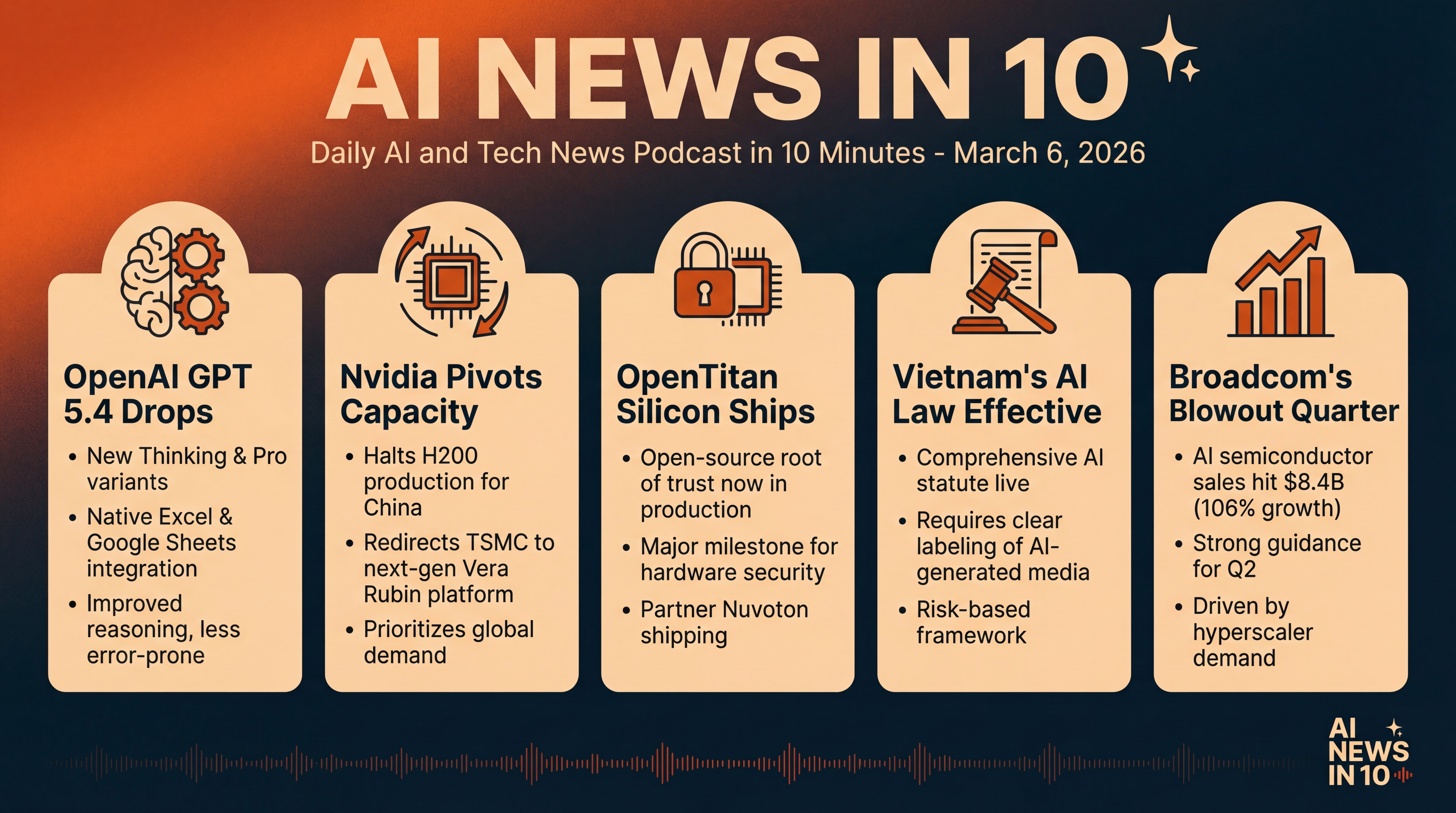
Episode Infographic
Show Notes
Welcome to AI News in 10, your top AI and tech news podcast in about 10 minutes. AI tech is amazing and is changing the world fast, for example this entire podcast is curated and generated by AI using my and my kids cloned voices...
It’s Friday, March 6th, and we’ve got a stacked lineup.
OpenAI just rolled out GPT 5.4, with new Thinking and Pro variants, plus handy tools that let ChatGPT work right inside Excel and Google Sheets. Nvidia, meanwhile, is reportedly halting production of H200 chips bound for China, redirecting precious TSMC capacity to its next-gen Vera Rubin platform... a big signal about where demand is headed. On the open hardware front, Google says the OpenTitan security chip is now shipping in production — an important milestone for open-source silicon. We’ll also touch on Vietnam’s first comprehensive AI law, now in effect and requiring labels for AI-generated media, and we’ll wrap with Broadcom’s blowout AI quarter and fresh guidance.
[BEGINNING_SPONSORS]
Let’s start with the big model drop. OpenAI launched GPT 5.4 yesterday, positioning it squarely for professional and knowledge-work tasks. There are two main variants — GPT 5.4 Pro, built for maximum capability, and GPT 5.4 Thinking, which exposes more of its step-by-step reasoning and can be steered mid-thought to change course. OpenAI says it’s less error-prone and better at sustained, complex work. The new models are available in ChatGPT and the API as of March 5.
For everyday workflows, first — native spreadsheet help. OpenAI highlighted tools that let the chatbot operate directly in Excel and Google Sheets: cleaning data, generating formulas, building quick dashboards... without copy-pasting between apps. If your week lives in rows and columns, that matters. Tech press coverage frames the release as targeting workplace adoption, with the Thinking mode a standout for long, multi-step tasks.
A few other tidbits. OpenAI says 5.4 is more efficient with its thinking tokens, and early write-ups point to incremental benchmark gains over 5.2 — especially on complex, tool-using tasks. Rollout is underway across ChatGPT tiers and the API.
Next up — Nvidia and the geopolitics of AI chips. Multiple outlets report that Nvidia has halted production of H200 GPUs intended for China and is reallocating that TSMC capacity to its forthcoming Vera Rubin platform. The move comes as H200 exports face added scrutiny and shifting conditions, while demand for Nvidia’s next generation remains ferocious. H200 output for China is paused, capacity is shifting to Rubin, and supply is being aligned with expected global demand. It’s a reminder that export rules, customer uncertainty, and the race to next-gen architectures are now tightly linked.
If you’ve lost the plot on Nvidia’s roadmap names — Rubin is the family that follows Blackwell, due later this year and into 2027 across various form factors. Putting scarce TSMC allocation behind Rubin instead of a China-specific H200 variant tells you exactly where Nvidia sees the clearest revenue line — and the least regulatory friction. There’s also broader market chatter around the White House pushing the industry to help fund new power generation for AI data centers... the other constraint in the room.
Number three today is big for open hardware security. Google says OpenTitan — the open-source silicon root of trust — has moved from years of collaborative development to shipping in production as of March 4. That’s a watershed moment for the idea that trustworthy hardware primitives don’t have to be closed. The OpenTitan project, stewarded by lowRISC, has emphasized auditable design, broad community review, and vendor-agnostic adoption. Partner Nuvoton is among the first with production silicon, and Google points to deployments in Chromebooks. For device makers worried about supply chain integrity and verifiable boot, this is a credible, open alternative to proprietary roots of trust.
Why should software teams care? Because the trust stack starts below your OS. If your root of trust is open, audited, and reproducible, it’s easier to validate firmware, detect tampering, and align your compliance story with regulators who increasingly want attestations all the way down. Today’s milestone means OpenTitan isn’t just a research project — it’s an option you can spec into real products.
[MIDPOINT_SPONSORS]
Story four — Vietnam has officially flipped the switch on its AI law, effective March 1. It’s the country’s first comprehensive, stand-alone AI statute, and it lands with some very concrete requirements — most notably, clear labeling of AI-generated images, audio, and video so they’re distinguishable from real content. The law also sets out a risk-based framework, governance duties, and — in serious abuse cases — potential criminal liability under existing penal provisions. There are grace periods for many providers until March 1, 2027, with sector-specific extensions, and the Ministry of Science and Technology has started issuing draft guidance on labeling and controlled testing.
Two practical takeaways. First, content authenticity tech — watermarks, C2PA metadata, provenance logs — just moved from nice-to-have to baseline in another fast-growing market. Second, user-facing transparency is no longer optional: businesses must disclose when users interact with automated systems and be prepared to show documentation around risk management. Depending on your vertical — health, education, finance — grace periods may extend into late 2027, but the clock has started.
And finally, Broadcom just provided a clean window into AI infrastructure demand with its fiscal first-quarter results on March 4. Revenue hit 19.3 billion dollars, up 29 percent year over year, led by AI semiconductor sales of 8.4 billion — 106 percent growth — driven by custom accelerators and AI networking for hyperscalers. Management guided second-quarter revenue to about 22 billion, implying 47 percent growth, and also authorized an additional 10 billion dollar share repurchase program. If you’re tracking the build-out of AI data centers, this is the tell: massive, sustained orders for accelerators, switch silicon, and high-bandwidth interconnects are still flowing.
One nuance worth noting. Broadcom’s outperformance is increasingly tied to custom silicon programs for a handful of very large customers. That mix carries different margin and concentration dynamics than selling merchant chips at scale, but it also suggests those customers are committing to multi-year roadmaps with tight co-design cycles — ringside seats to the next wave of AI architectures. Guidance and commentary on the call made that point clear.
Quick recap before we go. OpenAI’s GPT 5.4 is here, tuned for professional work and rolling into ChatGPT and the API — with new Excel and Google Sheets hooks to match. Nvidia is prioritizing its Vera Rubin platform, reportedly pausing China-bound H200 production as export uncertainties drag on. OpenTitan crossed a milestone and is now shipping in production, bringing open-source silicon to the root of trust. Vietnam’s AI law is live, with media labeling and a risk-based regime that will shape regional deployments. And Broadcom’s quarter shows AI infrastructure spend is still in overdrive.
Thanks for listening and a quick disclaimer, this podcast was generated and curated by AI using my and my kids' cloned voices, if you want to know how I do it or want to do something similar, reach out to me at emad at ai news in 10 dot com that's ai news in one zero dot com. See you all tomorrow.
