
Age Gates, Netflix’s AI, and Rocket Pivots
From Indonesia’s under‑16 social media ban to Netflix’s acquisition of Ben Affleck’s AI post startup, we break down the day’s biggest moves — plus a UK copyright push, NASA’s SLS pivot, and a fresh Starlink flight.
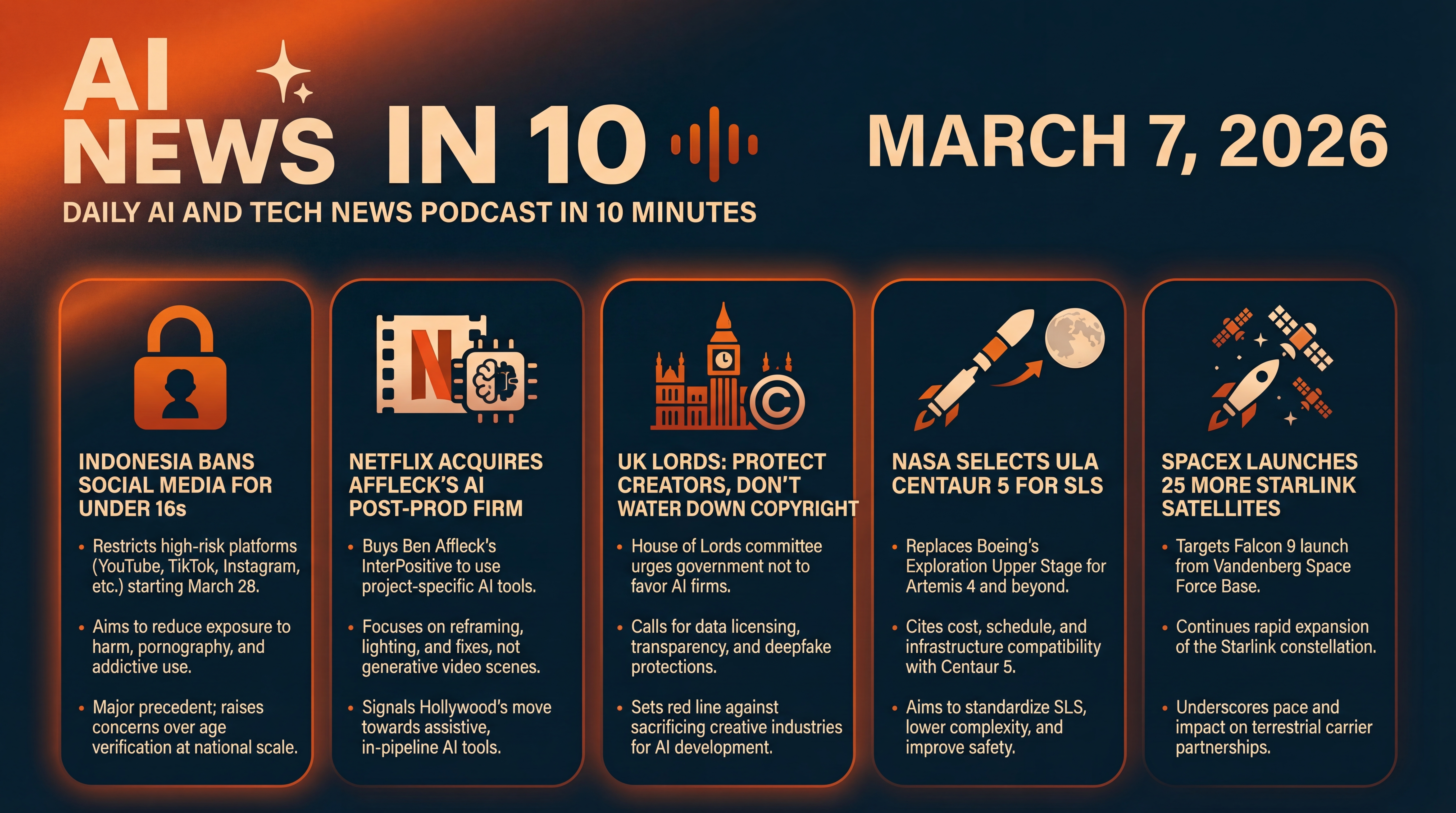
Episode Infographic
Show Notes
Welcome to AI News in 10, your top AI and tech news podcast in about 10 minutes. AI tech is amazing and is changing the world fast, for example this entire podcast is curated and generated by AI using my and my kids cloned voices...
It’s Saturday, March 7, 2026, and we’ve got a brisk run of big developments across AI, media, and space. Indonesia just drew a firm line on kids and social media, Netflix made an unexpected AI move, the UK is warning against trading away creators’ rights, and in space, NASA is reshaping SLS while SpaceX lines up another Starlink flight. Let’s get into it...
[BEGINNING_SPONSORS]
Story one. Indonesia will restrict children under 16 from creating or keeping accounts on what the government labels high‑risk platforms — YouTube, TikTok, Instagram, Facebook, Threads, X, Bigo Live, Roblox, and others. The minister says the rule is signed and rolling out starting March 28, with platforms expected to comply in phases. The goals are clear: reduce exposure to pornography, cyberbullying, fraud, and addictive use.
It’s a major escalation in the debate over age‑gating and social harms — following moves in Australia and discussions in Denmark and the UK. We’ll be watching how platforms verify ages, how appeals work, and what kind of enforcement teeth show up. Sources include the Associated Press and The Guardian.
A quick reality check. Age verification at national scale is thorny... ID checks, parental consent flows, and the risk of pushing kids toward darker corners of the web. And for platforms, a phased deactivation of under‑16 accounts — that’s nontrivial product and policy engineering. Still, it’s a meaningful precedent in one of the world’s largest internet markets, and the countdown to March 28 starts now.
Story two. Netflix has acquired InterPositive — Ben Affleck’s AI post‑production startup. Affleck says he founded the company in 2022 to build tools trained only on a project’s own footage — reframing shots, correcting bad lighting, removing stunt wires — while guarding creative intent, not generating entire scenes from text prompts. Netflix content chief Bela Bajaria frames the buy as expanding creative freedom, not replacing crews. Affleck will join as a senior advisor.
The signal is striking. After a year of Hollywood angst about AI, Netflix is betting that targeted, in‑pipeline tools can shave time and budget while staying inside union and IP boundaries... or at least closer to them. That’s a very different posture from headline‑grabbing generative video. Source: The Guardian’s detailed report, including the “not about text prompting” emphasis and Bajaria’s quote.
Two practical implications. First, expect these assistive tools to become standard across studios — fix‑it pipelines are easier to adopt than full‑on generative video. Second, look for clearer contract language around training data — project‑scoped, rights‑cleared footage only. That should reduce legal friction while keeping AI wins squarely in editorial and finishing.
Story three. In Westminster, the House of Lords Communications and Digital Committee is urging the UK government not to water down copyright to favor AI firms. The report calls for licensing of training data, transparency about which datasets are used, and stronger protections for creators against deepfakes. It also notes the creative industries contribute about 146 billion pounds to the UK economy, and sets a near‑term date — March 18 — for the government to publish the impact assessment on its proposed changes.
The headline here is the red line: don’t sacrifice the arts for AI jam tomorrow. Expect this to shape how the EU and the UK diverge on AI data use — and influence how global models source content. Source: The Guardian’s coverage of the report and deadlines.
[MIDPOINT_SPONSORS]
Story four. NASA has selected United Launch Alliance’s Centaur 5 as the new upper stage for the Space Launch System starting with Artemis 4, targeting no earlier than 2028. Contract filings published Friday confirm a shift away from Boeing’s Exploration Upper Stage — citing cost and schedule concerns — toward a stage with deep RL10 engine heritage and compatibility with the existing Mobile Launcher 1 infrastructure.
NASA leadership casts the move as standardizing SLS — lowering complexity, pulling hardware forward to raise cadence, and improving safety. Blue Origin’s New Glenn Stage 2 was analyzed but, according to NASA, would have required significant modifications to the stage and ground systems. It’s a big architectural pivot that should clarify mass‑to‑Moon planning for the late‑2020s manifest. Source: Spaceflight Now’s March 7 report, drawing on federal procurement documents and NASA statements.
Story five. Eyes on the West Coast skies... SpaceX is targeting a Falcon 9 launch from Vandenberg Space Force Base today to add 25 more satellites to the Starlink constellation. The Starlink 17‑18 mission is scheduled for 6:33 a.m. Pacific — 9:33 a.m. Eastern — 14:33:30 UTC — with the booster flying its seventh mission.
It’s another brick in a torrid Starlink pace this year. It also underscores why terrestrial carriers are eyeing direct‑to‑cell partnerships — and why regulators are revisiting spectrum use. Live coverage details and timing come from Spaceflight Now’s launch desk.
Before we wrap, a couple of tie‑offs. If you’re tracking the Indonesia policy, enforcement starts March 28 — and today is March 7 — so platforms have just three weeks to stand up new controls. We’ll keep you posted on compliance moves and any legal challenges.
And on NASA’s Centaur 5 selection, the knock‑on questions are schedule and payload flexibility. Shifting upper stages affects what can ride to the Moon and when — expect updated Artemis timelines in the coming months.
That’s it for today. To recap... Indonesia sets a firm age‑16 floor for major social apps... Netflix buys Ben Affleck’s InterPositive to bring AI into post‑production without full generative video... UK peers push for licensing and transparency around creator data... NASA standardizes SLS with ULA’s Centaur 5 for Artemis 4 and beyond... and SpaceX aims to loft another 25 Starlinks from Vandenberg this morning. Enjoy the rest of your weekend — we’ll see you tomorrow with the next round of AI and tech headlines.
Thanks for listening and a quick disclaimer, this podcast was generated and curated by AI using my and my kids' cloned voices, if you want to know how I do it or want to do something similar, reach out to me at emad at ai news in 10 dot com that's ai news in one zero dot com. See you all tomorrow.
