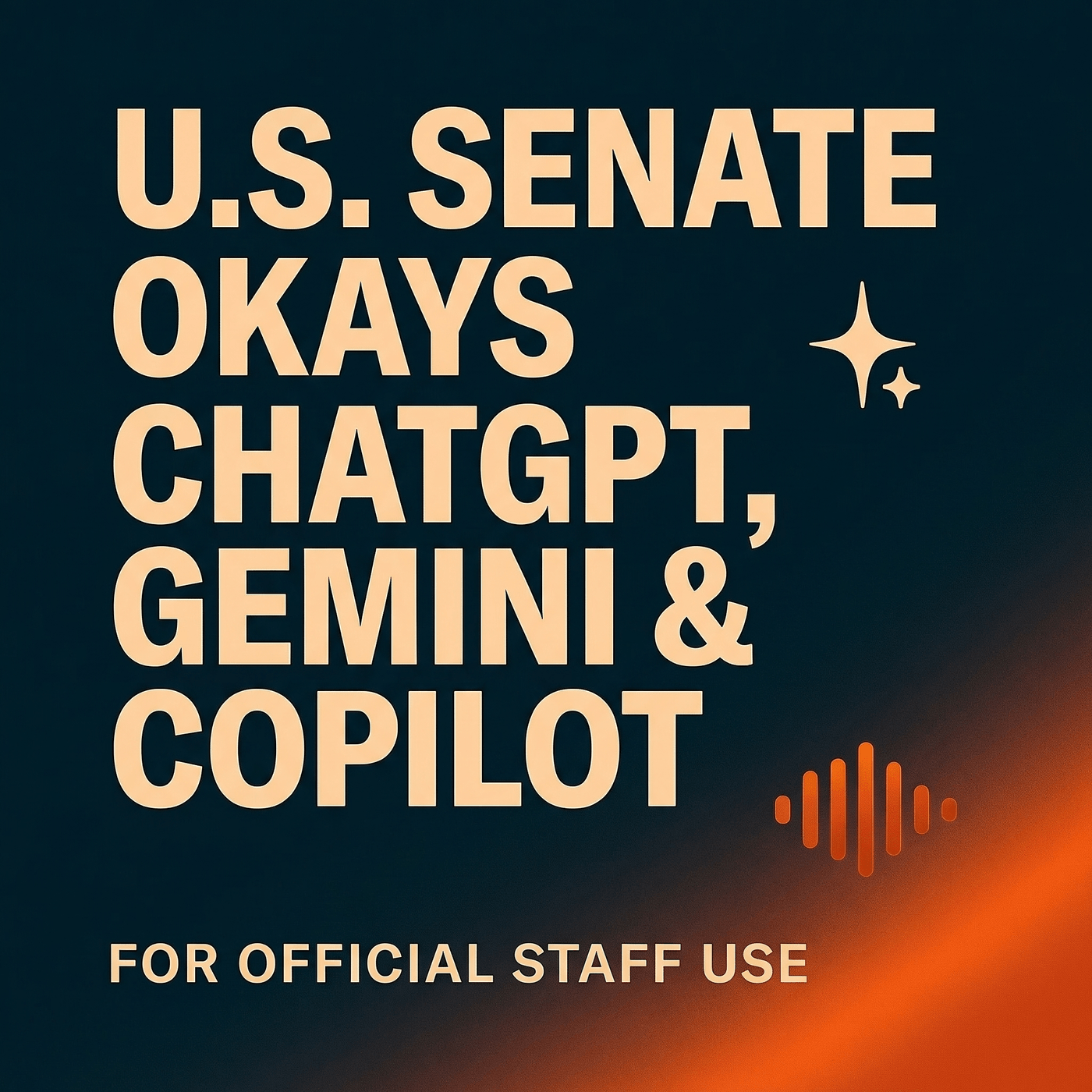
From Greenlights to Coworkers: AI’s Busy Week
We cover Washington’s new AI policy for Senate staff, Microsoft’s Copilot Cowork agent, Google’s Gemini upgrades in Workspace, edge AI momentum from Embedded World, and SXSW’s AI-heavy kickoff. Hear why these moves matter for compliance, workflows, and the year ahead.
Episode Infographic
Show Notes
Welcome to AI News in 10, your top AI and tech news podcast in about 10 minutes. AI tech is amazing and is changing the world fast, for example this entire podcast is curated and generated by AI using my and my kids cloned voices...
It’s Thursday, March 12, 2026 — and today’s a big one.
Washington just gave congressional staff a green light to use mainstream AI chatbots. Microsoft is pushing Copilot beyond chat into real task execution. Google is weaving more Gemini across Docs, Slides, and Drive. Europe’s Embedded World closes with edge AI in the spotlight. And SXSW 2026 kicks off in Austin with AI threaded through the week ahead.
Let’s get into it...
[BEGINNING_SPONSORS]
Story one — a policy milestone in D.C.
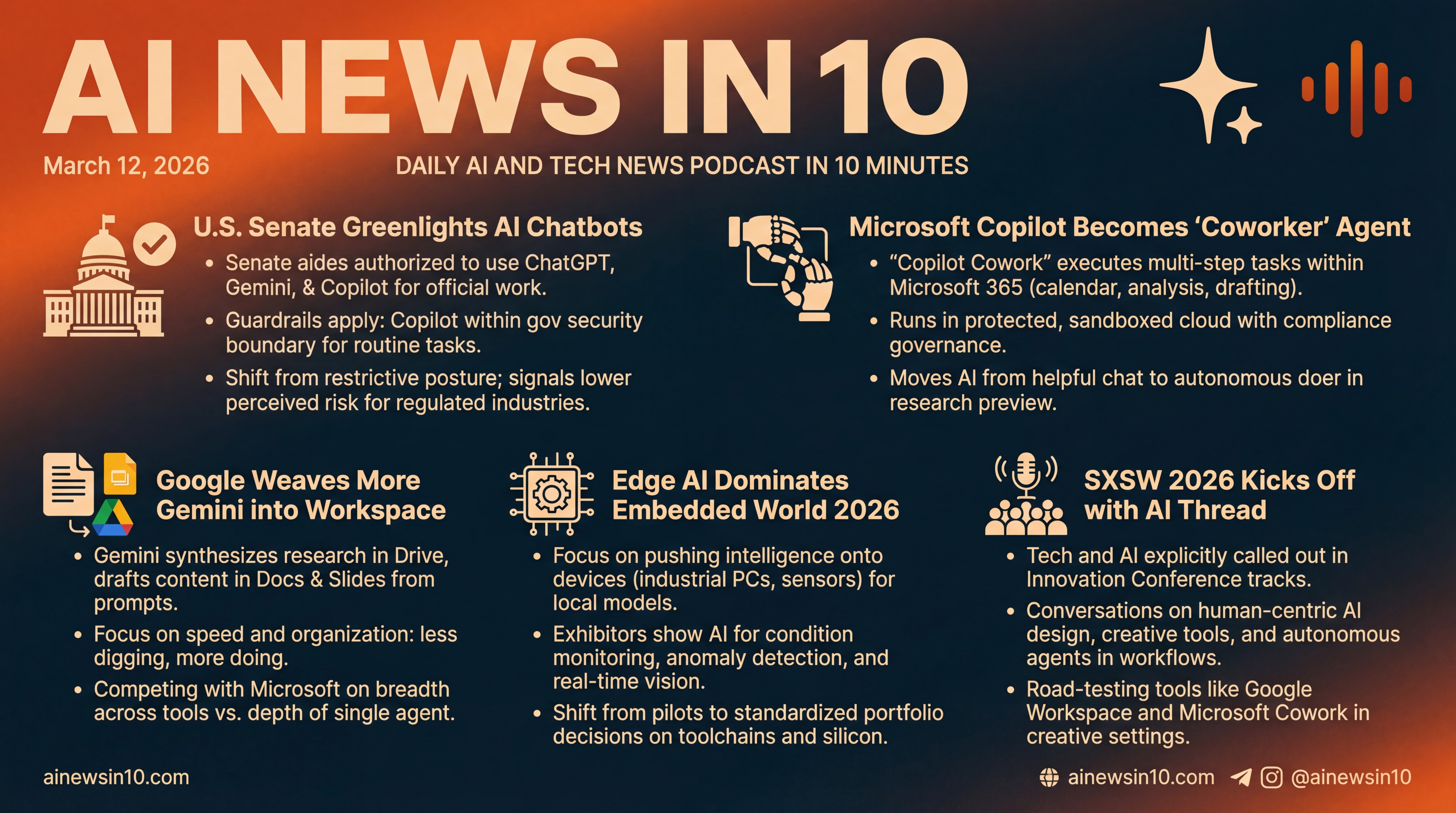
The U.S. Senate quietly authorized aides to use three major AI chatbots — OpenAI’s ChatGPT, Google’s Gemini, and Microsoft Copilot — for official Senate work this week. The approval came in a memo from the Senate Sergeant at Arms’ IT team, and it puts guardrails front and center. Copilot stays inside Microsoft 365’s government-grade security boundary, and usage is limited to routine drafting, editing, summarization, research, and talking-points prep. These tools are framed as productivity boosters — not decision makers. That’s a meaningful shift from the tighter posture we saw a year ago.
Why it matters... Federal adoption is often a bellwether for enterprises with strict compliance needs. When the Senate says these tools are safe enough — with the right data protections — it lowers the perceived risk for regulated industries considering similar deployments. Expect follow-on guidance to standardize things like citation hygiene, model choice by task, and disclosure when AI assists in official documents. And with the House and agencies weighing their own playbooks, today’s step could ripple across government IT in the months ahead.
Story two — Microsoft shifts Copilot from helpful chat to hands-on coworker.
The company introduced Copilot Cowork — an agent that doesn’t just answer questions, it carries multi-step tasks through to completion inside the Microsoft 365 universe. Think about reshuffling a jam-packed calendar to create focus time, compiling a competitive analysis in Excel, pulling emails and meetings to auto-draft a project launch plan, and building a first-cut slide deck with citations — all governed by your identity and compliance policies. Microsoft says Cowork runs in a protected, sandboxed cloud so work continues as you hop devices. It’s in research preview with selected customers now, expanding later this month through its Frontier program. If the trials hold up, this is the clearest move yet from copilots to truly autonomous doers at work.
Two quick takeaways. First, the compliance story is doing as much heavy lifting as the features — enterprises will ask where data lives, what audit trails look like, and how the system respects information barriers.
Second, the task catalog matters. Early wins will likely be time-consuming but well-bounded workflows — quarterly update prep, RFP redlines, or customer briefing packets — where speed and structure beat open-ended creativity.
Story three — Google keeps raising the everyday AI ante inside Workspace.
New Gemini updates rolling out this week let you ask Drive to synthesize research across your files, have Docs and Slides draft content from short prompts, and more easily find and assemble material for school or work projects. In Google’s words, this is about spending less time digging and more time doing — with examples like drafting a life-update slide from a few inputs, or asking Gemini to summarize everything you’ve collected on sleep science and hand back a structured outline. For students, teams, and solo makers, the through-line is speed plus organization.
What to watch... The competitive dynamic with Microsoft’s Cowork. Google’s push is breadth across familiar tools — search-like retrieval within Drive plus quick drafting. Microsoft’s push is depth — a single agent that coordinates many steps. Users will likely blend both patterns: quick generate-and-polish for simple artifacts, and longer multi-step agents for complex deliverables. Also watch the governance angle — as more of your corpus is reachable by AI, admins will tighten DLP and labeling to prevent accidental oversharing across teams.
[MIDPOINT_SPONSORS]
Story four — edge AI gets a growth spurt in Nuremberg.
Embedded World 2026 wraps today, and organizers say this year’s show expanded again: 1,262 exhibitors from 43 countries spread across seven halls and roughly 34,000 square meters of space. The dominant theme was pushing more intelligence onto devices — industrial PCs, sensor modules, and low-power accelerators — so models can run locally for latency, privacy, and cost. Exhibitors highlighted AI-enabled condition monitoring on factory lines, on-device anomaly detection, and real-time vision at the edge for robotics and logistics. If last year was “pilot everywhere,” this year looked like “portfolio decisions” — standardizing on toolchains and silicon across product lines.
A quick tour of the ecosystem tells the story. Vendors from Intel-ecosystem partners to specialized board and system makers showcased updated COM-HPC modules, rugged edge boxes, and dev kits aimed at getting from prototype to production faster — all while squeezing more TOPS per watt. The momentum reflects a broader shift: not every AI workload belongs in a hyperscale data center. For many industrial and smart-city cases, local inferencing with periodic cloud sync is winning on responsiveness, resilience, and total cost.
Story five — SXSW 2026 opens today, with AI threaded across the program through March 18.
The Innovation Conference tracks explicitly call out Tech and AI, and the organization is streaming a slate of sessions throughout the week. Expect conversations on human-centric AI design, creative tools, and what autonomous agents mean for marketing, media, and startup workflows — the full culture-meets-code mashup SXSW is known for. If you’re on the ground, AI is also woven through exhibitions and meetups. If you’re remote, the livestream will carry several of the big talks.
Why SXSW matters right now... It’s where big-company roadmaps meet scrappy builder energy. With Google’s Workspace upgrades landing this week and Microsoft’s Cowork entering preview, watch for panels and workshops that road-test these tools in creative pipelines, classroom settings, and startup ops. This is also a read on sentiment — are teams leaning into agents for end-to-end work, or still preferring assistive snippets embedded in their apps? The answers will shape which product approaches win the next twelve months.
That’s a wrap.
Today’s takeaways... The U.S. Senate’s green light signals growing institutional comfort with mainstream chatbots. Microsoft is steering Copilot toward real task execution while stressing compliance. Google’s Gemini continues to blend search, synthesis, and drafting across Workspace. Edge AI is graduating from pilots to platform choices as Embedded World 2026 closes. And SXSW opens with AI at center stage — giving us an early look at how teams will actually use all of this. See you tomorrow.
Thanks for listening and a quick disclaimer, this podcast was generated and curated by AI using my and my kids' cloned voices, if you want to know how I do it or want to do something similar, reach out to me at emad at ai news in 10 dot com that's ai news in one zero dot com. See you all tomorrow.
