Gigawatt Deals, Trillion Chips, and Power Pledges
From Nvidia’s gigawatt training pact to a near-trillion-dollar chip market, we unpack how AI is reshaping compute, costs, and the grid. Plus, PC pain from soaring memory prices and a telecom-linked breach spotlight third-party risk.
Episode Infographic
Show Notes
Welcome to AI News in 10, your top AI and tech news podcast in about 10 minutes. AI tech is amazing and is changing the world fast, for example this entire podcast is curated and generated by AI using my and my kids cloned voices...
Here’s what’s shaping AI and tech today — Saturday, March 14, 2026. A new mega-compute pact hints at the next wave of frontier AI training... the chip industry just posted a record year and is eyeing that trillion-dollar milestone... PC makers are bracing for a painful 2026 as memory prices spike... Washington’s latest move to keep AI’s energy tab off your utility bill lands on the industry... and a fresh enterprise data breach reminds us that security hygiene still matters.
[BEGINNING_SPONSORS]
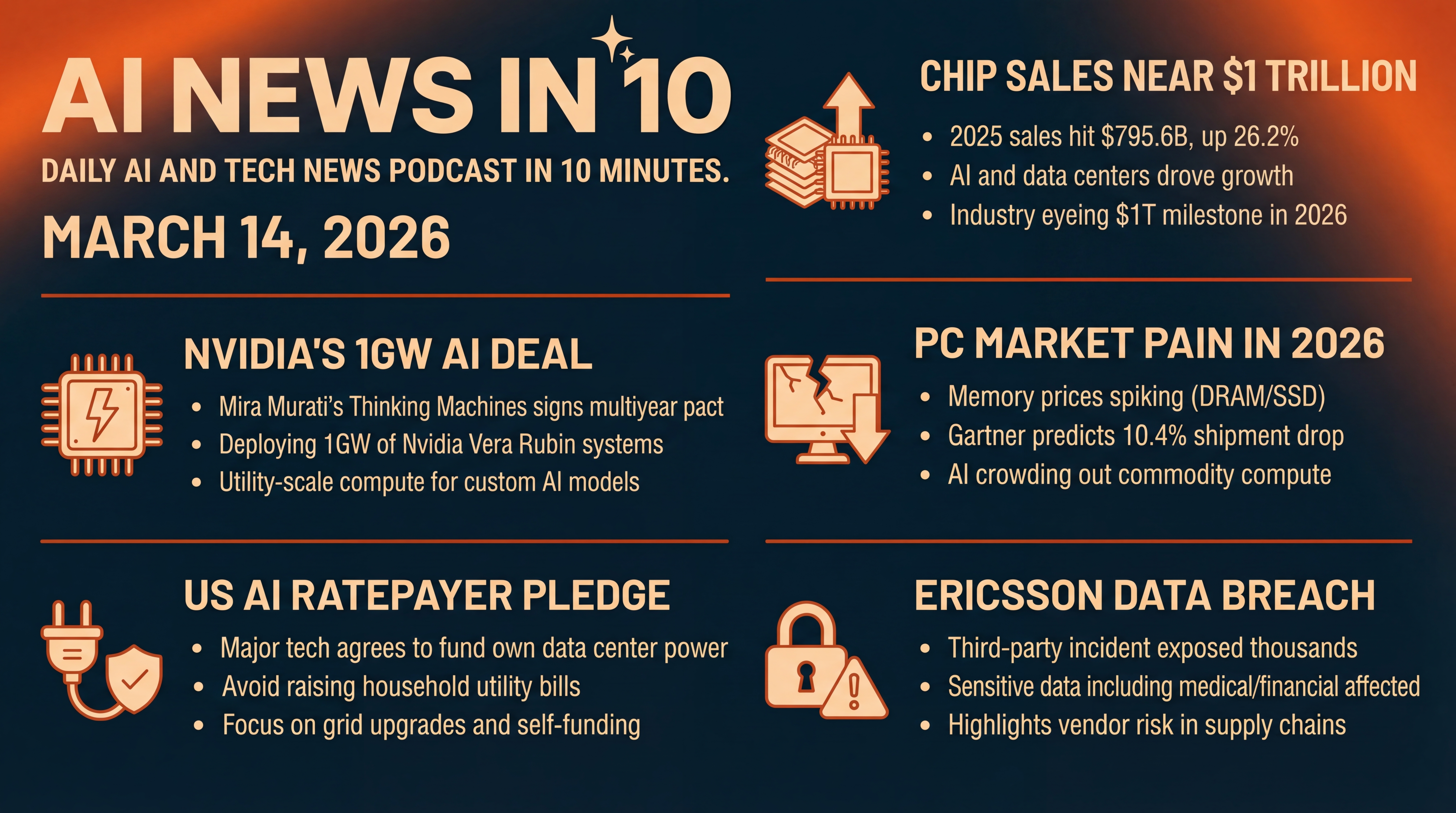
Story one... Nvidia just locked in a giant new partner for the coming wave of model training. According to Axios, Mira Murati’s startup, Thinking Machines, signed a multiyear deal to deploy at least one gigawatt of Nvidia’s Vera Rubin systems.
One gigawatt of AI compute — think utility-scale data center capacity dedicated to training and running adaptable models that users can tune for their own needs. It’s another signal that the center of gravity is shifting from a few labs holding most of the GPUs... to a broader ecosystem of model builders standing up their own dense capacity.
Nvidia, for its part, is cementing demand for its next-gen platform just days before GTC kicks off in San Jose. Axios also reports this is a long-term, system-level partnership — not just a server order.
Here’s why it matters... At gigawatt scale, you’re not just buying accelerators — you’re committing to power procurement, cooling, networking, and a hiring plan for MLOps at industrial scale. These are the kinds of contracts that shape regional energy markets, vendor roadmaps, and talent pipelines... months before any benchmark numbers show up.
Story two... the chip market just had one of its biggest years on record. New figures from the World Semiconductor Trade Statistics group show 2025 global semiconductor sales at 795.6 billion dollars — up 26.2 percent year over year — with the fourth quarter alone jumping 38.4 percent.
The growth engine was clear: AI and data center. Logic and memory led the surge, and WSTS now says the industry is on a path toward the one-trillion-dollar mark in 2026, with a formal forecast refresh due June 2. Regionally, Asia-Pacific led with 45 percent growth, the Americas rose 31 percent, China climbed nearly 18 percent, Europe posted modest gains, and Japan declined. It’s a snapshot of how AI-heavy infrastructure spending is rearranging the map.
Two takeaways... First, hyperscale and sovereign AI buildouts are now the tide that lifts — well, almost all boats: high-bandwidth memory, accelerators, switch silicon, optics, and power systems. Second, a near-trillion-dollar run rate means the old PC and phone upgrade cycles are no longer the only show in town — industrial and government demand tied to AI and compute is now a top-line driver.
Story three... the flip side — PC makers are staring at a rough 2026. Gartner’s latest projections, summarized by Tom’s Hardware and PC Gamer, warn that a 130 percent surge in combined DRAM and SSD pricing through year-end could drive a 10.4 percent drop in worldwide PC shipments this year — the steepest decline in more than a decade.
Analysts even caution the under-five-hundred-dollar, entry-level PC segment could disappear by 2028... as memory costs swell from roughly 16 percent to more than 20 percent of a PC’s bill of materials. That squeeze flows straight to consumers and small businesses as higher sticker prices and longer upgrade cycles.
Put differently, the AI boom is crowding out commodity compute. Memory makers are prioritizing data-center-grade HBM and enterprise SSDs that feed training and inference clusters. If you work in IT procurement, expect slimmer promos, tighter configurations, and more pressure to extend device lifetimes — along with the security and manageability headaches that come with running older fleets longer.
[MIDPOINT_SPONSORS]
Story four... the United States is trying to keep AI’s electric bill off household ratepayers. At the White House on March 4, major AI and cloud players signed a voluntary Ratepayer Protection Pledge — agreeing to secure or fund dedicated power for their data centers and to pay for grid upgrades so local consumers aren’t footing the bill.
The administration cast it as a way to enable rapid AI buildouts without raising monthly utility costs for families. Industry voices echoed the intent — Microsoft, Google, Amazon, OpenAI, Oracle, Meta, and xAI were among the participants. It’s nonbinding, and watchdogs note that enforcement is murky... but politically, it sets expectations ahead of a historic buildout of compute infrastructure.
The practical angle... Hyperscalers will lean harder into long-term power purchase agreements, on-site generation, and novel firming strategies — even advanced nuclear pilots — while negotiating who pays for transmission and interconnects. Expect siting to favor regions that can deliver speed-to-power, not just cheap land.
Story five... another corporate breach reminder — this time touching telecom. Ericsson’s U.S. arm disclosed that a third-party incident exposed sensitive data on thousands of individuals, according to filings with state attorneys general.
The company says it spotted suspicious activity last April, retained outside forensics, and notified the FBI. In Texas alone, more than 4,000 people were affected — with exposed fields ranging from contact details to government IDs and, in some instances, medical or financial data. It’s a case study in how vendor risk can ripple across critical infrastructure supply chains.
What to watch... The incident trail — older compromise, delayed discovery, broad data categories — will fuel calls for tighter third-party risk controls: stronger contractual security minimums, mandatory software bills of materials for SaaS, continuous monitoring, and narrower data collection and retention. For enterprises, the low-friction wins are again least-privilege access, sharp offboarding, and aggressive token and key rotation across vendors.
Quick wrap-up... Nvidia’s one-gigawatt pact shows the compute land rush is far from over... WSTS’s near-trillion-dollar outlook confirms AI is now the chip industry’s center of gravity... the PC market is bracing for a 2026 contraction as memory flows to data centers... Washington wants Big Tech to fund its own electrons... and yet another breach underscores how third-party security can become everyone’s problem.
That’s your Saturday rundown for March 14, 2026 — see you tomorrow with more AI News in 10.
Thanks for listening and a quick disclaimer, this podcast was generated and curated by AI using my and my kids' cloned voices, if you want to know how I do it or want to do something similar, reach out to me at emad at ai news in 10 dot com that's ai news in one zero dot com. See you all tomorrow.
