
Apple Cuts, Army Bets On Anduril, Meta Rebalances, FBI Warns
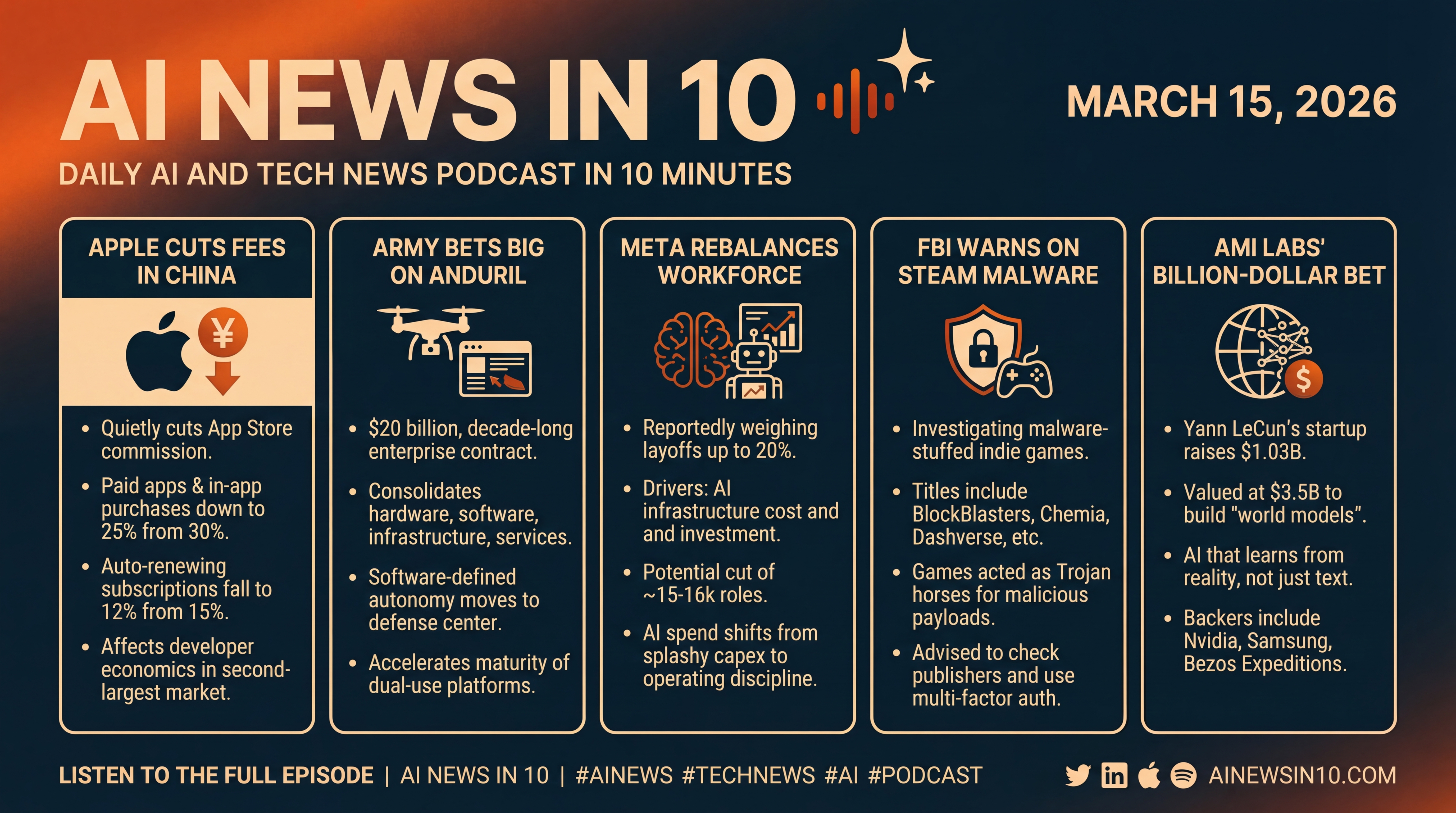
Apple trims App Store fees in China, the U.S. Army inks a $20B Anduril pact, and Meta weighs major cuts as AI costs surge. Plus an FBI alert on malware-laced Steam games, AMI Labs’ $1.03B world-models push, and fresh Gemini tools rolling out in Google Workspace.
Episode Infographic
Show Notes
Welcome to AI News in 10, your top AI and tech news podcast in about 10 minutes. AI tech is amazing and is changing the world fast, for example this entire podcast is curated and generated by AI using my and my kids cloned voices...
It’s Sunday, March 15th, 2026. Here’s your quick tour through the biggest AI and tech moves shaping the week ahead.
Apple quietly cuts App Store fees in China starting today — a shift that could ripple through developer economics.
The U.S. Army inks a massive, decade-long deal with Anduril — yes, Palmer Luckey’s defense tech firm — showing how software-defined autonomy is moving to the center of national defense.
Meta is reportedly weighing layoffs that could trim as much as a fifth of its workforce as AI infrastructure spending bites.
The FBI opens an investigation into malware-stuffed indie games sold on Steam — and we’ve got the titles to avoid.
And Yann LeCun’s new startup, AMI Labs, closes over a billion dollars to chase so-called world models — a bet on AI that learns from reality, not just text.
Let’s dive in.
[BEGINNING_SPONSORS]
Story one: Apple’s App Store math just changed in its second-largest market.
Effective today — Sunday, March 15th — Apple’s commission in China drops to 25 percent from 30 percent on paid apps and in-app purchases. Auto-renewing subscriptions after the first year fall to 12 percent from 15 percent.
Apple says developers don’t need to accept new terms — the updated rates are already reflected in the latest Developer Program License Agreement. While Apple’s tussles with EU regulators and U.S. litigation have dragged on for years, this China change arrived... with remarkably little public friction. Apple frames the move as keeping rates fair and transparent — and no higher than overall rates in other markets.
For developers — especially subscription businesses — that extra three to five points can be the margin that funds growth... or simple survival.
Two quick implications. First, watch China-focused consumer apps and games — a thinner Apple cut could spur more aggressive marketing and price experimentation. Second, keep an eye on whether Apple replicates this outside China — there’s no sign of that today, but large markets often set de facto norms. And the timing matters: setting these new rates on March 15th means March revenue reports will be the first to capture any signal.
Story two: A big milestone for defense tech. Anduril has landed a ten-year enterprise contract with the U.S. Army worth up to 20 billion dollars.
The agreement starts with a five-year base period — plus an optional five more — and it consolidates more than 120 separate procurement actions into one umbrella covering Anduril’s hardware, software, infrastructure, and services.
Pentagon tech leaders keep repeating a simple truth: the modern battlefield is increasingly defined by software. That’s why the Army wants to buy and deploy capabilities with real speed. It’s also a signal moment for founder Palmer Luckey’s bet that autonomous systems — from drones to undersea vehicles — will be built by software-first companies.
Here’s why it matters beyond defense. Big public-sector deals like this often accelerate the maturity of dual-use platforms — think perception stacks, edge-AI training workflows, and resilient communications — that later find their way into critical infrastructure and commercial robotics. And if you follow venture, this kind of long-horizon demand clarity can catalyze more capital into autonomy ecosystems... not just for Anduril, but for its suppliers and competitors.
Story three: Meta — the company behind Facebook, Instagram, WhatsApp, and Meta AI — is reportedly considering layoffs that could touch 20 percent or more of its workforce.
Reports point to two drivers: the cost of AI infrastructure — GPUs, data centers, and networking at unprecedented scale — and continued investment in AI-related M&A and hiring.
Meta ended 2025 with roughly 79,000 employees. A 20 percent cut would be on the order of 15 to 16 thousand roles. The company called the reporting speculative, but even the discussion is telling... 2026 is the year AI spend shifts from splashy capex headlines to ruthless operating discipline.
Remember, Meta cut at comparable scale in late 2022 and again in March 2023. Today’s context is different — AI agents and recommendation models are now core to Meta’s product roadmaps and cost structure.
If these cuts materialize, expect Meta to prioritize roles that directly ship AI features — and the infrastructure to run them — while flattening layers elsewhere. For the wider industry, this is another reminder that AI efficiency talking points can mask hard choices. Some firms will genuinely automate... others may use AI as rhetorical cover to reset headcount after pandemic-era hiring binges.
[MIDPOINT_SPONSORS]
Story four: A heads-up for PC gamers.
The FBI says it’s investigating a suspected developer who embedded malware in several indie games sold on Valve’s Steam store. Titles named in the alert include BlockBlasters, Chemia, Dashverse — also known as DashFPS — Lampy, Lunara, PirateFi, and Tokenova.
The games reportedly worked, but acted as Trojan horses — once installed, they could deploy info-stealers or other malicious payloads. The Bureau issued a victim-notification call and is seeking additional reports. Valve and the FBI declined to comment.
Two quick safety notes you can share with friends. First, treat unknown indie releases like you would random executable files — check the publisher’s history, reviews, and recent patch notes. Second, run a reputable endpoint scanner and keep Steam Guard enabled. If you played any of those titles, rotate passwords, enable multi-factor authentication, and monitor for unusual activity — especially on accounts tied to payments.
Story five: A billion-dollar bet on world models.
AMI Labs — the new venture co-founded by Turing Award winner Yann LeCun — has raised 1.03 billion dollars at a reported three-and-a-half-billion-dollar pre-money valuation to build AI systems that learn directly from the world, not just from text.
CEO Alexandre LeBrun says AMI’s approach leans on ideas like JEPA — Joint Embedding Predictive Architecture — to better understand and predict reality. Early partners include the digital health startup Nabla, and the team says it will publish papers and open-source substantial code as research progresses. Backers span Cathay Innovation, Greycroft, HV Capital, Hiro Capital, and Bezos Expeditions — alongside strategic investors like Nvidia, Samsung, Sea, Temasek, and Toyota Ventures.
Why it’s interesting: world models are seen as a path to more grounded, less hallucination-prone systems that can reason about physics, causality, and time — capabilities prized for robotics, industrial automation, and clinical decision support. LeBrun even quipped that in six months... every company will call itself a world model to raise funding. Hype warning duly noted. But the compute and talent bill to chase this is enormous — that’s why a billion-plus round matters.
Quick bonus context before we wrap.
If you’re in Workspace, Google is rolling out new Gemini helpers across Docs, Sheets, Slides, and Drive — think Help me create, Match writing style, and Ask Gemini in Drive — with AI Overviews across your files. The features are starting in beta for AI Ultra and Pro subscribers, with U.S.-first availability for some Drive capabilities. It’s a steady drumbeat heading into a packed spring conference season.
That’s a wrap. Today, Apple’s fee cut in China resets developer math, the Army’s Anduril pact cements software’s place on the modern battlefield, Meta’s potential 20 percent reduction shows AI’s cost gravity, the FBI’s Steam probe is a timely security nudge, and AMI Labs raises a war chest to pursue world models. New week, new momentum... see you tomorrow for more AI News in 10.
Thanks for listening and a quick disclaimer, this podcast was generated and curated by AI using my and my kids' cloned voices, if you want to know how I do it or want to do something similar, reach out to me at emad at ai news in 10 dot com that's ai news in one zero dot com. See you all tomorrow.
