
OpenAI Refocuses, Memory Crunch, Nvidia’s Trillion Bet
Five fast hits on today’s biggest AI and tech moves — OpenAI doubles down on enterprise, memory shortages linger, the U.S. fights to keep digital trade tariff-free, Samsung retreats from its TriFold, and Nvidia projects a $1T chip windfall. Plus, what to watch next as markets and builders react.
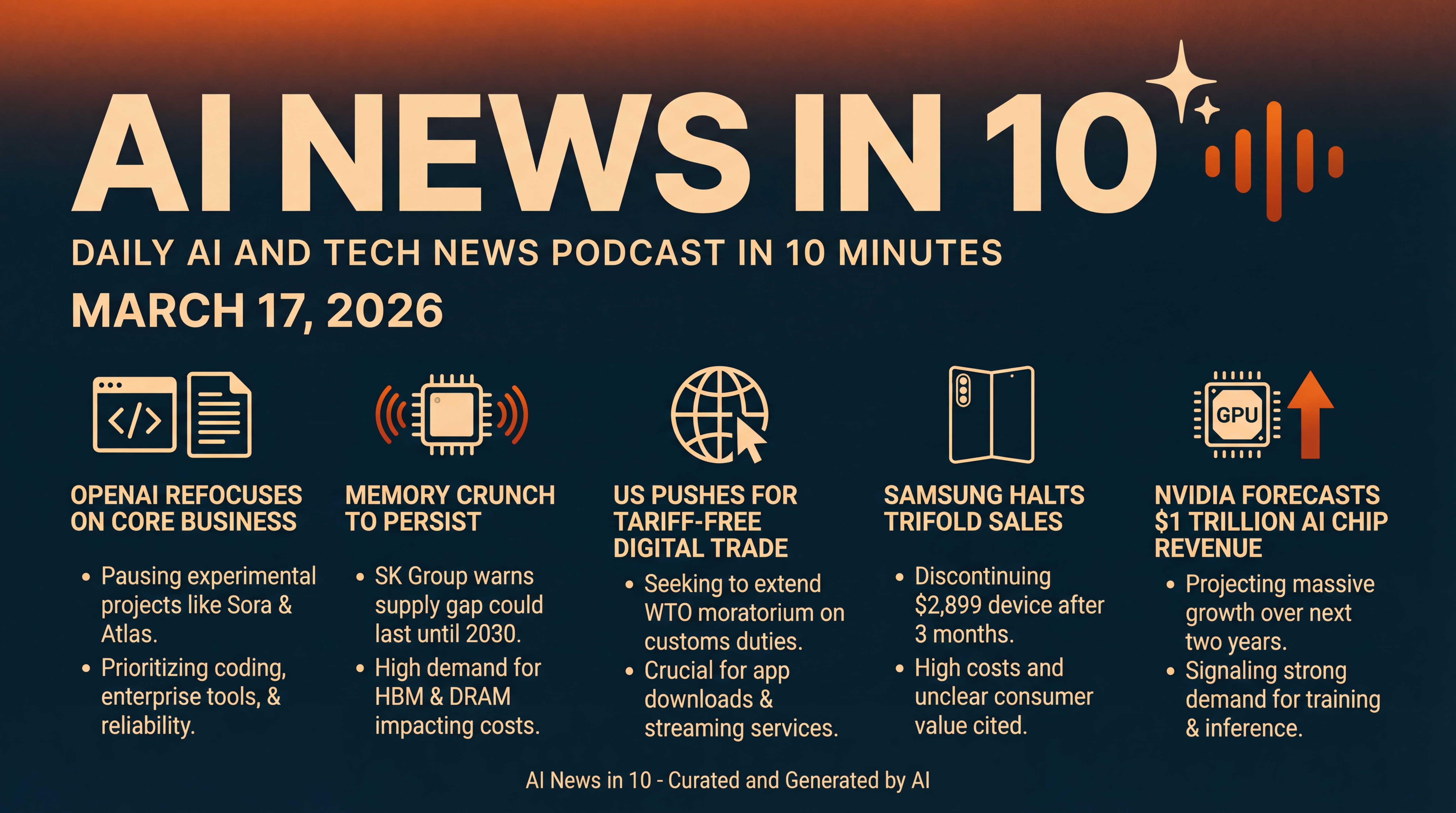
Episode Infographic
Show Notes
Welcome to AI News in 10, your top AI and tech news podcast in about 10 minutes. AI tech is amazing and is changing the world fast, for example this entire podcast is curated and generated by AI using my and my kids cloned voices...
It’s Tuesday, March 17, 2026... here’s your quick tour of the five biggest AI and tech stories shaping the day. OpenAI is tightening its product focus, SK Group warns the memory crunch won’t fully ease anytime soon, the U.S. is pushing the WTO to keep digital trade tariff-free, Samsung is reportedly pulling the plug on its ultra-pricey TriFold, and Nvidia is forecasting a trillion dollars in AI chip revenue over the next two years. Let’s get into it.
[BEGINNING_SPONSORS]
Story one: OpenAI hits pause on the side quests. Multiple reports say OpenAI is scaling back a handful of splashy experiments to nail its core business — coding and enterprise — instead of chasing breadth. According to the Wall Street Journal, flagged by The Verge, applications lead Fidji Simo told staff the company will prioritize developer and workplace use cases over projects like the Sora video generator, the Atlas browser, and various gadgets.
If you’ve been watching the last six months, this tracks — a heavy push into enterprise features and governance... then a slower cadence, and even delays, on consumer-oriented ideas like adult mode. The strategic signal is simple: enterprise AI buyers want measurable ROI, security attestations, and uptime service-level agreements. OpenAI wants to harden the stack where revenue is most durable — code, copilots, and company data — rather than spreading bets across moonshots. That should sharpen product roadmaps and cut context switching for teams... but it also raises the bar for every fun demo to justify its keep. Source: The Wall Street Journal and The Verge.
Story two: the AI boom’s inconvenient truth — memory still bites. Speaking on the sidelines of Nvidia’s GTC in San Jose, SK Group chair Chey Tae-won said the global shortage of memory chips could persist for another four to five years — potentially until 2030 — because base wafer supply trails demand by more than 20 percent. Even as SK Hynix and peers add capacity, the gap may linger thanks to unrelenting demand for high-bandwidth memory and next-generation DRAM powering AI training and inference.
Translation for builders: plan for constrained HBM and premium DRAM pricing to be a multi-year assumption... not a quarter-to-quarter headache. That ripples into GPU server total cost of ownership, cloud spot pricing, and how aggressively startups model cost per token or per image generated. If you were hoping 2026 would mark a return to plentiful, cheap memory — the people actually buying wafers are telling you to budget otherwise. Source: Bloomberg.
Story three: a fight you might not see, but will absolutely feel — keeping the internet tariff free. As we head toward the WTO’s 14th Ministerial Conference in Yaounde, Cameroon, the United States is pushing to preserve — and potentially extend — the decades-old moratorium on customs duties for electronic transmissions. That rule helps keep app downloads, game patches, and streaming bits from being taxed at the border.
Why this matters now: the current moratorium expires March 31, 2026 unless extended at MC14 later this month. Letting it lapse could open the door to digital tariffs, fragmenting costs for software vendors and cloud platforms — and ultimately trickling down to consumers through higher subscription prices or region-specific surcharges. Think of it as net-neutral shipping for bits... if tariffs appear, your cost to deliver a patch or model update into a market could change overnight. Sources: Bloomberg and WTO updates.
[MIDPOINT_SPONSORS]
Story four: bold form factor, brief life — Samsung’s TriFold reportedly bows out. Bloomberg reports Samsung will stop selling its $2,899 TriFold phone after only about three months on the market. That’s a swift reversal for a halo device that promised a tablet-like canvas in a pocketable form.
Why pull it? We’ll need official color from Samsung, but the likely culprits are clear: yields and costs on ultra-complex hinge and display stacks, unclear consumer value versus traditional foldables, and a backdrop where even premium buyers are weighing AI features over radical hardware. For developers targeting foldable layouts, the signal isn’t that folding is dead — it’s that economics still rule. Expect continued investment in mainstream foldables, while the truly exotic experiments stay limited-run — or R-and-D-heavy showcases. Source: Bloomberg.
Story five: Nvidia’s trillion-dollar, two-year forecast. At GTC, CEO Jensen Huang told attendees he expects AI chip revenue to hit one trillion dollars over the next two years — an audacious figure meant to calibrate Wall Street and suppliers to the scale of what’s ahead. Paired with hyperscalers’ stepped-up capital spending and enterprise GPU backlogs, that number reflects not just training demand, but the swell of inference at the edge — PCs and workstations with on-device models, factories and hospitals with local vision systems, and service providers layering AI into every workflow.
Remember, Nvidia’s last cycle added a future Rubin generation to keep the pipeline stuffed. If that cadence holds — and if memory bottlenecks don’t slow it down — the trillion-dollar claim is a bet that AI compute behaves more like essential infrastructure than hype. Source: Financial Times.
Quick reality check — and what to watch next.
On OpenAI’s refocus, expect faster iteration on dev tools, enterprise controls, and reliability... fewer shiny detours, more practical wins like reducing tickets and saving hours.
On chips, assume memory scarcity bakes into pricing models. If you’re deploying agent fleets or vision pipelines, run sensitivity analyses with 10 to 20 percent higher memory costs extended through 2028.
On the WTO front, we’re days from MC14. If the moratorium isn’t extended, digital commerce could get complicated fast — and procurement teams will start modeling geo-specific content delivery and tax exposure.
For devices, Samsung’s TriFold retreat doesn’t end the search for new form factors — but it does underline that AI features, battery life, and price discipline are what win in 2026.
And on Nvidia, a trillion-dollar forecast is part message, part signal to partners: build capacity, line up memory, and keep accelerator roadmaps on tempo.
That’s your wrap for March 17. OpenAI trims to scale, memory tightness may be the new normal, the U.S. leans in to keep bits tariff free, Samsung rethinks an expensive experiment, and Nvidia keeps the pedal down with a massive revenue outlook. We’ll be back tomorrow with the next wave.
Thanks for listening and a quick disclaimer, this podcast was generated and curated by AI using my and my kids' cloned voices, if you want to know how I do it or want to do something similar, reach out to me at emad at ai news in 10 dot com that's ai news in one zero dot com. See you all tomorrow.
