GPT-5.4, App Store Shakeup, and Orbital AI
We unpack GPT-5.4’s push into real work, Google’s proposed Epic remedies that could reset app store fees, Meta’s paid news licensing for AI, a conflict-linked AWS outage, and SpaceX’s 10,000-satellite milestone—plus the brewing fight over orbital data centers. Clear takeaways for builders, operators, and anyone tracking where AI meets real-world infrastructure.
Episode Infographic
Show Notes
Welcome to AI News in 10, your top AI and tech news podcast in about 10 minutes. AI tech is amazing and is changing the world fast, for example this entire podcast is curated and generated by AI using my and my kids cloned voices...
It’s Thursday, March 19, 2026, and here’s what’s new in AI and tech... We’ve got OpenAI’s latest flagship model and why it matters for real work, a major turn in the Google versus Epic antitrust saga that could change app store economics, Meta paying for premium news to feed its AI, the real-world fragility of cloud computing after reported attacks on AWS data centers, and SpaceX quietly hitting a 10,000 satellite milestone — while a separate plan for orbital AI data centers draws fire from astronomers. Let’s dive in.
[BEGINNING_SPONSORS]
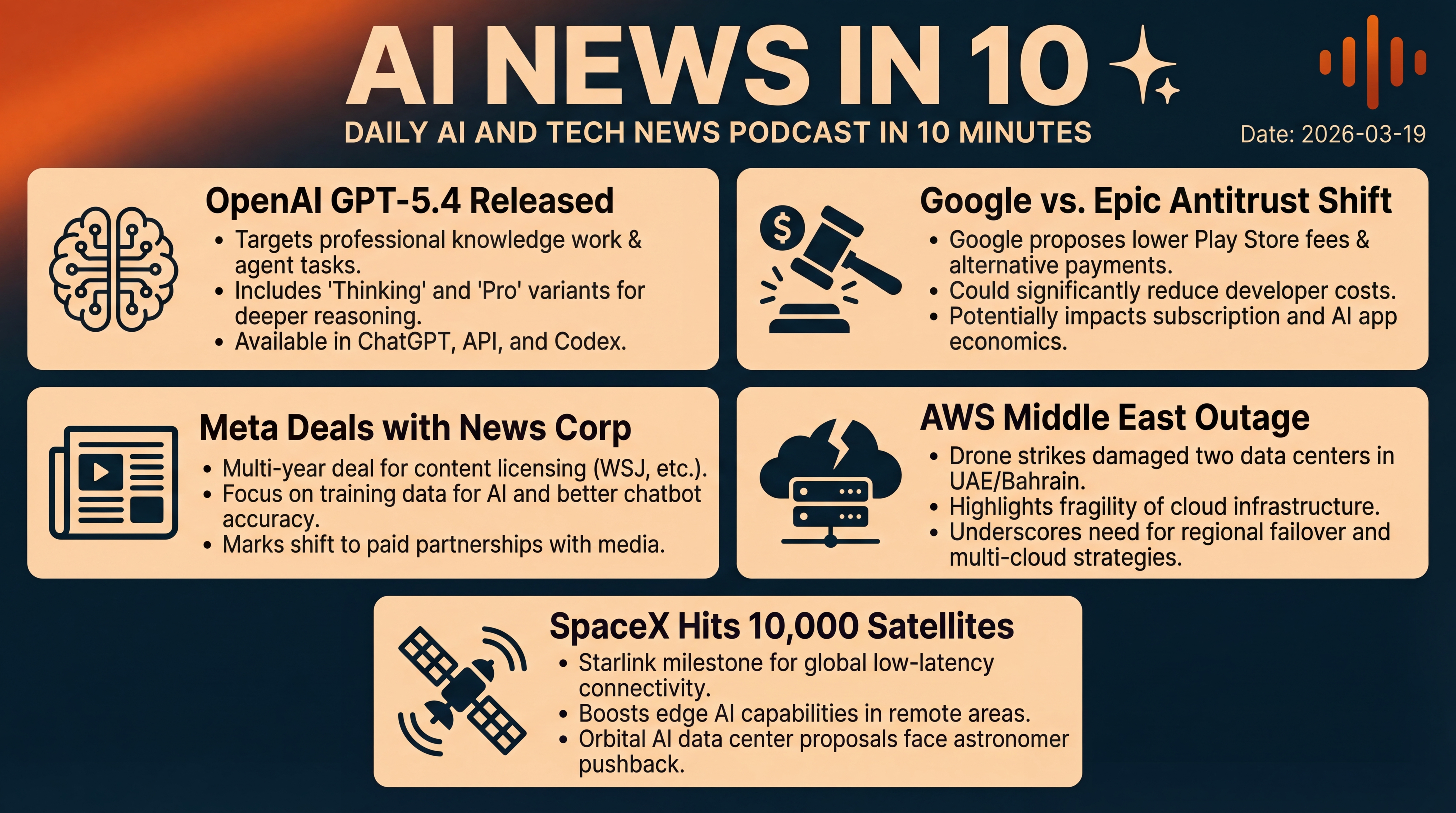
Story one... OpenAI rolled out GPT-5.4 earlier this month, positioning it as the company’s most capable and efficient frontier model for professional work, with two flavors — Pro and a Thinking variant that reveals more of its reasoning and can pivot mid-thought when you nudge it. It’s available in ChatGPT, the API, and Codex.
In plain English... this update targets knowledge work — spreadsheet analysis, longer-horizon agent tasks, and deeper step-by-step reasoning. Less babysitting, more getting things done.
Reaction has been brisk. Sam Altman even called GPT-5.4 his favorite model to talk to, noting that personality had lagged in some recent fifth-gen releases — a nod to the softer side of user experience, not just raw benchmarks. If OpenAI can pair more transparent reasoning with a voice people actually enjoy working with, that’s a powerful combo for adoption inside companies.
What to watch next... two things. First, whether the Thinking style shows measurable gains in accuracy on real enterprise tasks — not just lab tests. Second, how rivals respond on speed and cost. Early coverage framed 5.4 as unusually quick for complex jobs — if that holds at scale, expect pricing pressure and rapid fine-tuning from competitors.
Story two... a landmark shift in the Google versus Epic Games antitrust fight over Android app distribution. Google has proposed changes that would lower or restructure fees and open new paths for developers — rolling out in the US, the UK, and the EU if approved by the court. It’s a big step toward resolving the long-running Play Store case, and more importantly, it could put meaningful budget back into developers’ pockets.
Legal filings and reporting point to significantly reduced effective commissions in some scenarios — 20 percent or less, depending on how apps are distributed and billed — plus broader allowances for steering users to alternative payment options. That’s been a central friction point for years. If these commitments survive scrutiny and spread, every subscription-heavy developer — from productivity tools, to streaming, to AI assistants — will revisit their unit economics.
One more angle... this isn’t just about games. The past two years have seen a bloom of AI-first mobile apps that depend on usage-based billing. Even a small percentage swing on fees can decide whether an AI product pencils out at scale. Keep an eye on how quickly Google operationalizes the changes after court review — and whether Apple’s separate EU-driven reforms create a de facto global baseline over time.
Story three... Meta has struck a multimillion-dollar, multi-year licensing deal with News Corp, bringing content from brands like The Wall Street Journal into Meta’s AI products. Reporting pegs the value at up to 50 million dollars a year, over three years. Beyond the headline number, this is about training-data access and live answer quality — licensing real journalism to ground a chatbot’s responses and reduce hallucinations.
This follows a pattern... Media companies that once fought scraping are now negotiating — sometimes with a woo-or-sue posture — to be paid data partners. For Meta, which has been reorganizing around its next big model, the bet is that breadth and licensed depth produce better answers and fewer PR fires. For publishers, the calculation is revenue now, plus influence over how their work is used by AI systems that are already mediating how billions find information.
[MIDPOINT_SPONSORS]
Story four... the cloud met geopolitics. In early March, AWS’s Middle East infrastructure experienced severe disruption after reported drone strikes damaged data centers in the UAE and Bahrain, temporarily taking two of three availability zones in the ME-CENTRAL-1 region offline and impacting core services like EC2, S3, and DynamoDB. AWS communications stopped short of attributing cause, but did acknowledge that objects struck a data center, leading to fire and outages. This is the first widely reported, conflict-linked attack to take a hyperscale cloud region partially down.
Why this matters for AI: enterprises building agent workflows, RAG pipelines, or model-inference services tend to assume that zonal redundancy immunizes them from real-world events. Here, two zones in one region were unavailable at once. The immediate takeaway is boring but important — test regional failover like your business depends on it. Consider multi-cloud for genuinely critical functions. And audit your data replication and DNS cutover times. Community analyses emphasized how physical security and regional diversification are now table stakes for resilience.
A silver lining... the rest of AWS’s global footprint continued to operate normally, underscoring that architectural diversity across regions still works — provided customers actually use it. But between this event and February’s high-profile Cloudflare outage, the message is clear: build to fail small. Don’t let your AI stack hinge on assumptions that a single provider — or even a single geography — will always be there.
Story five... SpaceX just crossed 10,000 active Starlink satellites after dual launches this week — another milestone in making global, low-latency connectivity common, even at remote research sites and farms where AI-assisted operations are taking off. More capacity plus lower latency means more places you can feasibly run AI at the edge and keep models updated over the air.
But there’s a separate, provocative idea on the table that has astronomers sounding the alarm. Proposals for swarms of orbital AI data centers — effectively, compute in space — have triggered warnings about light pollution, radio interference, and the future of ground-based astronomy. Scientists argue that after years of learning to live with mega-constellations, this could push observatories past a breaking point. It’s a reminder that scaling compute has environmental and scientific externalities — on Earth, and above it.
Quick recap... OpenAI’s GPT-5.4 is about doing more real work with less hand-holding. Google’s concessions to Epic could reset app-store math for AI apps and beyond. Meta is paying for premium news to feed its AI models. The AWS Middle East outage showed that even the cloud has a physical layer you can’t ignore. And SpaceX’s 10,000-satellite network is redefining global connectivity — while the idea of orbital AI data centers is already meeting scientific pushback. We’ll keep watching how these threads — capability, distribution, content, resilience, and infrastructure — interweave as AI scales into everything.
Thanks for listening and a quick disclaimer, this podcast was generated and curated by AI using my and my kids' cloned voices, if you want to know how I do it or want to do something similar, reach out to me at emad at ai news in 10 dot com that's ai news in one zero dot com. See you all tomorrow.
