From Space Modules to Console Copilots
Nvidia’s GTC week delivers storage breakthroughs, HBM4 momentum, and a space-bound AI module, while Microsoft tightens Copilot access and trims Windows 11 bloat. We unpack Anthropic’s Pentagon showdown, DLSS 4.5’s launch date, and Xbox’s plan to bring Gaming Copilot to consoles.
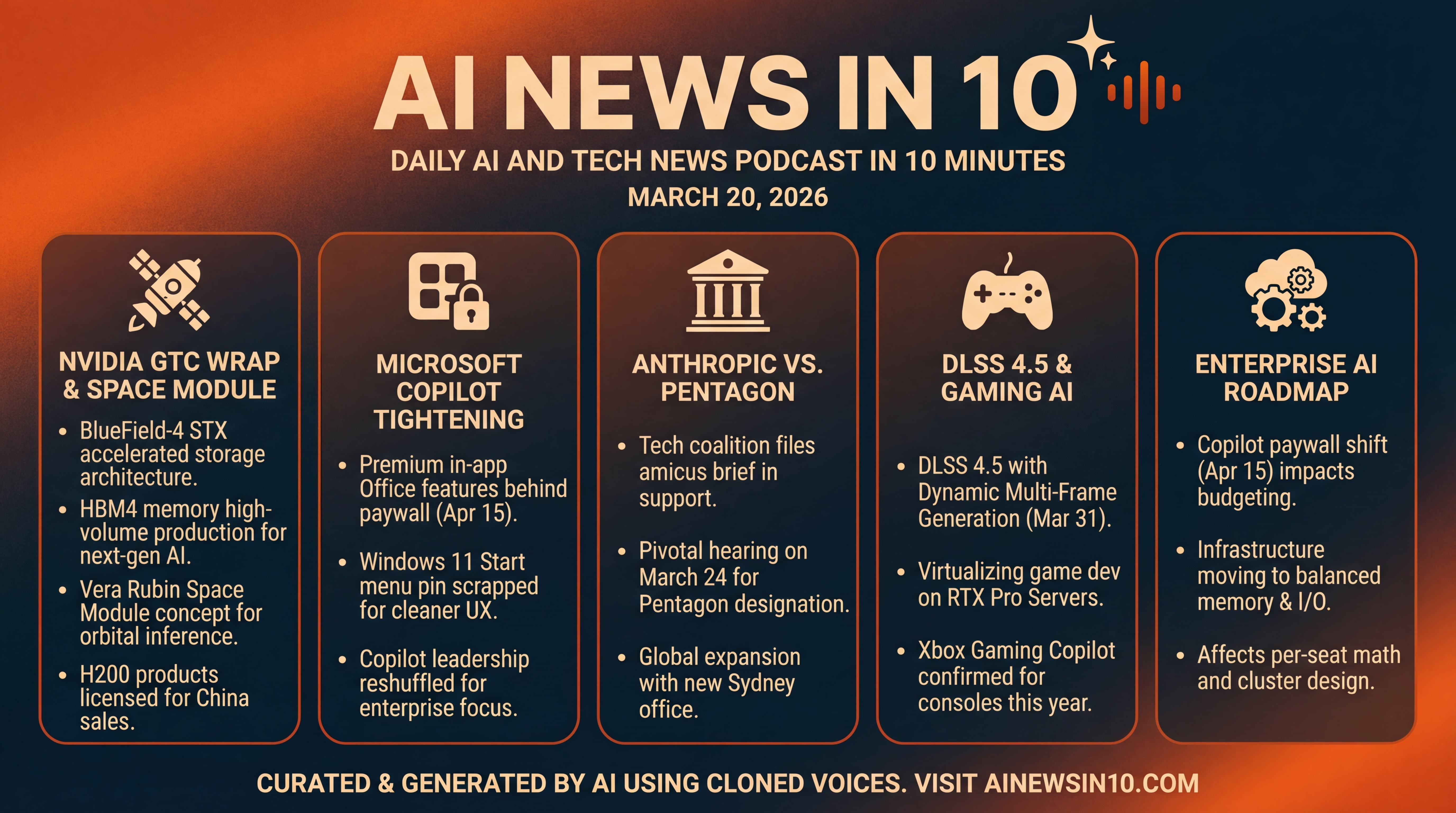
Episode Infographic
Show Notes
Welcome to AI News in 10, your top AI and tech news podcast in about 10 minutes. AI tech is amazing and is changing the world fast, for example this entire podcast is curated and generated by AI using my and my kids cloned voices...
It’s Friday, March 20, 2026 — here’s what’s fresh in AI and tech.
Nvidia’s GTC week brings a stack of hardware headlines — from a new accelerated storage architecture to a wild space-module concept — plus a clearer view into China sales. Microsoft, meanwhile, is tightening who gets Copilot inside Office apps and dialing back some Windows 11 bloat concerns while it reshuffles Copilot leadership. And in policy and power plays, a who’s who of tech is backing Anthropic in its Pentagon fight, with a key hearing next week. Gamers get a date for DLSS 4.5, and Xbox confirms its Gaming Copilot is coming to consoles this year. Let’s get into it.
[BEGINNING_SPONSORS]
First up, Nvidia’s GTC 2026 wrap — and it’s not just more GPUs.
Nvidia introduced BlueField-4 STX, a modular, accelerated storage architecture aimed squarely at the data bottlenecks of agentic AI. The company is claiming up to five times the token throughput, four times better energy efficiency, and twice the page ingestion speed versus traditional CPU-based storage paths — numbers that matter if your workloads are increasingly I O bound rather than compute bound.
On memory, Micron says it’s moving HBM4 into high-volume production targeted at Nvidia’s next-gen Vera Rubin platform, touting roughly two point three times the bandwidth and about a 20 percent power efficiency gain. That’s important as inference scales and memory becomes the limiter as often as compute. HBM supply has been the choke point for multiple training clusters — if Micron executes here, it could ease the worst backlogs and diversify your bill of materials beyond a single supplier.
Then there’s the curveball: the Vera Rubin Space Module — Nvidia’s concept to push high-throughput inference into orbit. Framed as up to 25 times the AI compute of an H100 for orbital data-center workloads, it signals a serious exploration of edge-in-space architectures for Earth observation and low-latency services. It’s early... but it shows Nvidia is scouting beyond terrestrial power and cooling constraints.
One more GTC-adjacent tidbit with near-term revenue implications: Jensen Huang says Nvidia has been licensed to sell some H200 products to customers in China. That’s a change from the long stretch of strict U.S. export limits. Volumes remain uncertain — but any legal pathway into the China market could meaningfully affect forecast models for the back half of 2026.
If you want the official play-by-play, Nvidia’s rolling GTC coverage runs through today, recapping keynotes, demos, and sessions across the week. Good catch-up material if you missed the live streams.
Next, Microsoft is tightening Copilot access and cleaning up some Windows 11 cruft.
Starting April 15, Copilot Chat users who don’t have a Microsoft 365 Copilot license will lose direct Copilot integration inside Office apps like Word and Excel. You’ll still have Copilot Chat — but the premium, in-app experiences will sit behind an enterprise-grade paywall. It’s a clear line between consumer-tier chat and the deeper, file-contextual features businesses will pay for.
On the desktop experience, Microsoft has reportedly scrapped plans to force-pin the standalone Copilot app onto the Windows 11 Start menu — part of dialing back perceived AI bloatware and improving user sentiment. It’s a small change, but symbolic in a year when OS-level AI integrations can quickly feel heavy-handed.
Insiders also saw March builds tweak the out-of-box setup, add a “Same as Copilot key” option for stylus buttons, and deliver a series of polish passes — the kind of quiet plumbing changes that signal a more measured approach to how Copilot shows up on the device.
Strategically, Microsoft is shuffling Copilot leadership so Mustafa Suleyman can focus on building more enterprise-tuned “lineages” and differentiated AI experiences on top of OpenAI models. That’s worth watching as customers push for domain-specific quality, governance hooks, and predictable total cost of ownership. The OpenAI licensing runway goes well into the 2030s — giving Microsoft time to blend foundation-model access with increasingly verticalized Copilot stacks.
Now, Anthropic versus the Pentagon — the calendar just got real.
A coalition of major tech and industry groups has filed an amicus brief supporting Anthropic’s bid to pause a Pentagon designation the company says is already chilling commercial deals. A federal court will hear the request for temporary relief on March 24 — four days from now — setting up a pivotal moment for how national-security policy intersects with commercial AI providers. For buyers, the near-term question is continuity of service and contract risk clauses. For policymakers, it’s the balance between security concerns and a flourishing AI ecosystem.
Quick context while we’re here: Anthropic is expanding its global enterprise posture — opening a Sydney office this month, with plans to deepen work across financial services, ag-tech, energy, healthcare, and science in Australia and New Zealand. That growth underscores why regulatory clarity matters... multinationals don’t want to knit together inconsistent risk regimes across markets.
[MIDPOINT_SPONSORS]
Over in gaming...
Nvidia says DLSS 4.5’s Dynamic Multi-Frame Generation — plus a new six-times mode and model updates — will hit the next Nvidia app beta on March 31. The pitch is smoother frame pacing and smarter scaling that adapts on the fly — useful as more titles lean into path tracing and heavier global illumination. If you’ve been holding frame generation at arm’s length because of latency quirks or uneven artifacting, the multi-frame and dynamic logic here are the parts to re-test.
These client-side advances dovetail with the GTC data-center story. Studios are increasingly mixing local upscaling and frame generation with server-side generation, cloud asset prep, and AI-assisted creation pipelines. Note Nvidia’s push to virtualize game development on RTX Pro Servers so content, quality assurance, and AI research can share pooled GPUs. The takeaway: your studio’s GPU budget might shift from desks to racks — without sacrificing interactive responsiveness.
And Xbox confirms Gaming Copilot — the AI assistant that’s already rolled out on Windows and mobile — is headed to consoles this year. Announced at GDC, Microsoft says it’ll continue bringing it to more services players are using — which reads like an intent to weave AI assistance deeper into the Xbox stack. Near-term, expect quality-of-life help: quest hints, system navigation, accessibility prompts, maybe capture-to-clip workflows — before anything that touches competitive balance. The cadence here suggests a cautious, opt-in posture as it lands in the living room.
Before we wrap, one more practical note from the week.
If you’re budgeting for enterprise AI this quarter, Microsoft’s Copilot paywall shift on April 15 — and Nvidia’s storage and memory moves — paint a consistent picture. Higher-value experiences are moving behind predictable SKUs, and the infrastructure blend is migrating from pure compute to balanced memory and I O. That affects both your per-seat math and your cluster design.
That’s the snapshot for Friday, March 20. Nvidia’s GTC week ends with new plumbing for agentic AI. Microsoft sharpens its Copilot tiers and Windows integration. Anthropic’s Pentagon showdown heads to court next week. DLSS 4.5 gets a date, and Xbox’s Gaming Copilot is console-bound. We’ll keep an eye on that March 24 hearing — and what it means for enterprise AI roadmaps. Stay tuned.
Thanks for listening and a quick disclaimer, this podcast was generated and curated by AI using my and my kids' cloned voices, if you want to know how I do it or want to do something similar, reach out to me at emad at ai news in 10 dot com that's ai news in one zero dot com. See you all tomorrow.
