Weekend AI Watch: Laws, Fabs, and Firefly
From Washington's federal AI blueprint to Musk's Terafab launch, we break down the weekend's biggest moves across chips, cloud security, Meta's inference silicon, and Adobe's creator tools. Clear takeaways, fast context, and what to watch next.
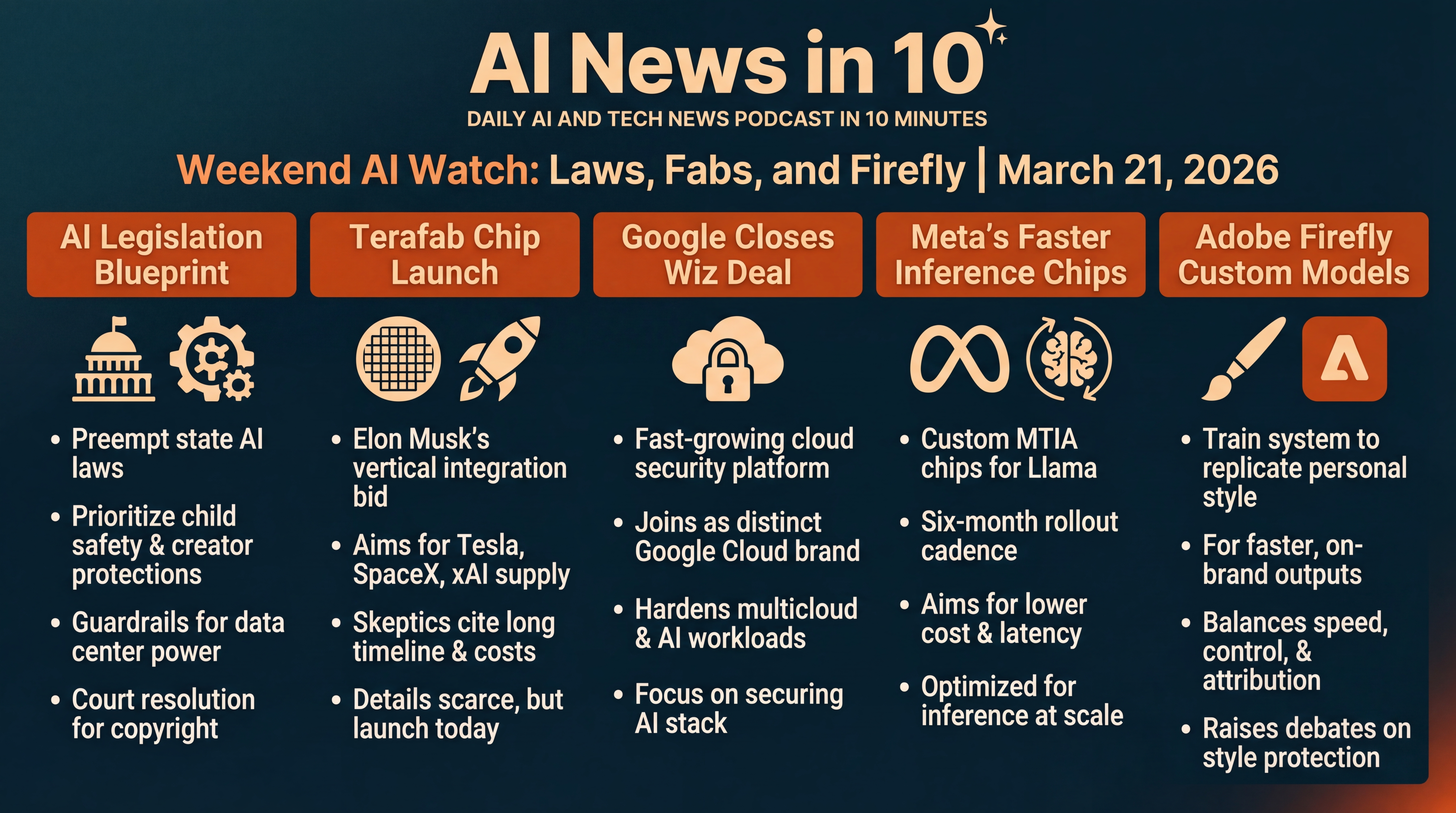
Episode Infographic
Show Notes
Welcome to AI News in 10, your top AI and tech news podcast in about 10 minutes. AI tech is amazing and is changing the world fast, for example this entire podcast is curated and generated by AI using my and my kids cloned voices...
It's Saturday, March 21, 2026. Here's your quick tour of five AI and tech stories shaping the weekend... Washington's new blueprint for AI legislation — Elon Musk's Terafab chip venture launching today — Google closing its deal for cloud security firm Wiz — Meta previewing a faster cadence for its in-house AI inference chips — and Adobe rolling out Firefly Custom Models that learn an individual creator's style. Let's break it down.
[BEGINNING_SPONSORS]
First up, the White House's AI plan.
Released Friday, the administration's legislative blueprint asks Congress to preempt state AI laws it sees as overly burdensome, while prioritizing child safety, copyright and creator protections, guardrails to keep electricity costs in check as data centers grow, and consumer education.
Republican leaders in the House signaled support. Key Democrats immediately criticized the framework as too lenient on industry.
The document also steers Congress away from rewriting copyright law right now — favoring court resolution of training data disputes — and ties into earlier moves meant to ensure AI data centers don't raise ratepayer bills.
Expect a fight... States like California, Colorado, Texas, and Utah already have AI rules on the books, and attorneys general are watching any attempt at federal preemption.
Why this matters: If Congress takes up this blueprint, it could reset a patchwork of state AI statutes into a single federal standard — hugely consequential for model developers, cloud providers, and enterprises deploying AI at scale. For creators, keeping copyright-training questions in court keeps current legal battles front and center — rather than forcing a rushed legislative answer this spring.
Story two: Elon Musk's chipmaking moonshot hits the calendar.
After months of hinting that traditional foundries can't meet his companies' appetite for AI accelerators, Musk posted that the Terafab Project launches today — Saturday, March 21. Details remain scarce, but earlier comments framed Terafab as a long-horizon bid to vertically integrate chip supply for Tesla, SpaceX, and xAI.
Skeptics point out that building fabs — especially for bleeding-edge nodes — takes years, vast capital, and access to key lithography gear. Still, any concrete reveal today could jolt the chip supply narrative and crank up pressure on established foundries.
Industry context: the toolchain is the bottleneck. EUV systems are capacity-constrained and extremely expensive. Packaging materials and advanced cooling are tight. So even a wildly ambitious plan must solve procurement, power, water, and workforce... before a single wafer rolls. We'll watch for site, partner, and process details if Musk shares them.
Story three: Google closes the deal for Wiz, the fast-growing cloud security platform.
Wiz joins Google Cloud as a distinct brand, expanding Google's ability to harden multicloud and AI workloads with posture management, vulnerability insights, and policy automation. For customers racing to deploy copilots and agentic apps, the sell is straightforward: as AI spreads across containers, data lakes, and microservices, guardrails have to move with it. This close also caps off a year-long regulatory wait since the acquisition was first announced in 2025.
Here's the takeaway: In 2026, AI security isn't just about model red-teaming — it's about securing the whole stack where the model runs and the data lives. Expect Google to quickly wire Wiz into Chronicle Security Operations and Vertex AI policy controls, pitching an integrated AI security posture to big enterprises.
[MIDPOINT_SPONSORS]
Story four: Meta's in-house inference silicon takes shape.
Over the last several days, Meta shared more about its custom MTIA chips built to serve Llama and other production workloads — and, notably, to roll out on a six-month cadence. That cadence is the headline. If Meta can iterate hardware and software together this quickly, it could squeeze cost per token and latency across Facebook, Instagram, and WhatsApp — while reducing dependence on merchant accelerators.
Details point to a portfolio tuned for inference at scale rather than bleeding-edge training... smart for the workload mix and for power budgets.
Strategically, MTIA gives Meta negotiating leverage in the hot accelerator market, and a sandbox to co-design models with hardware features like sparsity, KV-cache handling, and on-package memory. If six-month revs stick, watch for faster deployment of higher-bitrate audio, longer-context assistants, and on-device handoffs in Meta apps.
And story five for creators: Adobe Firefly just added Custom Models, letting you train the system to replicate your personal style for faster, on-brand outputs.
Adobe is pitching this as a pro-friendly way to encode your look across image generation — while keeping enterprise-grade controls and attribution. It's a notable step in the long-running tug-of-war between style protection and productivity... agencies want speed; artists want control and credit. Adobe's move will likely intensify debates around consent, provenance, and how far style transfer should go.
Practical angle: For studios and brands, Custom Models could slash iteration cycles for campaigns. For independents, it's a potential monetization lever — license your style to clients without handing over your raw workflows. Keep an eye on how Adobe enforces dataset boundaries, opt-ins, and watermarking in production deployments.
Quick recap before we go.
Washington's AI blueprint sets up a heavyweight federal-versus-state showdown on rules.
Musk's Terafab promises a fresh twist in chip supply — details pending.
Google's Wiz deal is a clear bet that AI security is the new cloud security.
Meta's MTIA cadence hints at cheaper, faster AI across its apps.
And Adobe's Firefly Custom Models could supercharge — and further complicate — creative workflows.
We'll keep watching for weekend updates — especially from the Terafab launch window and any Congressional reaction to the AI plan.
Thanks for listening and a quick disclaimer, this podcast was generated and curated by AI using my and my kids' cloned voices, if you want to know how I do it or want to do something similar, reach out to me at emad at ai news in 10 dot com that's ai news in one zero dot com. See you all tomorrow.
