Agents Rise: RSAC Security, Health, and Startups
From RSAC's agent-first security surge to Microsoft's look at 500,000 health chats, we break down how AI agents are reshaping defenses, care, and startups. Plus: a White House child-safety push, OpenAI builder events, and a Big Tech accelerator Demo Day.
Episode Infographic
Show Notes
Welcome to AI News in 10, your top AI and tech news podcast in about 10 minutes. AI tech is amazing and is changing the world fast, for example this entire podcast is curated and generated by AI using my and my kids cloned voices...
It's Tuesday, March 24, 2026, and today's tech news is all about security, health, and the rise of AI agents.
We've got day-two highlights from the RSA Conference in San Francisco... a fresh Microsoft study on how people actually use Copilot for health questions... a White House working session on kids, education, and responsible tech... OpenAI's startup push with agent-focused events... and a Big Tech-backed cybersecurity accelerator holding Demo Day alongside RSAC. Let's get into it.
[BEGINNING_SPONSORS]
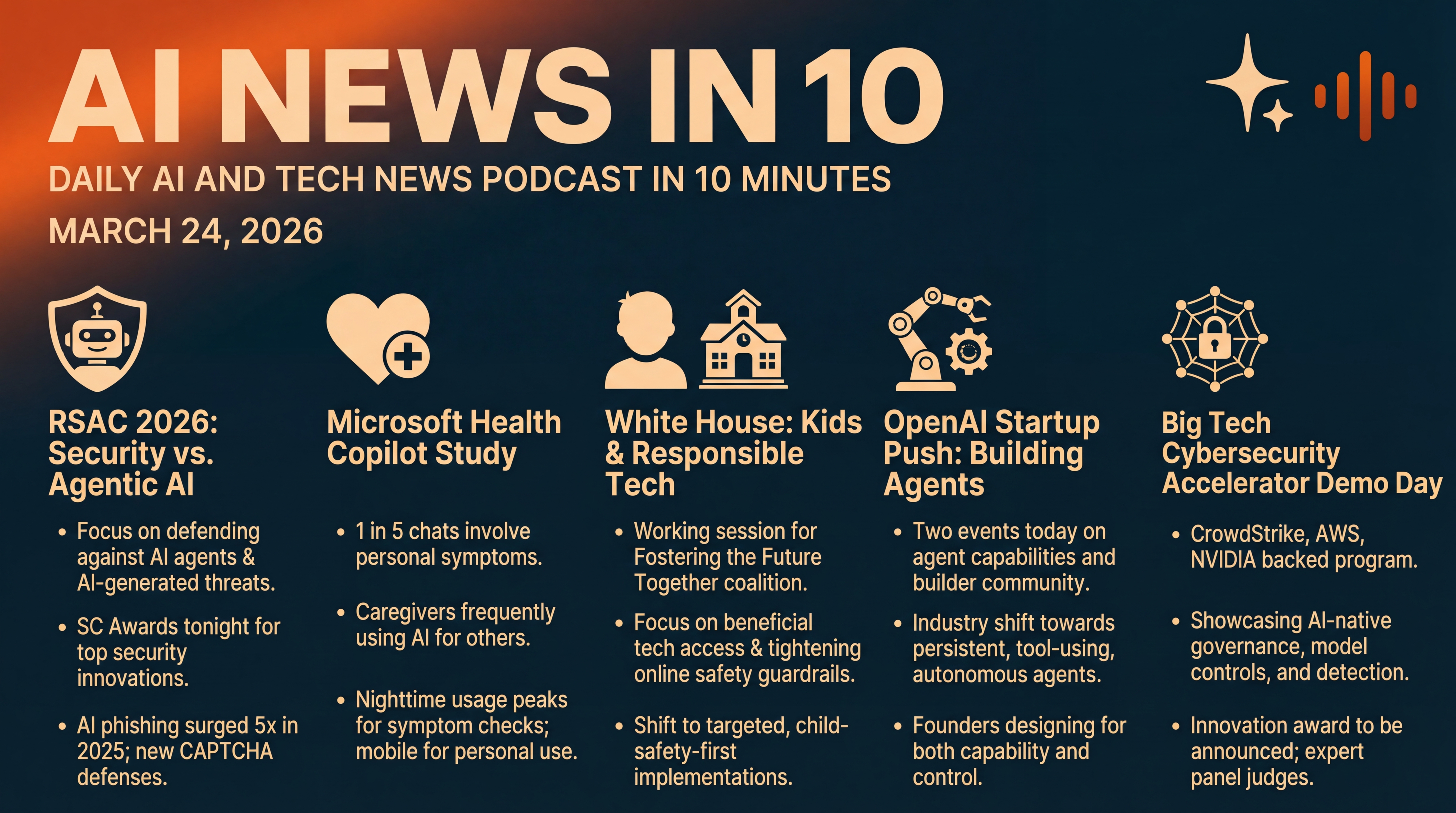
First up, RSA Conference 2026 is in full swing at Moscone. The vibe is crystal clear — security is racing to keep up with agentic AI.
The Early Stage Expo opens wider access this week, and tonight is a big one for bragging rights with the SC Awards reception in San Francisco. Expect lots of security for AI systems — detection, governance, and defenses tuned for autonomous agents.
If you want a snapshot of what defenders are facing, here's a stat making the rounds. AI-generated phishing and malware emails surged about fivefold in 2025... and they're getting better at slipping past legacy filters.
That's from AegisAI's new State of the AI Threat in Email report, published ahead of RSAC. The company is also previewing a system to neutralize adversarial AI CAPTCHAs — a sign that even bot defenses are entering an AI-versus-AI phase.
Vendors are timing launches for the show, too. Netskope is demoing AI-ready data security — think data lineage and model control-plane protections. Vicarius is introducing continuous agentic validation to stress-test how well enterprise defenses hold up against autonomous attack chains. Both play to this year's defend-against-agents theme. If you're walking the floor, they're worth a stop.
Second story. Microsoft just published a study analyzing more than 500,000 de-identified, health-related Copilot conversations from January. It maps what people actually ask conversational AI about their health — and when.
A few takeaways stand out. Nearly one in five conversations involves personal symptoms or condition discussions, suggesting these tools are becoming a first stop for triage. Roughly 40 percent of chats are general health information, but the topics skew toward specific treatments and conditions — which the authors say likely understates true personal intent. And about one in seven personal queries is about someone else — a child, a parent, a partner — showing how often AI is used by caregivers, not just patients.
Time of day and device matter, too. Symptom and emotional-health questions spike in the evening and at night — when traditional care access is limited. Mobile usage leans more personal; desktop skews toward professional and academic work.
The authors argue UI and safety design should reflect these contexts — think clearer guidance to seek care after red-flag symptom checks, and caregiver-aware responses when someone is asking on another person's behalf. It's an early, platform-specific look... but it's real-world telemetry that health systems, app builders, and regulators can use right now.
Third story. In Washington, the White House is hosting a working session today for Fostering the Future Together — a global coalition focused on children's well-being, education, and the responsible use of technology, including AI.
Delegations are gathering for practical workshops, with a high-level roundtable of First Spouses slated for tomorrow. The aim is concrete commitments that expand access to beneficial tech in schools... while tightening guardrails around online risks and youth mental health. It's a sign that policy conversations are shifting from broad AI principles to targeted, child-safety-first implementations.
[MIDPOINT_SPONSORS]
Fourth. OpenAI is leaning into the startup ecosystem today with two events. This morning at 10 a.m. Pacific, there's an online Build Hour focused on agent capabilities — how to design agents that tackle long-horizon tasks across large datasets. And this evening at 5 p.m. in San Francisco, OpenAI hosts a Builder Lounge with co-working, an AMA, and community networking.
If you're a founder trying to wring real workflow value out of agents — or just trying to keep up with rapid API changes — these are timely touchpoints.
It lines up with what we're seeing at RSAC. The industry is moving from simple, prompt-in, answer-out assistants toward persistent, tool-using agents that plan, retrieve, and act. Great for productivity... but also a bigger attack surface. The smartest founders this spring are designing for both sides of that ledger — capability and control — from day one.
Fifth and finally. Also in San Francisco today, a CrowdStrike, AWS, and NVIDIA cybersecurity startup accelerator is holding its in-person Demo Day at the AWS Startup Loft, timed to RSAC. The program showcases companies building for exactly the problems we've been talking about — governance of end-user generative AI use, model and data controls, and AI-native detection.
An expert panel will pick an innovation award winner, with potential follow-on from CrowdStrike's Falcon Fund. Whatever your stage, it's a good read on where enterprise buyers think the AI security puck is headed next.
Quick recap before we go.
RSAC's day-two focus makes it clear — the security market is rapidly retooling for agents and AI-generated threats, with awards and launches hitting tonight. Microsoft's new study shows people are using conversational AI for personal health — often after hours — raising the stakes for safety-by-design. The White House is convening partners to turn responsible tech into tangible protections for kids. OpenAI's startup events are all about building better agents... and that Big Tech-backed accelerator is betting those same agents will need serious governance and guardrails.
We'll keep watching what gets announced tonight — and what ships next.
Thanks for listening and a quick disclaimer, this podcast was generated and curated by AI using my and my kids' cloned voices, if you want to know how I do it or want to do something similar, reach out to me at emad at ai news in 10 dot com that's ai news in one zero dot com. See you all tomorrow.
