
California Leads AI Rules, Models Migrate, Video Gets Cheaper
California pushes ahead with sweeping AI rules as OpenAI sunsets GPT-4o, Anthropic buys into biotech, and DeepMind lowers video costs. Plus, Europe’s chat-scanning derogation expires today, forcing rapid safety and compliance changes across the EU.
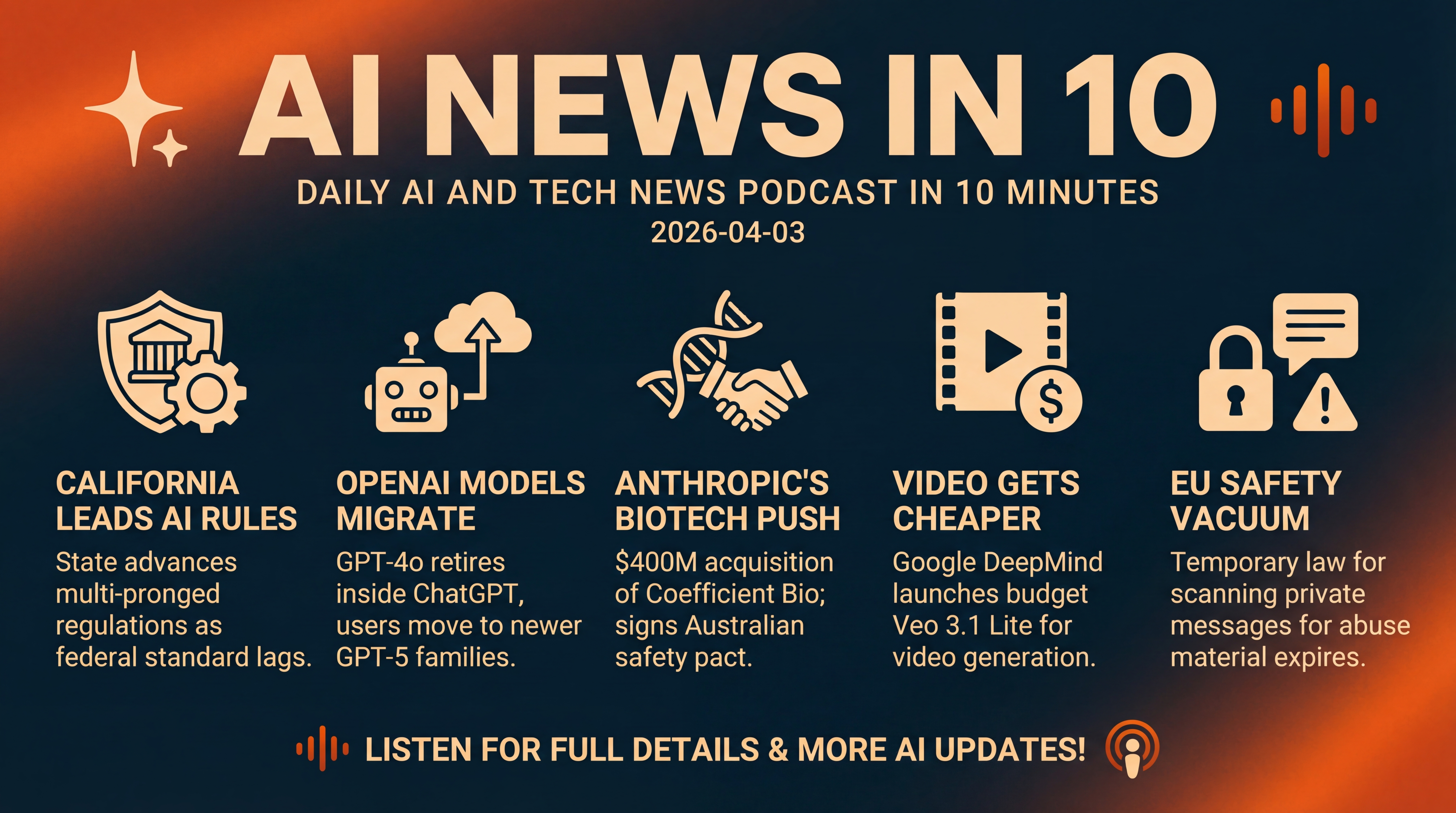
Episode Infographic
Show Notes
Welcome to AI News in 10, your top AI and tech news podcast in about 10 minutes. AI tech is amazing and is changing the world fast, for example this entire podcast is curated and generated by AI using my and my kids cloned voices...
Here’s what’s moving in AI and tech for Friday, April 3, 2026.
California is doubling down on becoming America’s AI rule‑setter... even as Washington pushes for a single federal standard.
OpenAI flips the final switch on GPT‑4o inside ChatGPT today, migrating users to newer models.
Anthropic makes a surprising biotech play with a roughly four hundred million dollar acquisition — while also signing a government safety pact in Australia.
Google DeepMind launches a budget‑friendly Veo 3.1 Lite for video generation and plans a price cut next week.
And in Europe, a temporary legal basis that let platforms scan private messages for child sexual abuse material expires today... creating a compliance and safety vacuum.
Let’s get into it.
[BEGINNING_SPONSORS]
Story one — California’s sprint to codify AI.
The state is moving ahead with a multi‑pronged approach — model transparency, testing and reporting obligations, sector‑specific guardrails, and safety incident disclosures — that could become a de facto national standard simply because of California’s market size and enforcement muscle.
The timing is striking. The White House is urging Congress to pass a national framework that would preempt most state AI laws. If federal preemption advances, it would rein in California’s patchwork... but until Congress acts, companies will likely build to California’s bar. That’s why we’re already hearing general counsels call Sacramento the default spec for US compliance in 2026.
A couple of practical angles for builders and IT leaders. First, expect more mandatory disclosures around model evaluations — especially for systems that could impact safety, employment, or consumer rights. Second, California’s approach is converging with emerging expectations in the EU around documentation and risk management for general‑purpose models. Global companies will aim for one harmonized stack of evidence and logs they can show both Sacramento and Brussels. If you’re leading AI governance at the enterprise level, that likely means tooling up for auditable evals, red‑team artifacts, and incident reporting pipelines... before summer.
Story two — OpenAI retires GPT‑4o inside ChatGPT, today.
For Business, Enterprise, and Education customers who still had GPT‑4o available in Custom GPTs, April third is the sunset date. OpenAI says chats and GPTs using deprecated models will auto‑migrate to the newest Instant and Thinking families — GPT‑5.3 Instant for speed‑first use, and GPT‑5.4 variants for deeper reasoning — and that voice and image features tied to related but distinct models remain unchanged. For admins, the gotchas are in app integrations and model pinning. If you’ve hard‑coded model IDs in workflows, confirm the fallbacks... so you don’t wake up to brittle automations on Monday.
What’s the broader takeaway? The retirement underscores how quickly model catalogs churn — and why organizations should plan for evergreen AI estates. That means abstracting model choice behind policy and capability tiers — Instant for chatty tasks, Thinking for complex reasoning — so your governance rules and service‑level agreements persist even as specific model names rotate. It’s also a reminder to monitor cost‑to‑quality ratios as vendors nudge usage toward newer product tiers.
Story three — Anthropic’s biotech move, and a government tie‑up.
The company has acquired Coefficient Bio for roughly four hundred million dollars, signaling a deeper push into AI‑driven drug discovery and life sciences tooling. Think compounds, protein interactions, and lab‑automation copilots — adjacent to the productivity suite where Claude already has traction. Separate but related, this week the Australian government signed a memorandum of understanding with Anthropic focused on AI safety research and support for Australia’s National AI Plan — including commitments around working with the AI Safety Institute and powering compute with renewables. That gives Anthropic a clear public‑sector partner as it expands in the region... and it’s opening a Sydney office this year.
Why it matters. On the tech side, the Coefficient Bio deal puts frontier‑model talent closer to complex scientific domains where data quality, simulation, and lab integration matter as much as raw model capability. On the policy side, the Australia agreement is notable for tying safety work to concrete infrastructure and energy commitments at a national level — a template we may see replicated with other governments that want AI investment, but with explicit safety and power‑sourcing guardrails.
[MIDPOINT_SPONSORS]
Story four — video gen gets cheaper. Google DeepMind launches Veo 3.1 Lite.
Rolling out this week via the Gemini API and AI Studio, Veo 3.1 Lite is pitched as Google’s most cost‑effective video model. It supports text‑to‑video and image‑to‑video at seven twenty p and ten eighty p, with flexible durations — four, six, or eight seconds. For developers, the eye‑catcher is pricing. Lite lands at less than half the cost of Veo 3.1 Fast, and Google says it’ll cut Fast pricing on April seventh as well. If you’re prototyping social ads, educational clips, or A slash B creative at scale, this pricing curve could flip your build‑versus‑buy math... especially if you’ve been throttling volumes to stay under budget caps.
One strategic note. We’re now seeing all the majors create good‑enough video tiers for high‑volume pipelines and keep the premium tiers for longer shots or higher fidelity. If you’re a platform product manager, design your render queue to route work by intent — Lite‑class for iterative ideation, higher tier for final cuts — so you don’t overspend. Also watch for the usual vendor lock‑in levers... codecs, asset storage, and effect libraries that make switching costly.
Story five — a European safety and privacy pivot. The interim legal basis for voluntary detection of child sexual abuse material in private messages expires today.
Known informally as Chat Control one point zero, the temporary ePrivacy derogation let platforms like messaging apps and social sites voluntarily scan for known child sexual abuse material using hash matching. Lawmakers failed to agree on another extension in March, which means the derogation sunsets on April third — creating legal uncertainty for providers operating in the EU. Without a new deal, companies face a difficult trade‑off between safety tooling and data‑protection risk. Several child‑safety groups and tech firms had urged a bridge solution; privacy advocates, meanwhile, warned against untargeted mass scanning. Expect near‑term changes to detection practices, reporting flows, and trust and safety playbooks across EU‑facing products.
Operationally, this could mean pausing or narrowing scanning features in the EU... spinning up targeted, court‑authorized detection under other legal bases... and accelerating investments in on‑device safety, age assurance, and abuse prevention that don’t involve inspecting private content. For product leaders, the message is clear — localize safety architecture to regional legal realities, document your risk assessments, and prepare communications for users and regulators.
Quick recap before we go.
California is tightening its grip as America’s AI rule‑setter, while the White House asks Congress for a single national framework. OpenAI officially shutters GPT‑4o inside ChatGPT today — admins, check your fallbacks. Anthropic dives into biotech with a four hundred million dollar Coefficient Bio deal and deepens ties with Australia on AI safety. Google DeepMind launches Veo 3.1 Lite and will trim video model pricing April seventh. And in Europe, the interim chat‑scanning law expires today, reshaping platform safety practices in the EU. We’ll keep watching how these legal and product shifts ripple through your roadmaps next week.
Thanks for listening and a quick disclaimer, this podcast was generated and curated by AI using my and my kids' cloned voices, if you want to know how I do it or want to do something similar, reach out to me at emad at ai news in 10 dot com that's ai news in one zero dot com. See you all tomorrow.
