Copilot Momentum, Claude Limits, and Mac GPU Compute
We break down Microsoft’s pivot to monetizing Copilot and the weekend uproar as Anthropic restricts Claude subscriptions in third-party tools. Plus, Planet Labs curbs Iran-conflict imagery, Apple signs a driver enabling external AMD and Nvidia GPUs for AI on Apple Silicon, and Samsung nudges U.S. users to Google Messages and RCS.
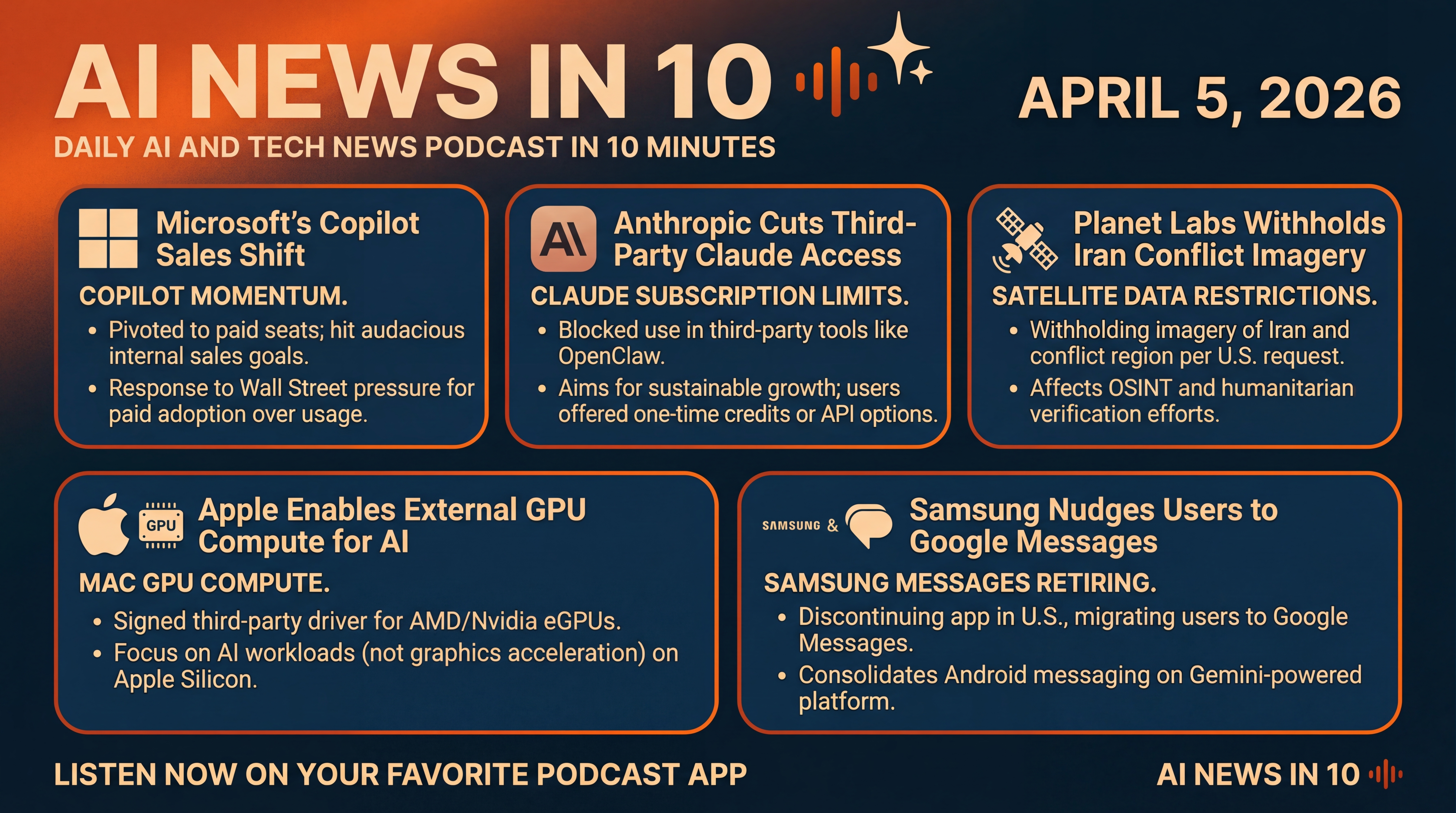
Episode Infographic
Show Notes
Welcome to AI News in 10, your top AI and tech news podcast in about 10 minutes. AI tech is amazing and is changing the world fast, for example this entire podcast is curated and generated by AI using my and my kids cloned voices...
It’s Sunday, April 5, 2026 — and we’ve got five meaty stories for you.
Microsoft quietly changed how it sells Copilot and says it just hit some big internal goals... Anthropic shut off Claude subscription access for OpenClaw and other third-party tools, sparking a weekend uproar... One of the world’s top satellite-imaging firms is withholding imagery of the Iran conflict at the request of the U.S. government... Apple signed a third-party driver that lets AMD and Nvidia external GPUs do AI work on Apple Silicon Macs — but no, it won’t make your games faster... and Samsung says it’s retiring its Messages app in the U.S., nudging millions toward Google Messages and R C S. Let’s get into it.
[BEGINNING_SPONSORS]
Microsoft first — and this one is about the business of AI more than the tech.
Inside the company, leaders told staff late this week that Microsoft hit some pretty big, audacious goals for Copilot sales in the quarter that ended in March — after pivoting from bundling Copilot everywhere to actually selling paid seats. Reporting says the shift followed blunt feedback from Wall Street — Microsoft needs to show paying adoption, not just usage. The comment came from Judson Althoff, who runs Microsoft’s commercial business, during an internal meeting on Thursday, April 2.
Why does this matter? As of January, Microsoft itself said only about three percent of customers were paying for Microsoft 365 Copilot — despite heavy capital spend and lots of product surface area. That three percent has hung over the stock. Independent reporting echoed the figure — around three to three point three percent — and added that Microsoft had roughly fifteen million paid Copilot seats at the time. So hearing that the team hit its audacious goals suggests momentum is finally showing up on the sales dashboards.
We’ll watch April earnings for hard numbers — but strategically, flipping from a distribution mindset to a monetization mindset is a notable turn.
Zooming out, Copilot is now everywhere — in Office, Windows, and even shopping flows — and some chats are turning straight into a checkout lane for retail partners. None of that will quiet investors unless paid conversion climbs... so this internal signal will have analysts leaning forward.
Story two: Anthropic lit up developer feeds this weekend by cutting off Claude subscription use in third-party harnesses like OpenClaw.
The change took effect at noon Pacific on Saturday, April 4. An email told subscribers they would no longer be able to use their Claude subscription limits with third-party harnesses including OpenClaw. Anthropic’s head of Claude Code, Boris Cherny, said these tools create outsized strain and that the company wants to manage growth more sustainably. Anthropic is offering a one-time credit equal to the monthly plan price and is pointing heavy users to usage bundles or the A P I. Developers are split — some say this protects the platform from being bled dry, others call it a trust hit that will push power users to local or open alternatives.
Context matters. A lot of agentic-coding workflows were piggybacking Claude subscriptions through third-party harnesses that kept agents running — and running — well beyond what a flat monthly plan can economically support. If you’re budgeting for April, the upshot is that OpenClaw and similar tools now require either an additional metered bundle or an A P I key... which means your per-token costs get real again. Watch for a ripple toward open-source, on-device agents for the heaviest users.
Third, the skies just went dim for open-source intelligence.
Planet Labs — the U.S. commercial satellite-imaging company — says it’s withholding imagery of Iran and the broader conflict region at the request of the U.S. government. Customers were notified that, effective retroactively from March 9, access shifts to a managed-distribution model with case-by-case releases for urgent public-interest needs. This is a major change for journalists, analysts, and humanitarian groups who rely on near-real-time shots to verify claims on the ground. It also underscores the tension between the commercial space sector’s openness and wartime operational security. Reports note the move expands earlier delays on Middle East imagery that Planet had already imposed as the war escalated.
What should you read into this? For O S I N T communities, less frequent, less immediate imagery means verification gets slower — and more contingent on official narratives. For governments, it reduces the risk that high-resolution imagery aids adversaries’ battle-damage assessments. And for Planet — which also sells imagery to the U.S. government — it’s a reminder that even commercial space sits close to national-security fault lines.
[MIDPOINT_SPONSORS]
Fourth today, Apple quietly took a step that — on paper — brings Nvidia and AMD GPUs back into the orbit of Mac... for AI work.
Apple signed a third-party driver from Tiny Corp that enables select AMD RDNA 3 and newer, and Nvidia Ampere and newer graphics cards to run as external GPUs over Thunderbolt or USB 4 on Apple Silicon Macs. Big asterisk — this is not for graphics acceleration, so no boost to your game frame rates, and video out is not accelerated. It’s expressly for compute workloads like running or fine-tuning models. Still, that’s a real shift for researchers and indie builders who’ve been limited to Apple’s integrated GPU and the Neural Engine.
A few practical details. According to the documentation, you’ll need macOS 12.1 or later, a compatible enclosure with enough power, and — in many cases — Docker for Nvidia. Apple signing the driver means you no longer have to disable System Integrity Protection to experiment — important for lab Macs and corporate machines. For anyone building local agents, retrieval pipelines, or custom fine-tunes, this opens the door to tapping commodity GPUs on a Mac Studio or even a MacBook Pro docked to an enclosure. It’s not turnkey — and it’s not Apple broadly endorsing Nvidia — but it is a meaningful lane for AI compute on Apple Silicon.
Our fifth story is a consumer-scale shift with big AI implications for messaging.
Samsung says it will discontinue its Samsung Messages app in the U.S. in July 2026, with Google Messages as the intended replacement. New Galaxy devices are already steering users away from Samsung Messages. The company’s notice includes a step-by-step migration and notes that older devices may see temporary R C S disruption during the switch. Why cover this on an AI show? Because Google Messages is where Google’s R C S push — and its Gemini-powered features — live. Samsung is effectively consolidating Android messaging in the U.S. onto a platform that bakes in AI-driven spam and scam detection, smart replies, expressive media tools, and cross-device continuity. It’s a soft-power win for R C S — and for Google’s AI footprint in everyday texting.
Two quick notes while we’re here.
First, the research drumbeat on how people interact with AI is getting louder. A University of Pennsylvania team just published experiments across more than 1,300 participants and 9,500 trials, showing what they call cognitive surrender — users accepting faulty AI reasoning far more often than you’d expect, even when it’s wrong. For product folks shipping AI features, that’s a push to design stronger verification and feedback loops... not just slicker prompts.
Second, back to Microsoft. Investors will be laser-focused on whether that audacious-goals line for March turns into higher paid-seat conversion this quarter. Remember, the company’s own disclosures earlier this year pegged paid conversion at roughly three percent. If that needle moves, it’ll show up in attach rates, A R P U, and — ultimately — gross margin commentary.
Alright, rapid recap...
Microsoft says it hit internal Copilot sales goals after a pivot to selling paid seats — watch earnings for the proof... Anthropic shut off Claude subscriptions for OpenClaw and other third-party tools, offering credits as it nudges heavy users to usage bundles or the A P I... Planet Labs is withholding imagery of Iran and the conflict region under a U.S. request — a big blow to O S I N T’s cadence... Apple signed a third-party external GPU driver so Apple Silicon Macs can tap AMD and Nvidia GPUs for AI compute — no graphics acceleration, but a win for researchers... and Samsung will retire its Messages app in July, consolidating U.S. Galaxy users on Google Messages and its Gemini-powered features.
Thanks for listening and a quick disclaimer, this podcast was generated and curated by AI using my and my kids' cloned voices, if you want to know how I do it or want to do something similar, reach out to me at emad at ai news in 10 dot com that's ai news in one zero dot com. See you all tomorrow.
