
AI Chips Soar, Cloud PCs Get Cheaper
Inside Amazon’s shareholder letter: Trainium demand nearly sold out, power capacity surging, and even potential chip rack sales. Plus Microsoft trims Windows 365 prices, South Korea guarantees baseline mobile data, Windows 11 tones down Copilot buttons, and Intel deepens its AI pact with Google.
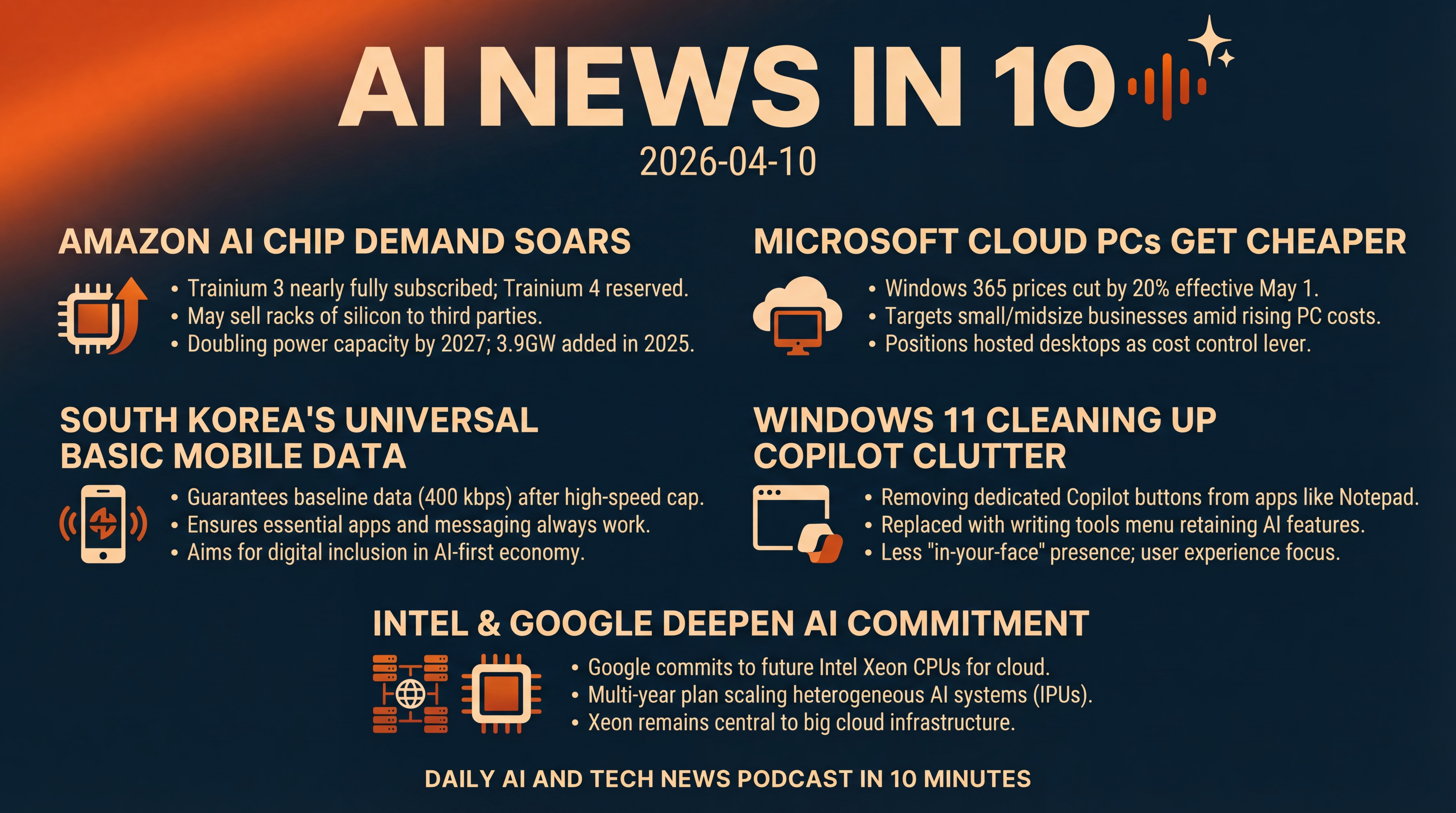
Episode Infographic
Show Notes
Welcome to AI News in 10, your top AI and tech news podcast in about 10 minutes. AI tech is amazing and is changing the world fast, for example this entire podcast is curated and generated by AI using my and my kids cloned voices...
It’s Friday, April 10, 2026, and here’s what’s on deck: Amazon’s shareholder letter is a goldmine — AI chips nearly sold out, power capacity surging, and even a hint it might sell racks of its own silicon to others... Microsoft takes a swing at desktop costs with a 20 percent cut to Windows 365 Cloud PCs... South Korea rolls out universal basic mobile data so you’re never totally offline... Microsoft also starts cleaning up those Copilot buttons in Windows 11 apps... and Intel lands a deeper AI infrastructure commitment from Google that keeps Xeon squarely in big cloud.
Let’s get into it.
[BEGINNING_SPONSORS]
Story one. Amazon’s Andy Jassy just dropped his annual letter to shareholders — and it’s the clearest window yet into how AWS is meeting the AI compute crunch.
Demand for Amazon’s custom Trainium chips is so strong that Trainium 3 — shipping early this year — is nearly fully subscribed, and a significant chunk of Trainium 4 — about eighteen months out — is already reserved.
He even floats selling entire racks of chips to third parties in the future, noting that if Amazon’s chips business were standalone — selling to AWS and others — it would be running at roughly fifty billion dollars a year. That’s a striking shift for a cloud provider that has historically kept its silicon in house.
The letter also quantifies AWS’s infrastructure sprint: 3.9 gigawatts of power capacity added in 2025, with plans to double total capacity by the end of 2027 — yet demand still exceeds supply. Two very large customers even asked to buy all of AWS’s Graviton CPU instance capacity for 2026 — a request Amazon says it declined to protect other customers.
Jassy pegs AWS’s AI revenue run rate at over fifteen billion dollars about three years into this wave, and argues Trainium’s price performance can deliver tens of billions in annual capital spending savings versus relying on others’ chips for inference.
And beyond the cloud, Amazon sketches an automation and connectivity roadmap: over one million robots already working in fulfillment centers; Prime Air aiming for 30 million customers by year’s end with 30 minute deliveries; and its low Earth orbit 'Amazon Leo' broadband service officially scheduled to launch mid 2026 with around 200 satellites to start — tightly integrated with AWS for data, analytics, and AI. That’s Amazon pointing AI upward — to space — while it also runs more of AI on its own silicon here on Earth.
Story two. Microsoft is cutting prices on Windows 365 Cloud PCs by 20 percent, effective May 1.
The price drop comes alongside an on demand start behavior change — Cloud PCs stay powered on for an hour after sign out, and reconnects after an hour may resume from hibernation, which can take a bit longer to wake... but performance is preserved once it’s up.
The new pricing targets small and midsize businesses and arrives as physical PC component costs rise — positioning hosted desktops as a cost control lever. Gartner has been arguing that hosted desktops are closing the total cost of ownership gap with laptops — momentum Microsoft clearly wants to accelerate.
If you haven’t priced Windows 365 in a while, Microsoft’s Business lineup advertises three base tiers — Basic, Standard, and Premium — each with fixed vCPU, RAM, and storage bundles, mirrored in Enterprise plans with higher fleet ceilings. The 20 percent cut applies on renewal for existing subscribers and for new sign ups starting May 1. Watch for updated partner communications and SKUs over the next couple of weeks.
Story three. A big policy move out of Seoul. South Korea is launching universal basic mobile data access for everyone — after you use up your high speed cap, carriers will continue providing data at 400 kilobits per second so essential apps still work.
The Ministry of Science and ICT says SK Telecom, KT, and LG Uplus have agreed to the program, with the government also pressing for cheaper 5G plans — 20,000 won or less — and better Wi Fi on subways and long distance trains. Officials frame the policy as both a public interest safeguard and a nudge for telcos to rebuild trust after recent security lapses.
Local coverage adds that the basic access policy is designed to ensure messaging and other light online tasks keep working post cap without extra charges, and that it’s rolling out across LTE and 5G plans. It’s a notable template for other nations debating minimum connectivity in an AI first economy... where being offline can mean being locked out.
[MIDPOINT_SPONSORS]
Story four. Microsoft is cleaning up Copilot clutter in Windows 11. In new Insider builds, the company has begun removing the Copilot button from apps like Notepad and Snipping Tool, replacing it in Notepad with a writing tools menu that still brings AI features — just without the always present Copilot branding.
Microsoft previously promised to reduce unnecessary Copilot entry points across first party apps including Photos and Widgets — and this is the first visible swing at that promise. It’s less about killing features and more about toning down Copilot’s in your face presence while leaving the underlying AI intact.
It also reopens a broader user experience question: where should AI live in the Windows experience? A quieter integration could reduce fatigue and help users find AI when it’s useful — rather than when a button says so. The next litmus test... will Microsoft stick with the dedicated Copilot key requirement on new Windows keyboards, or rethink that too? Watch this space.
Story five. Intel just deepened its AI infrastructure collaboration with Google. In a joint announcement, the companies say Google has committed to future generations of Intel’s Xeon CPUs for cloud workloads... and they highlight custom infrastructure processing units — IPUs — as part of a multi year plan to scale heterogeneous AI systems. The release also references ongoing Xeon 6 deployments in Google Cloud’s workload optimized instances.
It’s a strategically important signal for Intel: even as accelerators dominate headlines, big AI clouds still need high efficiency, high core count CPUs to orchestrate, feed, and secure those GPU and TPU clusters. Bloomberg Law’s write up underscores the commitment angle — Intel’s effort to keep Xeon central to hyperscale data centers as AI reshapes hardware stacks. For developers and enterprises, the takeaway is clear: the AI era isn’t CPU or accelerator — it’s both... plus smarter networking silicon to keep the pipelines full. Expect to hear more at Google Cloud Next later this month.
Quick recap. Amazon says Trainium 3 is almost spoken for — and it might even sell racks of chips to others — all while doubling power capacity by 2027. Microsoft trims Windows 365 prices 20 percent to make virtual PCs more attractive. South Korea guarantees baseline mobile data at 400 kilobits per second after caps. Windows 11 starts dialing back Copilot buttons without dropping AI features. And Intel secures a deeper, multi year AI infrastructure pact with Google — keeping Xeon in the cloud conversation.
That’s your AI and tech rundown for Friday, April 10, 2026.
Thanks for listening and a quick disclaimer, this podcast was generated and curated by AI using my and my kids' cloned voices, if you want to know how I do it or want to do something similar, reach out to me at emad at ai news in 10 dot com that's ai news in one zero dot com. See you all tomorrow.
