
Cloud Breach Fallout, Cheaper AI Video, Smarter Glasses
From a confirmed EU cloud breach to cheaper Google AI video, state-level pushback on data centers, shifting EU AI Act timelines, and Meta’s prescription-ready smart glasses — here’s what matters and why. Practical takeaways for builders, security leaders, and policy watchers.
Episode Infographic
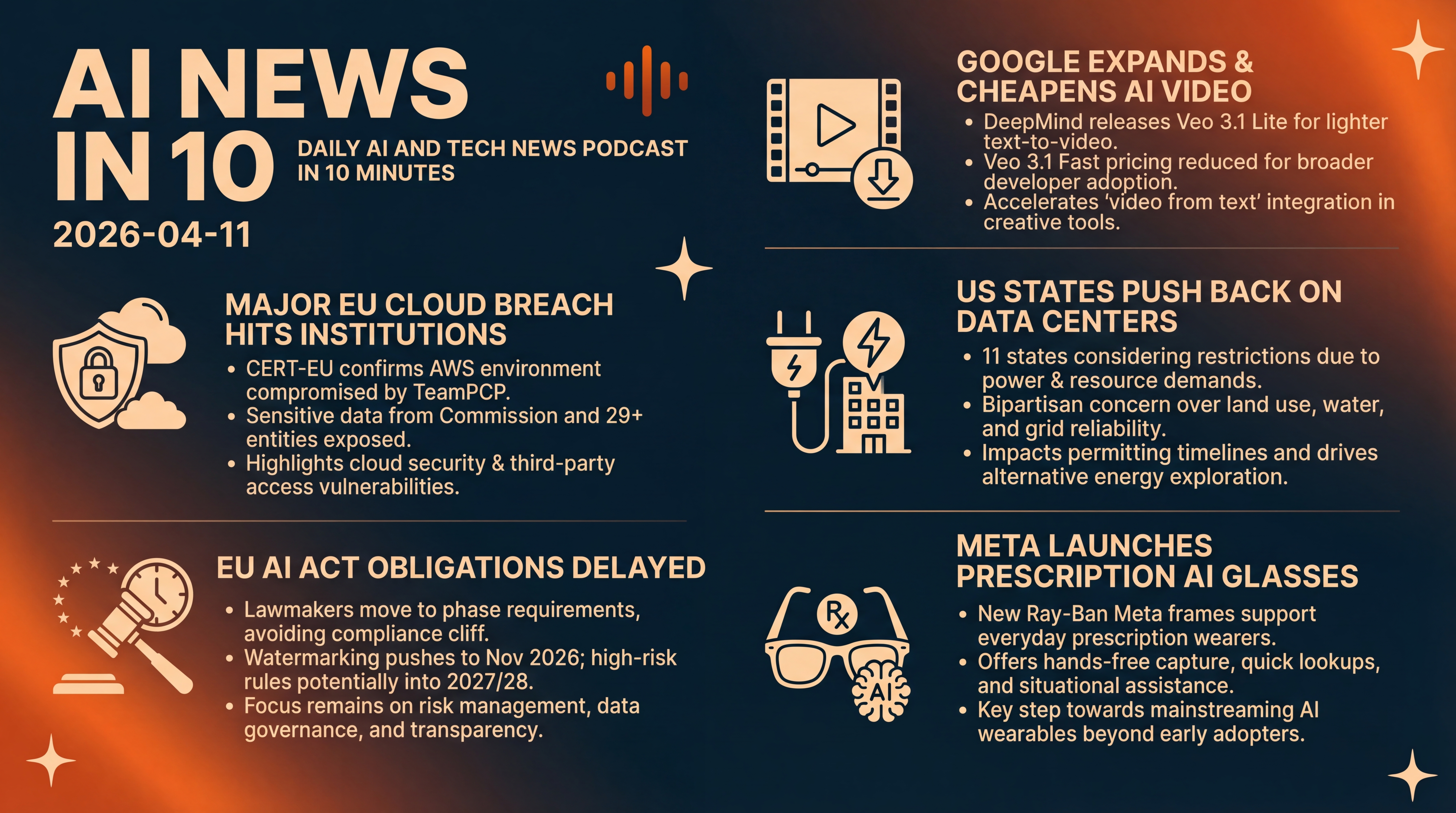
Show Notes
Welcome to AI News in 10, your top AI and tech news podcast in about 10 minutes. AI tech is amazing and is changing the world fast, for example this entire podcast is curated and generated by AI using my and my kids cloned voices...
It’s Saturday, April 11, 2026, and today we’ve got a sharp mix of security, policy, and product news. Europe is probing a major cloud breach hitting its own institutions, Google is expanding access and trimming prices on AI video, U.S. states are pushing back on data center sprawl, Brussels is fine-tuning its sweeping AI law, and Meta is bringing AI glasses to people who actually need prescription lenses. Let’s dive in.
[BEGINNING_SPONSORS]
First up, a cyber story with policy overtones in Brussels.
CERT-EU has confirmed that the European Commission’s AWS cloud environment was breached by a threat group known as TeamPCP, exposing sensitive data from the Commission and at least 29 other EU entities. Investigators are still scoping the damage, but the lesson is clear — cloud, and the third-party access around it, has become a soft underbelly for public institutions.
Early findings say credentials and internal documents were accessed, raising questions about segmentation, key management, and whether zero trust controls were consistently applied. Reports indicate the attackers targeted the Commission’s AWS environment and moved across connected tenants.
For CISOs listening... revisit assumptions about intra-tenant trust and identity brokering — especially for privileged roles.
Source: Integrity360’s Cyber News Roundup on April 10, citing CERT-EU.
Second, Google’s AI video stack just got more accessible.
DeepMind published the Veo 3.1 Lite model card this week — a lighter weight system that can synthesize high-quality video, with audio, from text prompts or images. Pair that with Google’s note that, as of April 7, pricing for Veo 3.1 Fast has been reduced, and you can see the strategy — broaden developer adoption while keeping a premium tier for heavier lifts.
If you’re building creative tools or marketing workflows, this matters. Lite variants enable rapid prototyping and lower-cost experimentation, while Fast tiers handle higher fidelity and throughput. Expect more apps to ship "video from text" as a default — because the marginal cost just dropped.
Sources: Google DeepMind’s Veo 3.1 Lite model card published April 8, and Google’s blog outlining April 7 pricing changes for Veo 3.1 Fast.
Third, the data center backlash is getting very real at the U.S. state level.
At least eleven states — from Georgia and South Carolina to Minnesota, New York, Vermont, and Virginia — have introduced or are considering restrictions on new data center development, citing concerns about power, water, land use, and grid reliability. Axios frames it as a bipartisan election-year flashpoint: voters want AI-powered growth, but they don’t necessarily want a substation, diesel backup, and a 100 megawatt campus in their backyard.
For the AI industry, that could mean longer permitting timelines, more incentives to co-locate next to existing industrial loads, and sharper pressure to adopt liquid cooling and heat reuse. It also adds urgency to the hunt for new power — everything from long-term power purchase agreements to small modular reactors and advanced geothermal.
Source: Axios Technology, April 5.
[MIDPOINT_SPONSORS]
Fourth, a notable shift in Europe’s rulebook.
Lawmakers are moving to delay or phase certain obligations in the EU AI Act to avoid a compliance cliff. Committees in Parliament support pushing the watermarking requirement for AI generated media to November 2, 2026. Legal analyses from European tech law firms suggest additional postponements for some high-risk system obligations into 2027 or even 2028 under a broader "Digital Omnibus" cleanup.
The goal — at least on paper — is to line up standards, conformity assessments, and sector rules so providers aren’t coding to a moving target. What should companies do? Keep implementing risk management, data governance, and model transparency now... but watch the calendar. Delays are about timing, not direction — the core risk-based architecture isn’t changing.
Sources: CIO’s April update on Parliament’s position, and Fladgate’s April roundup detailing proposed new dates and scope.
And fifth, a product story with very human implications.
Meta announced new Ray-Ban Meta glasses built to support prescription wearers — part of its broader push to blend on face AI assistants with everyday eyewear. Alongside last week’s AI model updates, Meta says these frames are for people who actually rely on glasses all day — a key step toward mainstreaming AI wearables beyond early adopters.
Think hands-free photo and video capture, quick AI lookups, and situational assistance... without juggling contacts or a second pair of frames. It’s also a competitive signal. As Apple, Google, and Snap scope the next wave of smart eyewear, prescription support is table stakes for mass adoption.
Source: Meta Newsroom, April 8.
Quick reality check as we wrap...
Today we covered a significant European cloud breach linked to TeamPCP and confirmed by CERT-EU. Google’s two-step on AI video with Veo 3.1 Lite plus a pricing trim. State-level brakes on data center growth in the U.S. The EU pacing its AI Act to match real-world complexity. And Meta making AI glasses friendlier for prescription users.
The through line? AI is colliding with infrastructure, regulation, and daily life — fast — and today’s decisions on security, power, policy, and product design will shape how smoothly this all scales tomorrow. Stay safe, stay curious... and I’ll catch you next time.
Thanks for listening and a quick disclaimer, this podcast was generated and curated by AI using my and my kids' cloned voices, if you want to know how I do it or want to do something similar, reach out to me at emad at ai news in 10 dot com that's ai news in one zero dot com. See you all tomorrow.
