Adobe Zero Day, Counter-Drone AI, Artemis II
Urgent Adobe Acrobat zero day, AI counter-drone defenses for the World Cup, Microsoft's plan for an agentic SOC, a humanoid robot production surge, and fresh Artemis II mission data—packed into a fast, practical rundown. Patch guidance, governance takeaways, and where autonomy is headed next.
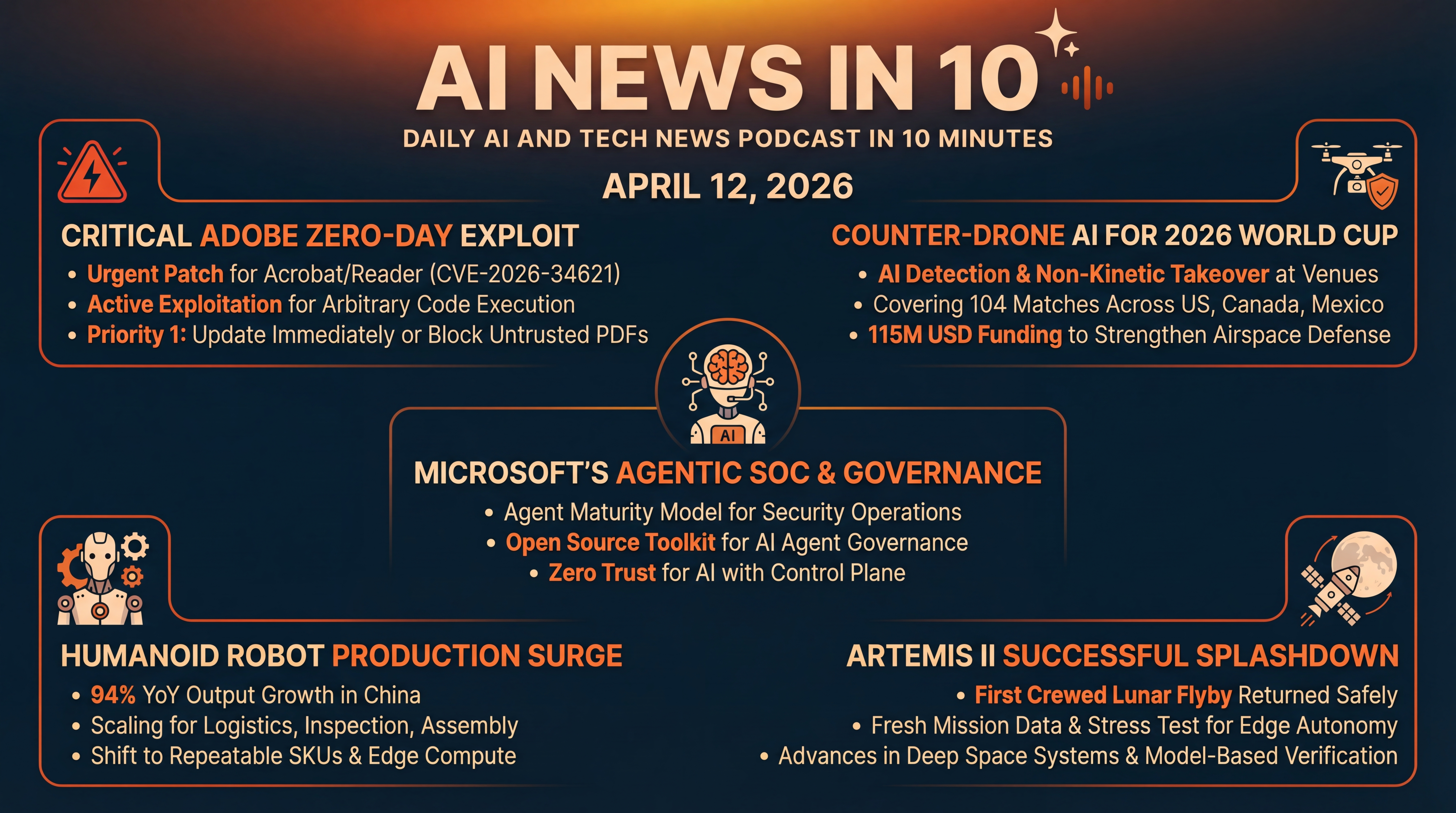
Episode Infographic
Show Notes
Welcome to AI News in 10, your top AI and tech news podcast in about 10 minutes. AI tech is amazing and is changing the world fast, for example this entire podcast is curated and generated by AI using my and my kids cloned voices...
It's Sunday, April 12, 2026, and here's what's shaping the AI and tech landscape right now.
We've got a critical Adobe zero day under active exploitation — and a patch you should install today... new counter-drone AI headed for this summer's massive sporting venues... Microsoft laying out how security teams will actually run with AI agents at scale... a forecast that says humanoid robots are about to hit the gas... and NASA closing out Artemis II with fresh mission data after Friday night's splashdown.
Let's get into it.
[BEGINNING_SPONSORS]
Story One — Urgent: Adobe Acrobat zero day is being exploited
If you or your company use Adobe Acrobat or Reader, there's a weekend patch you shouldn't sleep on. Adobe disclosed a critical vulnerability — tracked as CVE-2026-34621 — in Acrobat and Reader for Windows and macOS, and the company says attackers are already exploiting it.
Affected builds include Acrobat and Reader DC 26.001.21367 and earlier, plus the Classic 2024 track 24.001.30356 and earlier. If you're on those versions or older, update immediately through Creative Cloud or your managed software channel.
The impact is arbitrary code execution — exactly the kind of foothold attackers love to chain with phishing or privilege escalation bugs. Adobe rates this Priority 1, which means broad deployment is expected within 72 hours. If you manage fleets, fast track testing and ring deployments today, and consider a temporary policy to block untrusted PDFs from launching external processes. That alone can blunt a lot of real-world Acrobat exploits.
This bulletin posted Saturday, April 11 — so it's as fresh as it gets. Per advisory APSB26-43, the mitigation is an update, not a configuration change. Full details are in the show notes.
While you're in there, review EDR alerts where Reader or Acrobat spawn PowerShell or Script Host, and look for suspicious child processes. Adobe's cadence is familiar — March releases often roll smaller fixes, but the company escalates mid cycle when attackers start hitting live systems. Don't wait for Tuesday. More in the show notes.
Story Two — AI counter-drone protection lines up for the 2026 World Cup
With 104 matches across the U.S., Canada, and Mexico, airspace security is a headline risk — and multiple firms are being tapped to help. Ondas said this week its Sentrycs subsidiary has landed multimillion-dollar contracts to deploy detection and takeover tech across most World Cup venues, covering stadiums, fan zones, and related sites.
These systems use cyber over RF to identify, locate, and — where permitted — assume control of unauthorized drones without kinetic intercepts, reducing debris and interference risks around packed stadiums. That dovetails with earlier U.S. funding moves: Homeland Security and partner agencies have set aside about 115 million dollars to strengthen counter-UAS defenses ahead of the tournament and other major events.
Expect a layered stack — RF detection and identification, radar, optical tracking, and selective mitigation — under unified command. According to the company's April 7 release and independent coverage, deployments will span venues and practice facilities, with coordination across federal, state, and local teams. Links in the show notes.
Two quick takeaways for event ops and city CIOs: one, non-disruptive mitigation matters when you've got broadcast gear, cellular repeaters, and fans shoulder to shoulder. Two, these deployments are effectively live AIOps exercises — fusing real-time sensor data with rules and machine learning models to make split-second decisions under strict policy. Expect to see this pattern well beyond sports. More in the show notes.
Story Three — Microsoft explains the agentic SOC, and ships tools to govern AI agents
If you've been wondering how security teams will run with AI agents without losing control, Microsoft just filled in key details. The company published a deep dive on the agentic SOC — a three-stage maturity model where AI agents start by accelerating investigations, then orchestrate workflows across identity, data, endpoint, and cloud, and eventually coordinate broader defense outcomes.
Think of it as moving from copilots inside consoles... to agents that raise cases, enrich evidence, draft playbooks, and kick off remediations — always with human oversight. Microsoft highlighted new pieces in Sentinel — like a natural language playbook generator and a model context protocol entity analyzer — plus partner-built agents available in a Security Store. Link in the show notes.
Microsoft also released Secure agentic AI end to end guidance — essentially extending Zero Trust to AI. It covers data pipelines, model access, agent permissions, and runtime safeguards, and it previews a control plane called Agent 365 to observe, govern, and secure agents at scale alongside Defender, Entra, and Purview. For developers and red teams, the open source Agent Governance Toolkit adds runtime policy enforcement to catch prompt injection, tool abuse, and agentic hijacking behaviors before they trigger risky actions. If you're piloting autonomous agents internally, this is quickly becoming the enterprise playbook. Links in the show notes.
One practical note: the governance pitch is not just policy docs. Microsoft is wiring this into identity — least privilege scopes for agents, continuous adaptive access, and telemetry so you can prove who, or what, did what, when. Even if you're multi-vendor, the model — controls wrapped around agents, plus kill switches and audit — is portable. More in the show notes.
[MIDPOINT_SPONSORS]
Story Four — Humanoid robots: production surge and market concentration
An industry read says 2026 is the year humanoids tip from demo to deployment — especially in China. TrendForce is forecasting a 94 percent year-over-year jump in output there, with two manufacturers — Unitree and AgiBot — capturing a dominant share as they scale standardized platforms for logistics, inspection, and light assembly.
The broader point: we're moving from bespoke showcase units to repeatable SKUs with predictable bills of materials, repair paths, and edge compute that can actually run multimodal policies on device. Early pilots show power assist and warehouse put-wall tasks leading adoption, while higher-risk general-purpose factory work waits for better hands, better compliance, and cheaper actuators. Details in the show notes.
For buyers eyeing trials, watch two specs: sustained torque density, and onboard AI throughput. Vendors are quoting 40 to 700 TOPS across classes, though real-world performance depends on sensor fusion and motion planning stacks tuned to each task. On the supply side, expect verticalized packages — perception, policy, gripper kits — rather than a single general brain to do it all. Commercialization should ramp in the second half of 2026 as platforms stabilize and integrators productize the last ten meters of each workflow. More in the show notes.
Story Five — Artemis II splashes down; NASA posts fresh data
NASA's Artemis II — our first crewed lunar flyby in over 50 years — safely splashed down in the Pacific on Friday evening, April 10, capping a roughly ten-day mission that included a far side pass and a maximum distance record for this generation of spacecraft. Over the weekend, NASA has been publishing additional mission materials — reentry logs, trajectory visualizations, and public-facing explainers. Links are in the show notes.
If you're tracking the tech side, Artemis II doubles as a stress test for guidance, navigation, and control systems; radiation-hardened compute; and high-throughput comms — capabilities that feed directly into AI at the edge for Earth observation constellations and deep space autonomy. It's also a systems engineering masterclass: model-based verification, incremental flight objectives, and disciplined telemetry loops — principles that mirror how we should roll out safety-critical AI on Earth.
Two thoughts as Artemis rolls forward: longer duration deep space operations require more onboard autonomy — and that means more compute, smarter policies, and verifiable behaviors. The playbook NASA is following — simulate, fly, measure, iterate — is remarkably close to where responsible AI is headed in industry. More in the show notes.
Quick recap
Adobe pushed an emergency fix for an Acrobat zero day now under active attack — patch it. Counter-drone AI is set to protect World Cup venues at scale. Microsoft laid out its agentic SOC approach and shipped an open source toolkit to keep AI agents in bounds. Humanoid robots are moving from splashy demos to production lines. And NASA wrapped Artemis II with new data that will ripple into edge autonomy.
That's your April 12 rundown... see you tomorrow.
Thanks for listening and a quick disclaimer, this podcast was generated and curated by AI using my and my kids' cloned voices, if you want to know how I do it or want to do something similar, reach out to me at emad at ai news in 10 dot com that's ai news in one zero dot com. See you all tomorrow.
