Orbiting GPUs, Linux 7.0, and Digital Sovereignty
From laser-linked GPUs in orbit to Linux 7.0’s AI-assisted bug hunting, we tour the biggest global moves reshaping infrastructure and policy. Plus: China’s classroom AI plan, SK Telecom’s Arm-based inference push, TSMC’s surge, France’s Linux pivot, and Rockstar’s third-party breach.
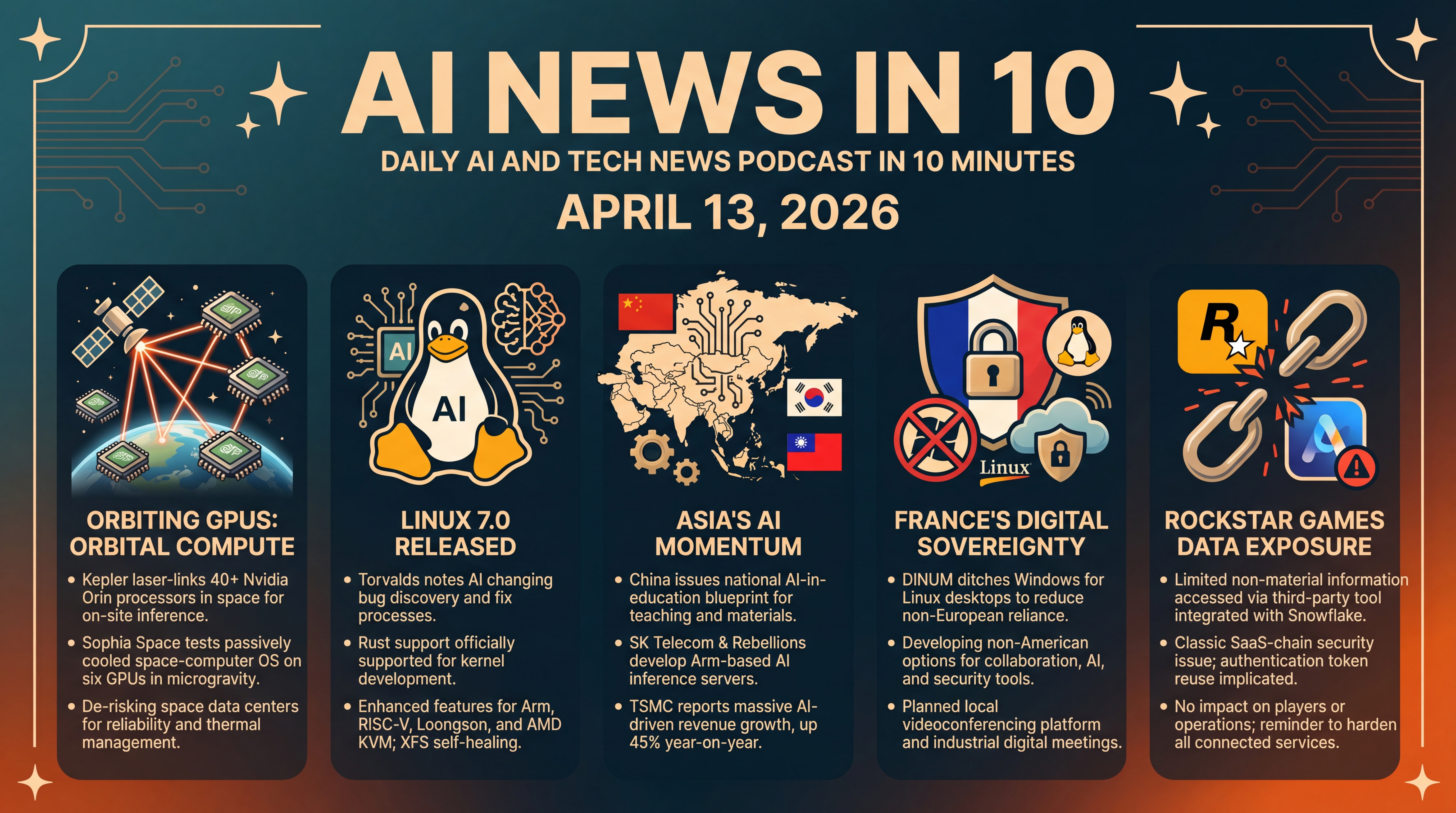
Episode Infographic
Show Notes
Welcome to AI News in 10, your top AI and tech news podcast in about 10 minutes. AI tech is amazing and is changing the world fast, for example this entire podcast is curated and generated by AI using my and my kids cloned voices...
It’s Monday, April 13th — and today, we’re taking a global tour of AI and tech.
We’re starting in space. A Canadian startup just switched on what it says is the largest orbital compute cluster — distributed GPUs linked by lasers, ready to crunch data above the clouds.
Back on Earth, the Linux kernel hits a milestone: version 7.0 is out. Even Linus Torvalds is noting how AI is changing the way bugs are found and fixed.
In Asia, China lays out an AI‑in‑education blueprint, SK Telecom leans into Arm‑based AI inference servers, and TSMC posts eye‑popping revenue.
In Europe, France’s digital directorate is officially ditching Windows for Linux as part of a sovereignty push.
And we’ll close with security: Rockstar Games confirms a new data exposure tied to a third‑party tool connected to its Snowflake environment.
[BEGINNING_SPONSORS]
Let’s head to orbit. Kepler Communications says its cluster — launched in January — now links roughly 40 Nvidia Orin edge processors across 10 operational satellites via laser crosslinks. The goal isn’t to train giant models up there... it’s to run fast, on‑site inference that eases the load on power‑hungry sensors and cuts latency for time‑sensitive tasks.
Kepler has 18 customers on board and just announced Sophia Space as the newest. Sophia will test its passively cooled space‑computer OS by spinning it up on six GPUs across two spacecraft. That might sound routine for a terrestrial data center — but doing reliable orchestration in microgravity, with tight thermal budgets, is a major de‑risking step for space compute.
Kepler frames itself as the networking and processing layer for other satellites — or even drones and aircraft below — while Sophia is attacking the thermal and reliability barriers that make true space data centers so hard.
A spicy aside from Sophia’s CEO: he pointed to last week’s Wisconsin data center moratorium as a sign that on‑earth buildouts may hit political limits, quipping, 'There’s no more data centers in this country... it’s gonna get weird.' Hyperbole or not, the commercialization of orbital GPU time just got very real. Source: TechCrunch.
Down on Earth, Linux 7.0 has landed. Torvalds downplayed the version bump as a normal rollover — he usually jumps to a new major after the dot‑19 release — but he added a telling observation: AI tools are surfacing corner cases more often, and that may be the new normal for kernel bug discovery.
On features, Rust support moves from experimental to officially supported for kernel development. There’s further work across Arm, RISC‑V, and Loongson. KVM gets more sophisticated on AMD’s latest EPYC generation. And XFS gains self‑healing capabilities to make the filesystem more robust.
Kernel maintainers also updated security‑bug docs to help AI tools — and the humans reading them — file more actionable reports as volume climbs. Translation: AI isn’t just running on Linux... it’s increasingly helping maintain Linux. Source: The Register.
Next up, Asia — three signals that show how fast AI infrastructure and policy are moving.
First, China’s National Data Administration published an action plan to weave AI into education at all levels — teaching students and upskilling teachers, with AI assisting in lesson prep, homework management, intelligent grading, Q and A, and tutoring. The plan also calls for digital textbooks, next‑gen MOOCs, immersive classrooms, and updated safety standards to curb fraud, academic misconduct, and privacy leaks. Source: The Register, citing the NDA.
Second, South Korea’s SK Telecom says it will co‑develop servers for AI inference using Arm’s AGI chips alongside Korean accelerator firm Rebellions — whose upcoming RebelCard will play a role. SKT argues the boxes will cut power and cost versus GPU‑based alternatives and could even run the telco’s sovereign foundation model, A.X K1, in its own AI data centers. If that deployment sticks, it’s another data point that inference hardware is fragmenting beyond GPUs... especially where power constraints bite. Source: The Register.
Third, TSMC’s March numbers underscore the AI wave making all this possible — NT$415.2 billion in revenue for the month, up 45 percent year on year and up 30 percent from February — with the quarter rising 35.1 percent over the prior year. A reminder that every new model, accelerator, and 'AI PC' ultimately rolls downhill to foundry throughput. Source: The Register.
[MIDPOINT_SPONSORS]
To Europe, where France’s Interministerial Directorate for Digital Affairs — DINUM — just said it will move off Windows desktops and adopt Linux, part of a broader tech‑sovereignty drive to reduce reliance on non‑European vendors. Minister David Amiel put it plainly: 'The State can no longer simply acknowledge its dependence; it must break free.'
Beyond desktops, France wants ministries to craft plans that emphasize non‑American options for collaboration tools, antivirus, AI, databases, virtualization, and networking. One very tangible deliverable: a homegrown videoconferencing platform, Visio, to lessen reliance on Zoom, Teams, Webex, and Google Meet.
DINUM’s headcount is small compared to France’s 5.8‑million‑person civil service — so this is more signal than scale, for now — but the direction is set, with 'industrial digital meetings' scheduled for June to bring private‑sector partners into the fold. If the program expands beyond DINUM, expect a long, messy migration... and a lot of procurement drama... as agencies unwind years of Microsoft, Cisco, and VMware investments. Source: The Register.
And we finish with security. Rockstar Games confirmed that 'a limited amount of non‑material company information' was accessed via a third‑party service connected to its Snowflake data warehouse. The extortion crew ShinyHunters claimed responsibility, posting a pay‑or‑leak ultimatum and alleging the entry point wasn’t Snowflake itself but Anodot — a cloud cost‑monitoring tool integrated with Rockstar’s environment.
If the claim holds, it’s a classic SaaS‑chain problem: steal or reuse authentication tokens from a connected service, then impersonate a legitimate workflow — which is hard to spot in real time because it looks... normal. Rockstar says there’s no impact on players or operations. Not the company’s first rodeo — remember the 2022 leak of early GTA VI footage — but another reminder to inventory and harden every service tied into your data backplane, not just the primary system. Source: The Register, with Rockstar’s statement to Kotaku referenced.
Quick recap... In space, Kepler’s laser‑linked satellites are bringing GPU inference to orbit as Sophia Space tests a passively cooled OS in microgravity. On the desktop, Linux 7.0 is official, and AI is now a day‑to‑day factor in how kernel bugs surface. Across Asia, China is formalizing AI in classrooms, SK Telecom is pushing Arm‑based inference hardware, and TSMC’s revenue reminds us who prints the world’s compute. France is turning sovereignty talk into action by moving DINUM off Windows to Linux and planning local alternatives to American collaboration suites. And Rockstar’s third‑party breach shows that in 2026, your weakest link might be the tool you barely think about. Stay safe out there — and I’ll see you tomorrow.
Thanks for listening and a quick disclaimer, this podcast was generated and curated by AI using my and my kids' cloned voices, if you want to know how I do it or want to do something similar, reach out to me at emad at ai news in 10 dot com that's ai news in one zero dot com. See you all tomorrow.
