ASML Surges, TLS Shake-Up, Agents Move In
ASML’s upbeat quarter, a browser trust reset for DigiCert’s G1 root, and a sweeping AI policy roundup anchor today’s show. We also unpack Tempus’s 31 oncology abstracts headed to AACR and Oracle’s push to run agentic AI where enterprise data already lives.
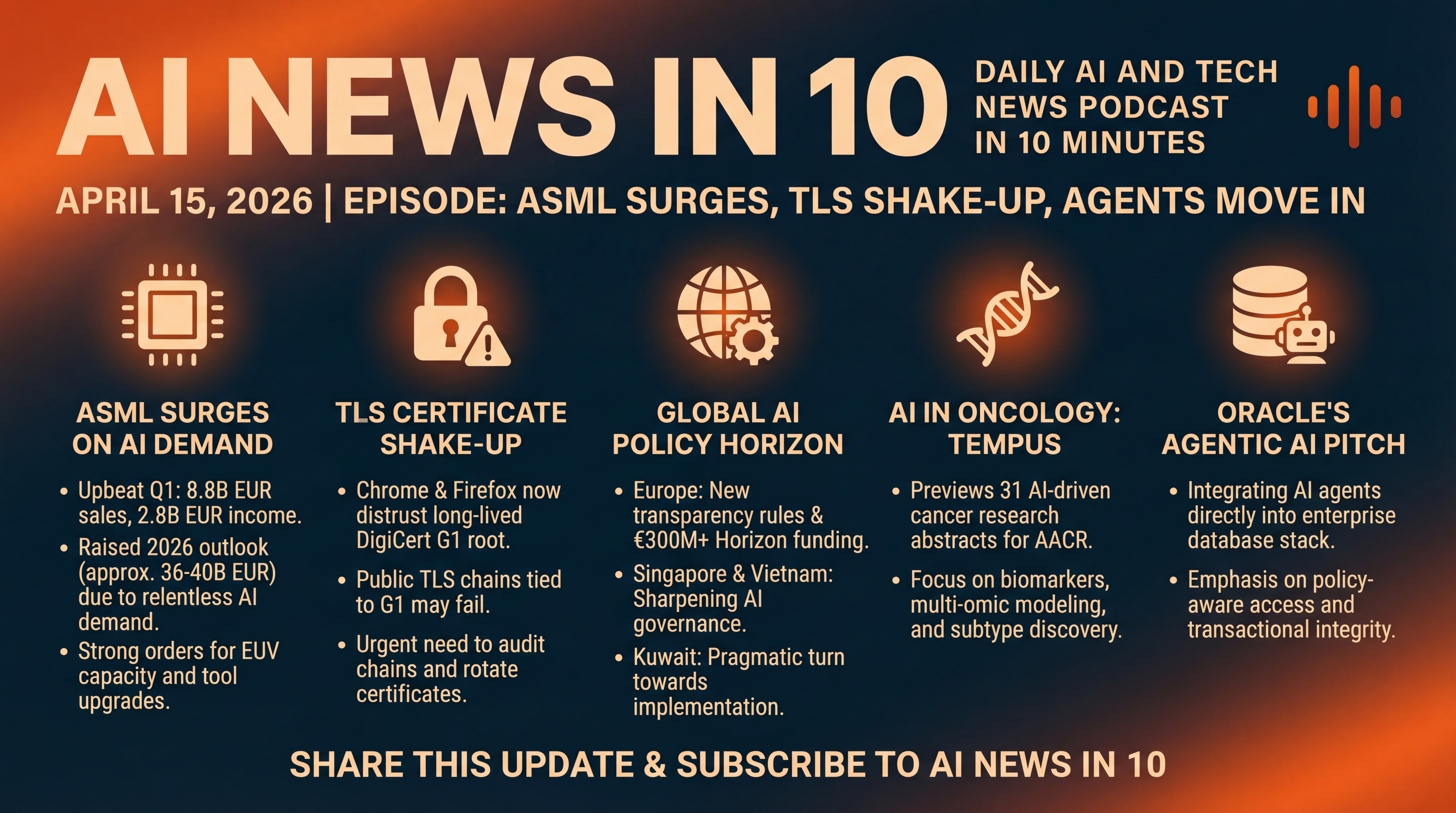
Episode Infographic
Show Notes
Welcome to AI News in 10, your top AI and tech news podcast in about 10 minutes. AI tech is amazing and is changing the world fast, for example this entire podcast is curated and generated by AI using my and my kids cloned voices...
It’s Wednesday, April 15, 2026, and we’ve got a big one. ASML kicks off chip equipment earnings with an upbeat quarter and a raised outlook—thanks to relentless AI demand. Meanwhile, your TLS certificates might be crying for help... today is the day Chrome and Firefox distrust the long-lived DigiCert G1 root, with ripple effects across clouds and enterprises. We’ll also scan the global AI policy horizon: Europe is moving money and transparency rules, Singapore and Vietnam sharpen governance, and Kuwait signals a pragmatic turn. In health tech, Tempus previews dozens of AI oncology studies headed to AACR. And we’ll wrap with Oracle’s pitch to bake agentic AI directly into its enterprise database stack.
[BEGINNING_SPONSORS]
First up—ASML opens chip equipment earnings season on a high note.
ASML reported first-quarter 2026 net sales of 8.8 billion euros and net income of 2.8 billion euros. Guidance for the second quarter lands at 8.4 to 9.0 billion euros in sales, with gross margins of 51 to 52 percent. Most importantly for the AI build-out, management said orders remain very strong, and lifted the 2026 revenue outlook—several outlets peg the full-year target at roughly 36 to 40 billion euros. ASML also proposed a final dividend of two euros and seventy cents per share, recognizing earlier interim payouts. Source: ASML press release.
The read-through: hyperscalers and foundries are still racing to add EUV capacity and upgrade installed tools, even as component constraints and export controls ebb and flow. In short, the shovel seller to AI’s gold rush just signaled demand is holding.
Why this matters: EUV isn’t just about next-gen flagship chips. Performance upgrades to the installed base—and service revenue—are becoming a recurring engine. If that continues, 2026 won’t just be about big one-off tool shipments... it will be about annuity-like upgrade and service dollars as customers squeeze every watt and wafer for AI.
Next—a quiet industry earthquake: today’s DigiCert G1 root distrust.
If you noticed sudden certificate chatter on your SRE or SecOps channels... here’s why. As of today, Chrome and Firefox complete their removal of DigiCert’s legacy Global Root G1 from public trust stores. That means public TLS chains still anchored to G1 will start failing as client platforms pick up policy updates.
Vendors have been warning for months—DigiCert advisories, Cloudflare migration notes, Microsoft Azure notices, Cisco Duo guidance—all pointing to the April 15 cutoff. The fix is straightforward: pivot chains to DigiCert’s newer G2, G3, or G5 roots—or vendor-specific issuers—but the blast radius is wide. mTLS wallets, app servers, load balancers, and IoT endpoints may all need updates. If you run Oracle’s Autonomous Database with mTLS, wallets generated before late January need rotation to avoid breakages after today. Bottom line: audit your certificate chains, update trust stores, and schedule emergency rotations where needed.
Practical takeaway: don’t just renew—re-chain. Confirm intermediates, verify stapled OCSP, test client behavior... and log today’s changes for future incident timelines.
Now—the world’s AI policy pulse, mid-April edition.
A fresh legal roundup highlights how fast the rulebook is evolving. In Europe, new transparency steps for labeling AI-generated content are moving in tandem with funding—over 300 million euros via Horizon Europe calls aimed at strategic digital tech. In Asia, Singapore has refined healthcare AI guidance to better cover generative and agentic tools, while Vietnam’s AI law enters into force. In the Middle East, Kuwait outlined a pragmatic governance stance to push from principles toward implementation. Source: industry legal bulletin, April 2026.
The through-line is operationalization. Regulators aren’t just writing principles—they’re standing up codes of practice, whistleblower tools, and sector-specific guardrails, with real application deadlines... some landing this week. Companies building or deploying models in these jurisdictions should map obligations across privacy, cybersecurity, product safety, and content transparency—not just the headline AI Act conversation.
Why this matters: compliance is becoming a multi-framework exercise. Expect procurement teams to ask for training-data provenance, evaluation results, incident-reporting SLAs, and content-labeling roadmaps—all in the same R F P.
[MIDPOINT_SPONSORS]
Back to health tech—AI in oncology: Tempus previews 31 studies for AACR 2026.
Chicago-based Tempus, a precision-medicine and data company, says 31 of its AI-driven cancer research abstracts were accepted for presentation at the American Association for Cancer Research meeting in San Diego—including an oral presentation. The work spans biomarkers, multi-omic modeling, and subtype discovery. One example: a small-cell lung cancer analysis that examined expression across 56 cell-surface proteins in more than 1,300 patients.
Conference abstracts aren’t peer-reviewed journal papers, but AACR is a key venue where translational AI results often debut before moving into clinical validation. Watch for signs of prospective utility—triage, trial matching, and early detection remain the likely killer apps for clinical AI over the next 12 to 24 months. Source: company announcement.
Finally—Oracle makes the case for agentic AI inside the database.
Oracle is leaning into a thesis we’ve been talking about for months: move from chatty copilots to AI agents that take action on enterprise data—and do it where the data and governance already live. In a post published today on its engineering blog, the company pitches its AI Database as a backbone for mission-critical agentic AI, emphasizing policy-aware access to business data, observability, and transactional integrity.
If you squint, that message mirrors a broader industry pattern: push more of the agent stack—tools, memory, routing—closer to secure data planes and existing app logic, not just a SaaS AI layer floating above. For buyers, the question becomes which platform makes it easiest to chain actions safely across databases, ERP, and messaging... without a fragile web of glue code.
Speed round—two quick actions for today:
- If you operate public-facing services, double-check your certificate chains after the G1 cutoff and watch telemetry for rising TLS failures. If you’re an Oracle Autonomous Database customer using older mTLS wallets, rotate now. Reference: platform migration guides.
- Building products for regulated markets? Use today’s policy roundup as a checklist moment—content transparency, incident reporting, sector-specific safety cases, and auditing hooks are no longer nice-to-haves.
Recap
ASML’s strong quarter—and a higher 2026 bar—signals the AI hardware wave is still running hot. Behind the scenes, a foundational internet trust change lands today as browsers drop DigiCert’s G1 root, pushing enterprises to rotate certificates at scale. Policymakers are turning AI principles into funded programs and enforceable practices. Tempus shows how fast AI is moving into real oncology questions. And Oracle is making its bid to run action-oriented agents where enterprise data already lives.
We’ll be back tomorrow to track the next turn of the AI flywheel.
Thanks for listening and a quick disclaimer, this podcast was generated and curated by AI using my and my kids' cloned voices, if you want to know how I do it or want to do something similar, reach out to me at emad at ai news in 10 dot com that's ai news in one zero dot com. See you all tomorrow.
