Chips Surge, Massive Patches, Safer AI Agents
TSMC’s record quarter signals relentless AI demand, while Microsoft drops 167 fixes amid active zero-days. We also hit Samsung’s AI TVs, OpenAI’s sandboxed Agents SDK, and Adobe’s urgent Acrobat patch — plus what it all means for builders and defenders.
Episode Infographic
Show Notes
Welcome to AI News in 10, your top AI and tech news podcast in about 10 minutes. AI tech is amazing and is changing the world fast, for example this entire podcast is curated and generated by AI using my and my kids cloned voices...
Here’s what’s fresh in AI and tech today. TSMC delivered a blockbuster first quarter and raised the stakes for the entire chip ecosystem... Microsoft shipped a mammoth bundle of security patches, including two actively exploited zero-days... Samsung put next-gen AI TVs in front of European media... OpenAI quietly shipped a meaty upgrade to its Agents SDK... and Adobe rushed a critical Acrobat fix you’ll want to install. Let’s get into it.
[BEGINNING_SPONSORS]
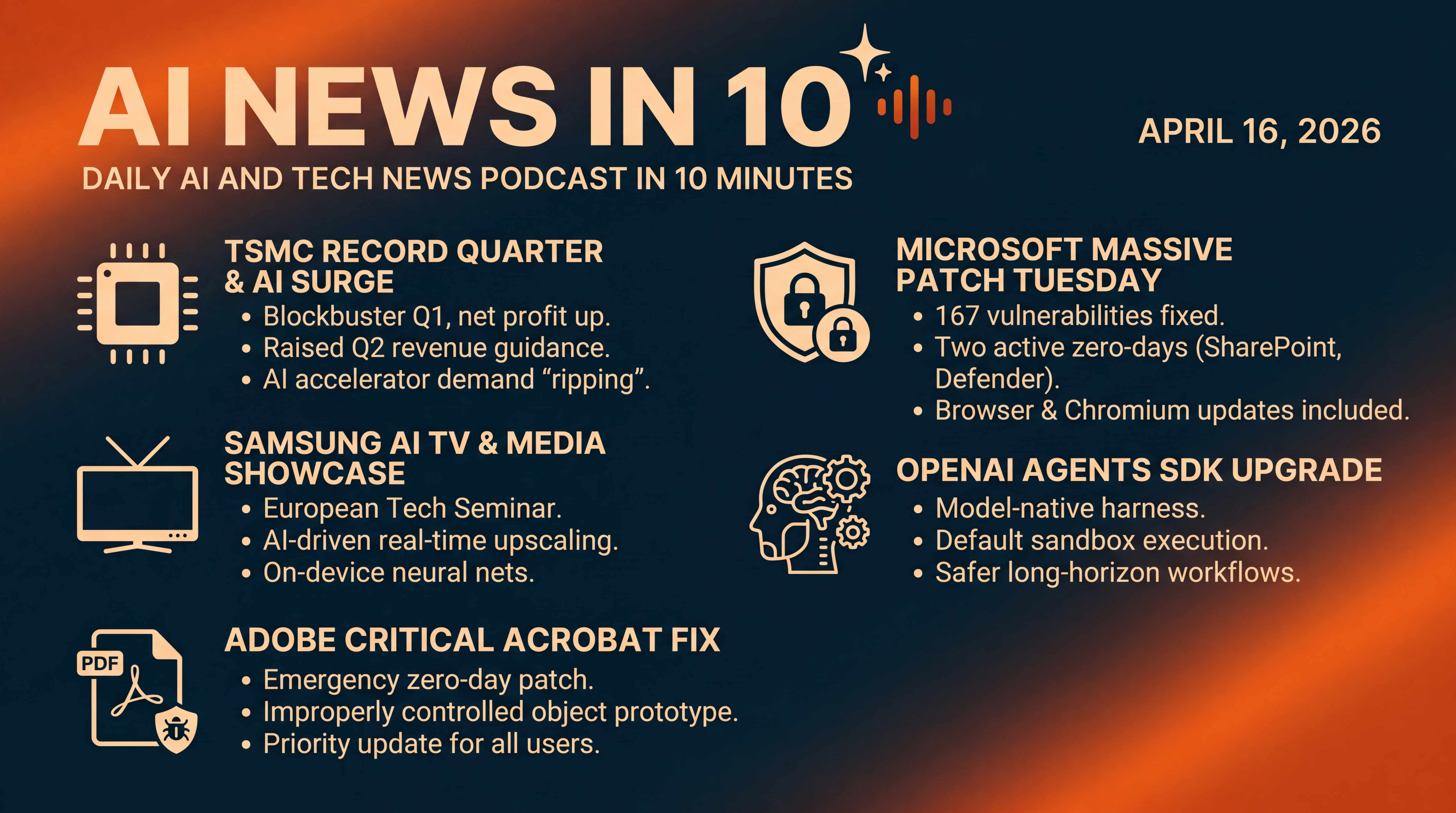
Story one. TSMC — the world’s most important chipmaker, and a key supplier to Apple and Nvidia — just reported a record quarter. Net profit jumped to 572.5 billion New Taiwan dollars — about 18.1 billion U.S. dollars — for the three months ending March, beating expectations.
The company also guided revenue for April through June to a range of 39 to 40.2 billion dollars, signaling that AI accelerator demand is still ripping. One note of caution from management: they flagged potential supply-chain and cost risks tied to the conflict in the Middle East, even as they reiterated confidence in AI-driven growth.
That combo — record earnings with geopolitical caveats — sets the tone for the rest of chip earnings season, according to AP News.
Why it matters. TSMC’s guidance is a bellwether for everything from HBM memory suppliers to equipment makers — and even cloud providers racing to add capacity. If TSMC is projecting another leg up this quarter, hyperscale build-outs aren’t slowing yet... and that has downstream implications for power, water, and logistics in every region courting data centers.
Story two. It’s the second week of the month, which means Patch Tuesday — and this one was big. Microsoft released fixes for 167 vulnerabilities across Windows, Office, and more, including two zero-days under active exploitation.
One is a SharePoint spoofing flaw — tracked as CVE-2026-32201 — that attackers have already been using to pivot inside organizations. The other — CVE-2026-33825 — is an elevation-of-privilege bug in Microsoft Defender. Security researchers advise prioritizing SharePoint servers, and making sure Defender’s anti-malware platform is up to date.
If you manage enterprise fleets, add browser updates to your list — this month’s round also touched Chromium and WebGPU issues highlighted by multiple researchers. Details come from BleepingComputer’s Patch Tuesday brief, Computer Weekly’s roundup, and Field Effect’s technical write-up.
Two quick takeaways. First, the SharePoint flaw shows why collaboration portals remain high-value targets — they often hide sensitive docs and tokens. Second, the Defender fix is a reminder that endpoint protection itself can become an attacker’s stepping stone if it’s not patched swiftly. If your change windows are tight, follow vendor guidance on out-of-band Defender platform updates — and consider emergency maintenance for internet-facing SharePoint.
Story three. Samsung spent the week in Frankfurt hosting its 2026 European Tech Seminar, giving media and partners hands-on time with this year’s AI-powered TVs, displays, and audio gear ahead of market rollout. Beyond the usual panel improvements, Samsung is emphasizing AI-driven upscaling and scene analysis — think real-time enhancements that adjust sharpness, motion handling, and dynamic tone mapping on the fly, powered by on-device neural nets.
It’s a snapshot of how AI is settling into mainstream consumer hardware — less sizzle-reel magic, more steady quality-of-life upgrades baked deep into the image pipeline. That’s straight from Samsung’s newsroom note on the April 15 to 16 seminar.
[MIDPOINT_SPONSORS]
Story four. OpenAI rolled out a significant update to its Agents SDK — the toolkit developers use to build agents that can work across files, run tools, and handle multi-step jobs. The new version adds a model-native harness and, crucially, default sandbox execution — so agents can run commands and edit code within tightly controlled environments.
Translation: it’s easier to stand up long-horizon, semi-autonomous workflows without giving an agent unfettered access to a developer’s machine or your production systems. If you’re piloting agentic workflows — documentation triage, test-suite authoring, migration assistants, incident runbooks — this release lowers the ops and safety barriers to experimentation. That’s from OpenAI’s April 15 product post.
A couple of practical notes for builders. Sandboxing won’t eliminate risk, but it changes the failure modes — you get contained logs, restricted I/O, and more reproducibility for audits. Pair it with granular tool permissions and human-in-the-loop gates for anything that writes to source control, deploys infrastructure, or changes access policies.
Story five. Adobe shipped an emergency fix for Acrobat and Reader to squash a zero-day that attackers had been exploiting since late 2025. The bug — cataloged as CVE-2026-34621 — involves improperly controlled modification of object prototype attributes.
In plain English: an attacker could craft a malicious PDF to trigger unexpected behavior — and potentially run code. Adobe’s bulletin and independent reviews say this one deserves priority patching for anyone who opens external PDFs — which is... basically everyone. If you manage endpoints, test and push the update, then verify that risky file associations aren’t bypassing your PDF handler policies. Coverage comes from TechRadar Pro’s alert and the Zero Day Initiative’s monthly review.
Stepping back... today’s slate underlines a few bigger themes. First, AI demand is still the strongest tailwind in tech — TSMC’s numbers say so, even as management keeps one eye on geopolitics. Second, security remains the necessary ballast for all this autonomy: agents are getting more capable, so sandboxing and least-privilege design are becoming table stakes — and week after week, the easiest wins are still fast patch cycles for software we use every day.
That’s the rundown: TSMC’s blowout Q1 and bullish guide... Microsoft’s 167-fix Patch Tuesday with two zero-days... Samsung’s AI TV showcase... OpenAI’s safer, more capable Agents SDK... and Adobe’s urgent Reader patch. More build-out, more autonomy — and yes, more patching. See you tomorrow.
Thanks for listening and a quick disclaimer, this podcast was generated and curated by AI using my and my kids' cloned voices, if you want to know how I do it or want to do something similar, reach out to me at emad at ai news in 10 dot com that's ai news in one zero dot com. See you all tomorrow.
