
XChat Slips, FAA Woos Gamers, AI Rings
XChat's launch slips a week as the FAA targets gamers for air-traffic controller roles, CHI spotlights wearable AI like rings, Nebraska races AI bills to adjournment, and Warzone Mobile shuts down. Plus a quick lightning round on YouTube's AI avatars and Starlink's rapid cadence.
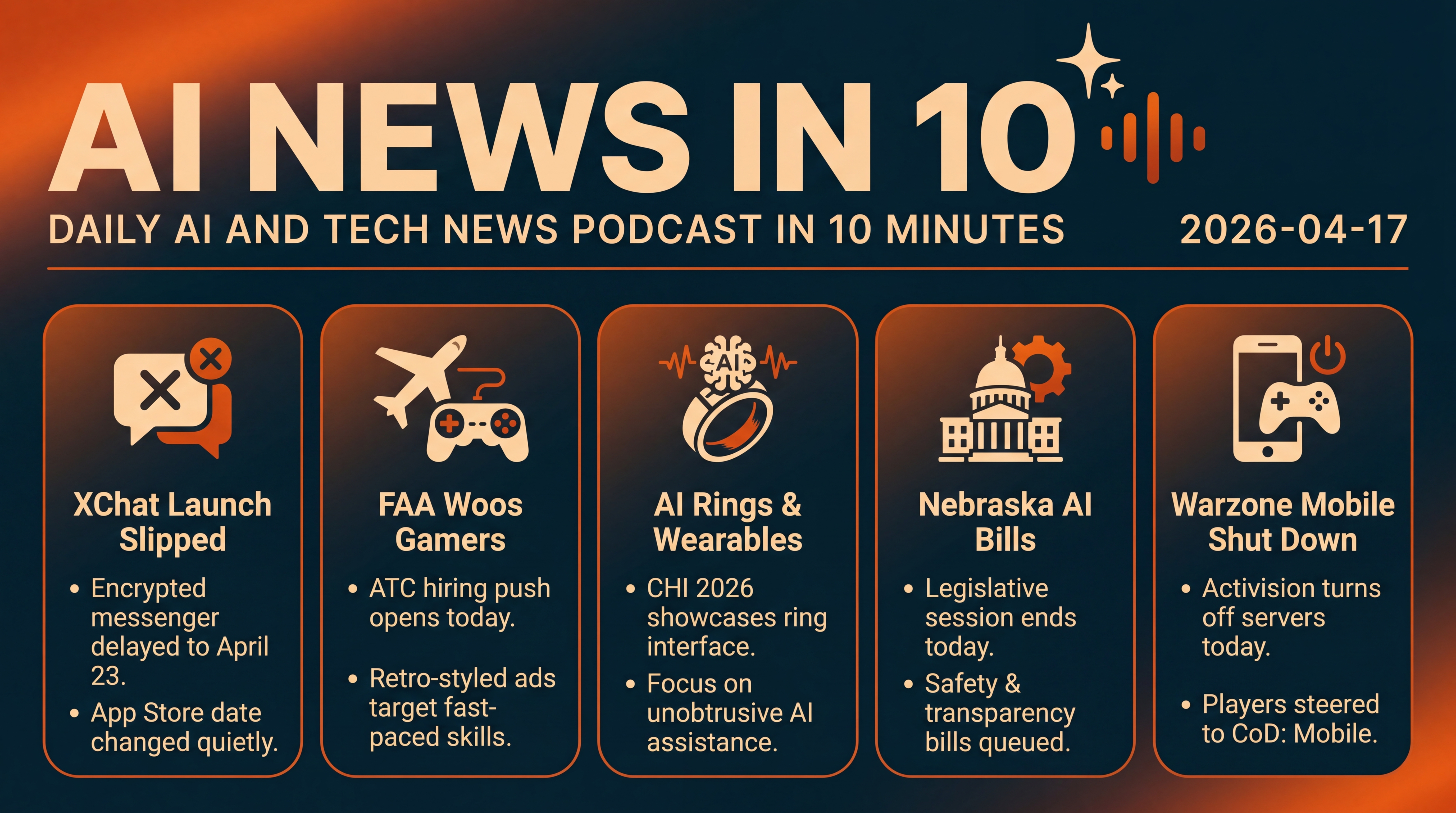
Episode Infographic
Show Notes
Welcome to AI News in 10, your top AI and tech news podcast in about 10 minutes. AI tech is amazing and is changing the world fast, for example this entire podcast is curated and generated by AI using my and my kids cloned voices...
Here's what's new in AI and tech today—Friday, April 17, 2026. Five stories in ten minutes.
First, X's long-teased encrypted messenger, XChat, just slipped its release window. Second, the FAA opens a gamer-focused hiring push for air-traffic controllers at midnight. Third, the CHI 2026 research conference wraps with intriguing human-AI interaction papers, including an AI ring. Fourth, Nebraska's legislative session ends today with several AI safety and transparency bills queued up. And fifth, Activision pulls the plug on Warzone Mobile—closing a chapter in mobile gaming as toolchains and costs shift.
[BEGINNING_SPONSORS]
Story one: the XChat launch date just moved.
All week, X's App Store listing pointed to an April 17 download for XChat—a standalone end-to-end encrypted messenger that syncs with your X account and promises disappearing messages, screenshot blocking, and big group chats up to 481 people. But late yesterday, watchers noticed the date quietly changed... X is now signaling an April 23 release on iOS and iPadOS.
If you pre-ordered, it won't auto-install today—you'll likely see it next week instead. The slip follows a week of hype posts and coverage around the original April 17 date. Bottom line: XChat is still coming, just a week later. If you were planning to kick the tires this weekend... hold that thought. Source: PiunikaWeb.
A couple of quick notes while we wait. X and early reviewers have emphasized three points: end-to-end encryption, no ads or user tracking, and no phone number required to sign up—aimed squarely at privacy-minded WhatsApp and Telegram users. X has tested a standalone chat app via TestFlight, and the App Store age rating is 17 plus, same as X proper. The launch remains iOS and iPadOS first—no Android date yet. We'll watch whether X flips the switch early in some time zones, but for now, plan on April 23. Source: TechCrunch.
Story two: the FAA's annual air-traffic controller application window opens today at 12:00 a.m. Eastern—and the agency is pitching the role to gamers with a retro-styled ad.
The FAA calls this a period of "supercharged hiring" and highlights an average salary around $155,000 after three years, as it tries to chip away at a persistent staffing gap. It's a tech-heavy job: modern towers lean on advanced decision-support tools and high-fidelity simulators, and the pitch to gamers is essentially... if you can manage fast, information-dense environments, you can manage the sky. If this sounds like you, the window is short—and it starts today. Source: Engadget.
Story three: CHI 2026—pronounced "kai"—the premier human-computer interaction conference, wraps today in Barcelona. This year has a clear through-line: moving AI assistance out of screens and into unobtrusive wearables and contexts.
Two papers from Microsoft Research stood out. First, "AI at Your Fingertips" explores a low-friction wearable ring as a direct interface to AI—think subtle gestures to invoke agents, capture snippets, and get context-aware help without fishing for a phone or saying a wake word. Second, "AI and the Self" looks at how AI systems intersect with identity and agency in everyday life—how we attribute decisions when an agent helps, and how that shapes trust. Source: Microsoft Research.
Beyond Microsoft's work, the CHI schedule leaned heavily into agent safety, multimodal interaction, and ways to keep humans in the loop when agents act on our behalf. That "agent UX" push matters because 2026 is the year many mainstream tools start handing tasks to agents—filling forms, browsing, drafting, and scheduling—without micromanagement. Academic results today often become next year's features... so expect these ring-style and glanceable interactions to show up in commercial wearables soon.
[MIDPOINT_SPONSORS]
Story four: a quick policy pulse from the Heartland, because the clock hits zero today. Nebraska's unicameral legislature adjourns on April 17—and several AI measures are queued up or moving alongside broader tech-privacy packages.
Among them: LB 1185, the Conversational AI Safety Act, which would set basic guardrails for consumer chatbots; and LB 1083, the Transparency in Artificial Intelligence Risk Management Act, flagged as a priority bill last month. There's been active maneuvering to bundle and prioritize items before the gavel drops... and today is the deadline. We'll know shortly which measures cross the finish line and what gets punted to the next session. Source: Transparency Coalition.
Why does a statehouse story matter to AI builders nationwide? Because in the absence of a comprehensive federal AI law, state-level moves set de facto standards for disclosures, safety rails, and auditing—especially for small and midsize teams shipping consumer AI. If you operate chatbots or agentic tools that interact with the public, track this one: operational compliance timelines can be tight, and even "lightweight" statutes often come with enforcement teeth. Source: Altitudes Magazine.
Story five: Activision is turning off the servers for Call of Duty: Warzone Mobile today, April 17.
The decision was telegraphed for nearly a year—Warzone Mobile was delisted in 2025 and stopped getting new content—but the shutdown makes it official. If you still want a CoD battle royale on your phone, Activision is steering players to Call of Duty: Mobile, which continues with seasonal updates.
It's a gaming headline, but it dovetails with a broader industry shift: mobile titles that rely on heavy live-ops pipelines and sophisticated anti-cheat tooling are being re-evaluated as cloud costs, AI-assisted moderation needs, and anti-fraud systems grow more expensive and complex. Today's shutdown is a reminder that the economics of running at scale on mobile have changed. Source: Engadget.
A quick lightning round before we wrap.
YouTube's AI-generated avatars for Shorts are rolling out—with visible disclosures and watermarks like C2PA and SynthID. That's a notable approach to authenticity in the age of creator AI... expect other platforms to borrow liberally. Source: Engadget.
Meanwhile, Google I/O session teasers this week point to deeper Android-and-AI hooks next month, and SpaceX continues its rapid Starlink cadence with two launches 19 hours apart—fueling the satellite-connectivity bedrock that a lot of edge-AI experiments will lean on.
That's it for today.
Recap: XChat slips a week, the FAA opens the doors and aims its pitch at gamers, CHI 2026 closes with tangible AI-in-the-world ideas like ring interfaces, Nebraska's legislature races the clock on AI bills, and Warzone Mobile signs off.
We'll be back tomorrow to see whether X revises its launch timing again—and what clears in Lincoln by day's end.
Thanks for listening and a quick disclaimer, this podcast was generated and curated by AI using my and my kids' cloned voices, if you want to know how I do it or want to do something similar, reach out to me at emad at ai news in 10 dot com that's ai news in one zero dot com. See you all tomorrow.
