Dual-Cache Ryzen, TSMC Roadmap, Starlink Tonight
AMD’s new dual-cache Ryzen lands as TSMC outlines its next nodes and SpaceX targets another Starlink launch. We also unpack software’s AI jitters and what Vertiv’s results reveal about the true pace of AI data center buildouts.
Episode Infographic
Show Notes
Welcome to AI News in 10, your top AI and tech news podcast in about 10 minutes. AI tech is amazing and is changing the world fast, for example this entire podcast is curated and generated by AI using my and my kids cloned voices...
Here’s what’s new on Wednesday, April 22, 2026. We’re tracking a big desktop CPU debut from AMD, fresh tremors in software stocks as Wall Street reassesses AI’s impact, a closely watched chip roadmap day at TSMC’s North America Technology Symposium, SpaceX’s Starlink launch attempt tonight, and an earnings morning from Vertiv — one of the cleanest reads on AI data center demand. Let’s get into it.
[BEGINNING_SPONSORS]
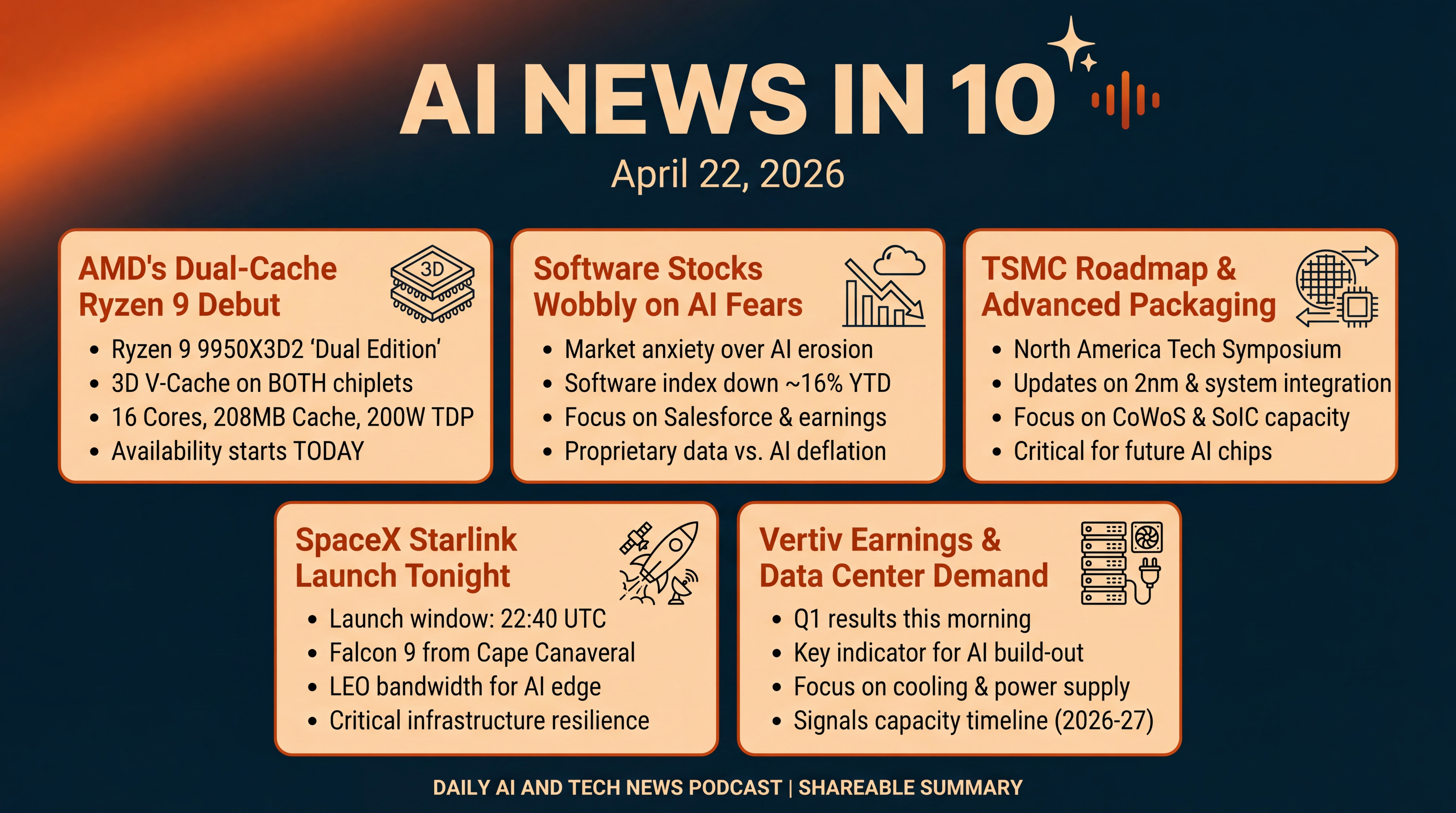
Story one... AMD’s new halo desktop CPU, the Ryzen 9 9950X3D2 "Dual Edition," arrives today. Headline: 3D V-Cache on both chiplets this time. You get 16 cores and 32 threads — and more notably, a massive 208 megabytes of total cache and a 200-watt TDP. Boost clocks dip a touch — 5.6 gigahertz compared to the prior X3D — but early guidance points to up to 10 percent gains in cache-sensitive games and workloads that love L3.
Pricing wasn’t disclosed at announcement; the single-cache 9950X3D has been hovering around 675 dollars, and availability starts today. If you’re building a top-end rig and you hate core-parking quirks from mixed dies, this dual-cache design is meant to remove that variable entirely. That said, plan your cooling accordingly... two hundred watts is serious. Sources: Ars Technica and Tom’s Hardware.
Why this matters: AMD spent years proving 3D V-Cache can move the needle for gaming and certain pro apps. Putting the extra L3 on both CCDs should reduce scheduler gymnastics — and may deliver more consistent performance across a wider range of titles... if the price premium doesn’t scare you off. Expect reviewers to scrutinize power and thermals just as much as frame rates this week.
Story two... AI is still the market’s obsession — and its anxiety. A Reuters roundup this morning flags that even strong quarters may not soothe investors, as they worry generative AI could erode demand for traditional software seats and services. The software and services index is down roughly 16 percent year to date versus a 3.2 percent rise for the S&P 500, and names like Salesforce are in the spotlight ahead of results. Executives argue that proprietary data moats, workflow depth, and in-house AI are stickier than people think — but for now, AI deflation fears are real. Source: Reuters.
What to watch: guidance language on copilots, usage-based pricing, and whether AI features are cannibalizing or upselling core SKUs. Also, deal cycles — are customers consolidating point tools into platform assistants, or adding spend? Those answers will shape the next leg for enterprise software valuations.
Story three... it’s roadmap day. TSMC’s North America Technology Symposium is under way in Santa Clara, with updates promised on transistor scaling and system integration — the stuff that turns PowerPoint AI dreams into wafers, packages, and shipments. Partners and foundry customers flock to these events for clarity on nodes, yield, packaging lanes, and capacity — especially important as AI shifts compute from just GPUs to whole systems designed around memory bandwidth and advanced packaging.
TSMC has previously indicated its 2-nanometer "N2" process started volume production in late 2025, and it has signaled eye-popping 2026 capex between 52 and 56 billion dollars to feed demand. Today’s session should help clients triangulate what’s real for late 2026 products, from mobile to accelerator silicon. Sources: TSMC event site and Tom’s Hardware coverage.
Why this matters: advanced packaging — chiplets, HBM stacks, and backside power — has become the new bottleneck. If TSMC signals faster ramps or expanded CoWoS and SoIC capacity, that can ripple through GPU availability, AI server lead times, and ultimately the cadence of model training at scale.
[MIDPOINT_SPONSORS]
Story four... SpaceX is eyeing a Starlink launch window tonight. Ars Technica’s launch schedule shows a Falcon 9 targeted for April 22 at 22:40 UTC from Cape Canaveral, carrying another batch of Starlink satellites. As always, windows move — but it’s another data point in SpaceX’s blistering cadence, and a reminder that low Earth orbit bandwidth has quietly become critical infrastructure for everything from off-grid sensors to field robotics and disaster response. Source: Ars Technica.
Zooming out: continued launch tempo isn’t just about consumer internet — it’s about the backhaul for an AI edge. As more inference happens near where data is created, resilient links like LEO constellations are part of the reliability stack enterprises increasingly plan for.
Story five... an AI data center bellwether steps up to the mic this morning. Vertiv — which makes the power, cooling, and racks that keep AI training clusters alive — reports Q1 results before the market opens, with a call slated for 11 a.m. Eastern. Investors have used Vertiv’s bookings and backlog to gauge how fast the AI build-out is converting from MOUs and site plans to equipment orders and installs. If management talks about lead times for liquid cooling and modular power, or cites regional grid constraints — that’s signal. Source: Vertiv investor relations.
Context: hyperscalers and model labs may dominate headlines, but companies like Vertiv are the early warning system for whether 2026 to 2027 capacity shows up on time — or gets tripped up by transformers, switchgear, and cooling supply chains. Today’s guideposts can feed right back into GPU availability, cloud AI service pricing, and when smaller players can finally get capacity.
Quick recap... AMD’s dual-cache Ryzen 9 goes on sale, the market keeps wrestling with AI’s upside and downside for software, TSMC’s symposium sets the tone for the next wave of silicon and packaging, SpaceX targets a Starlink flight tonight, and Vertiv’s quarter should tell us how fast AI data center buildouts are actually moving. We’ll keep watching the wires and earnings calls... see you tomorrow.
Thanks for listening and a quick disclaimer, this podcast was generated and curated by AI using my and my kids' cloned voices, if you want to know how I do it or want to do something similar, reach out to me at emad at ai news in 10 dot com that's ai news in one zero dot com. See you all tomorrow.
