
Phones Reach Space, Clinicians Get GPT, Compute Wars
From direct-to-phone satellite service and Rocket Lab’s JAXA mission to GitHub’s Copilot training shift, OpenAI’s clinician tool, and Anthropic’s massive AWS compute pact — here’s what matters and what to watch next. Practical takeaways for developers, clinicians, and anyone tracking the AI capacity race.
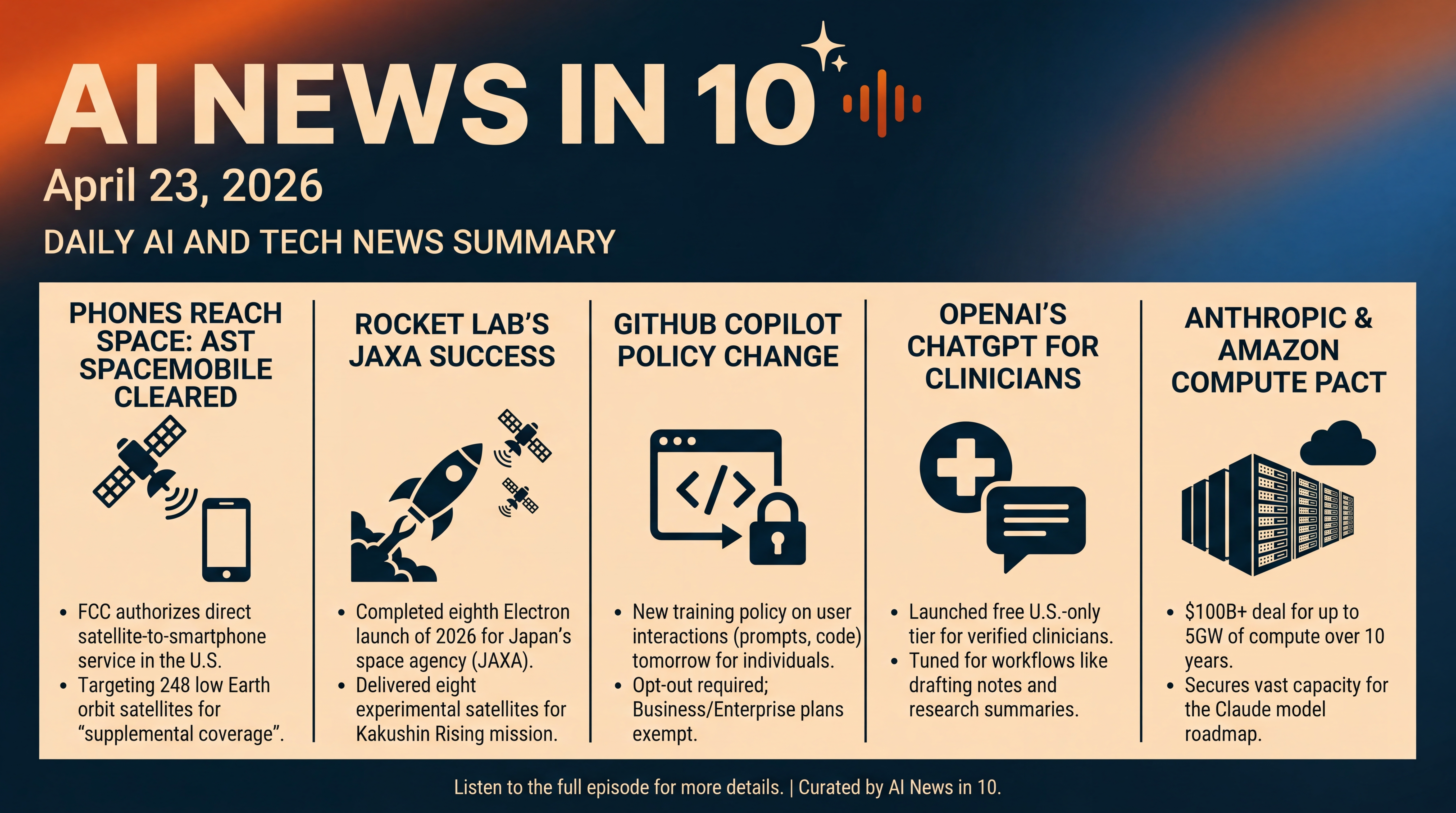
Episode Infographic
Show Notes
Welcome to AI News in 10, your top AI and tech news podcast in about 10 minutes. AI tech is amazing and is changing the world fast, for example this entire podcast is curated and generated by AI using my and my kids cloned voices...
Here’s what’s shaping AI and tech this Thursday, April 23rd, 2026. The FCC just cleared AST SpaceMobile to commercially offer satellite-to-smartphone service in the U.S. — a big milestone for direct-to-device coverage. Rocket Lab pulled off another Electron success for Japan’s space agency, lofting a cluster of experimental satellites. If you code with Copilot, heads up — GitHub’s policy change to train models on user interactions kicks in tomorrow, with an opt-out. OpenAI launched a free, U.S.-only ChatGPT for Clinicians designed for real clinical workflows. And Anthropic has inked a compute mega-deal with Amazon — truly eye-watering numbers — to secure capacity for the Claude roadmap. Let’s dive in.
[BEGINNING_SPONSORS]
First, a regulatory green light that could change how your phone gets bars in the middle of nowhere. The FCC has authorized AST SpaceMobile to deploy and operate up to 248 low Earth orbit satellites to provide what regulators call 'supplemental coverage from space.' In plain English — your regular phone, no new hardware — connecting directly to satellites when terrestrial towers aren’t available.
The order, adopted April 21, clears AST to use low-band 700 and 800 megahertz spectrum in coordination with partners like Verizon, AT&T, and FirstNet. That spectrum travels farther and penetrates buildings better, which is why it’s used for rural coverage and emergencies. AST says it’s targeting roughly 45 satellites in orbit by the end of 2026, with launches every one to two months. Each satellite carries a massive 223-square-meter array and flies roughly 425 to 690 kilometers up. It’s a shot across the bow in the emerging direct-to-device race now drawing in multiple satellite and mobile players.
What should you watch for? Two things. First, coexistence with ground networks — the authorization comes with coordination conditions to avoid interference with terrestrial LTE and 5G. Second, scale and reliability — the leap from successful field calls to consistent nationwide service will hinge on launch cadence, spectrum sharing, and real-world handset experience. After years of test licenses and pilot calls, this is real commercial authority in the U.S. market… and investors have already noticed.
Staying in space, Rocket Lab notched another win for small-sat launch. The company completed its second dedicated mission for Japan’s space agency, JAXA — mission codename 'Kakushin Rising' — from Launch Complex 1 in New Zealand. Liftoff was at about 3:09 p.m. local time on Thursday, April 23rd, delivering eight experimental spacecraft for JAXA and Japanese universities into orbit. It’s one of the company’s most active stretches — this marks the eighth Electron launch of the year — underscoring Rocket Lab’s cadence while other providers navigate slips and scrubs.
Why does this matter beyond the cool footage? Japan’s tech-demo cubesats validate components — deployable structures, sensors, attitude control — before they fly on higher-stakes missions. We often talk about AI in the cloud, but a lot of the edge-AI future rides on space hardware, from on-orbit processing to resilient communications. Today’s success strengthens Rocket Lab’s position as the go-to for quick-turn small-sat deployments while major heavy-lift players juggle competing manifest priorities.
Now, a heads-up for developers and engineering leaders. Tomorrow — Friday, April 24th — GitHub’s revised Copilot policy takes effect for individuals. By default, GitHub will begin using Copilot interaction data — your prompts, outputs, accepted or edited suggestions, and code near your cursor — to train and improve its models, unless you opt out. Business and Enterprise plans are exempt. You can change this in Settings under Copilot privacy.
GitHub says training on real-world interactions measurably boosts model quality. Critics argue the default opt-in nudges users who may not fully grasp the trade-offs, especially when private repository context is involved. Expect spirited internal debates today at a lot of organizations… and likely a wave of memos clarifying where Copilot can be used and which settings are allowed.
Key takeaway if you manage code at scale: double-check your developer policy. If your teams rely on Copilot Free, Pro, or Pro+, and your repositories include sensitive logic or customer IP, opting out may be prudent until you complete a formal risk review. Conversely, if you’re on Copilot Business or Enterprise, this change won’t apply — but it’s still worth reaffirming guardrails and logging. Plenty of plain-English guides show the opt-out flow… share one with your teams today.
[MIDPOINT_SPONSORS]
On to health tech. OpenAI just launched ChatGPT for Clinicians — a free offering for verified physicians, nurse practitioners, physician associates, and pharmacists in the U.S. It’s tuned for clinical workflows like drafting notes, summarizing research, and preparing prior-authorization documentation. OpenAI says it’s built on models like GPT-5.4 and cites internal HealthBench results, plus an advisory-led test where clinicians ran 6,924 real conversations before launch. The goal is to reduce administrative drag so clinicians can focus on patients. Responsible use and human oversight remain non-negotiable, and the rollout is U.S.-only for now while verification and compliance are refined.
Practically, here’s what matters. Hospitals and practices are already piloting scribe tools, ambient documentation, and literature-triage agents. A free, verified tier from a major model provider could accelerate adoption — especially among independent clinicians and smaller groups without enterprise contracts. Watch for EHR integrations, auditability features, and specialty-specific prompt packs next — those will determine how fast this moves from a helpful assistant to a daily essential in clinics.
Now, a power move in the compute wars. Anthropic is expanding its partnership with Amazon, committing more than one hundred billion dollars over the next decade to secure up to five gigawatts of compute — vast clusters spanning training and inference capacity for the Claude family. In a market where capacity is king, this is as much about strategic lock-in and predictable access as it is about raw performance. Five gigawatts rivals the generation capacity of multiple utility-scale plants. Analysts now project Big Tech capital spending to surge roughly seventy-five percent in 2026 amid a scramble for AI-ready power and racks. The deal signals Anthropic’s intent to scale fast in a world where model upgrades and agentic workloads eat compute for breakfast.
Strategically, two questions loom. First, how quickly can utilities and suppliers deliver grid interconnects, substations, and cooling to match these commitments? Second, how much of this capacity will be paired with demand-flex technologies — load shifting, onsite generation, long-duration storage — to ease grid stress and speed deployment? The winners in AI may simply be those who secure the power and the racks soonest… and keep them full.
Quick recap before we go. The FCC just gave AST SpaceMobile the green light to stand up a 248-satellite, direct-to-phone network — watch spectrum coordination and launch cadence next. Rocket Lab delivered again for JAXA with an eight-satellite rideshare, keeping Electron’s cadence humming. GitHub’s Copilot data-training policy flips on tomorrow for individuals — opt out if needed. OpenAI rolled out a free, verified ChatGPT for Clinicians aimed at documentation and research support. And Anthropic’s decade-long, one-hundred-billion-dollar compute pact with Amazon underscores that in 2026, capacity is strategy. We’ll keep tracking how these stories evolve through the week.
Thanks for listening and a quick disclaimer, this podcast was generated and curated by AI using my and my kids' cloned voices, if you want to know how I do it or want to do something similar, reach out to me at emad at ai news in 10 dot com that's ai news in one zero dot com. See you all tomorrow.
