
Big Bets, Robot Wins, and Faster Wi‑Fi
Weekend briefing: Google eyes up to $40B for Anthropic, Cohere teams with Aleph Alpha, Sony’s ping‑pong robot tops elite humans, the FCC’s 6 GHz power rules take effect, and France’s ID authority reports a major breach. Clear takeaways, what to watch next, and why it matters for builders and buyers.
Episode Infographic
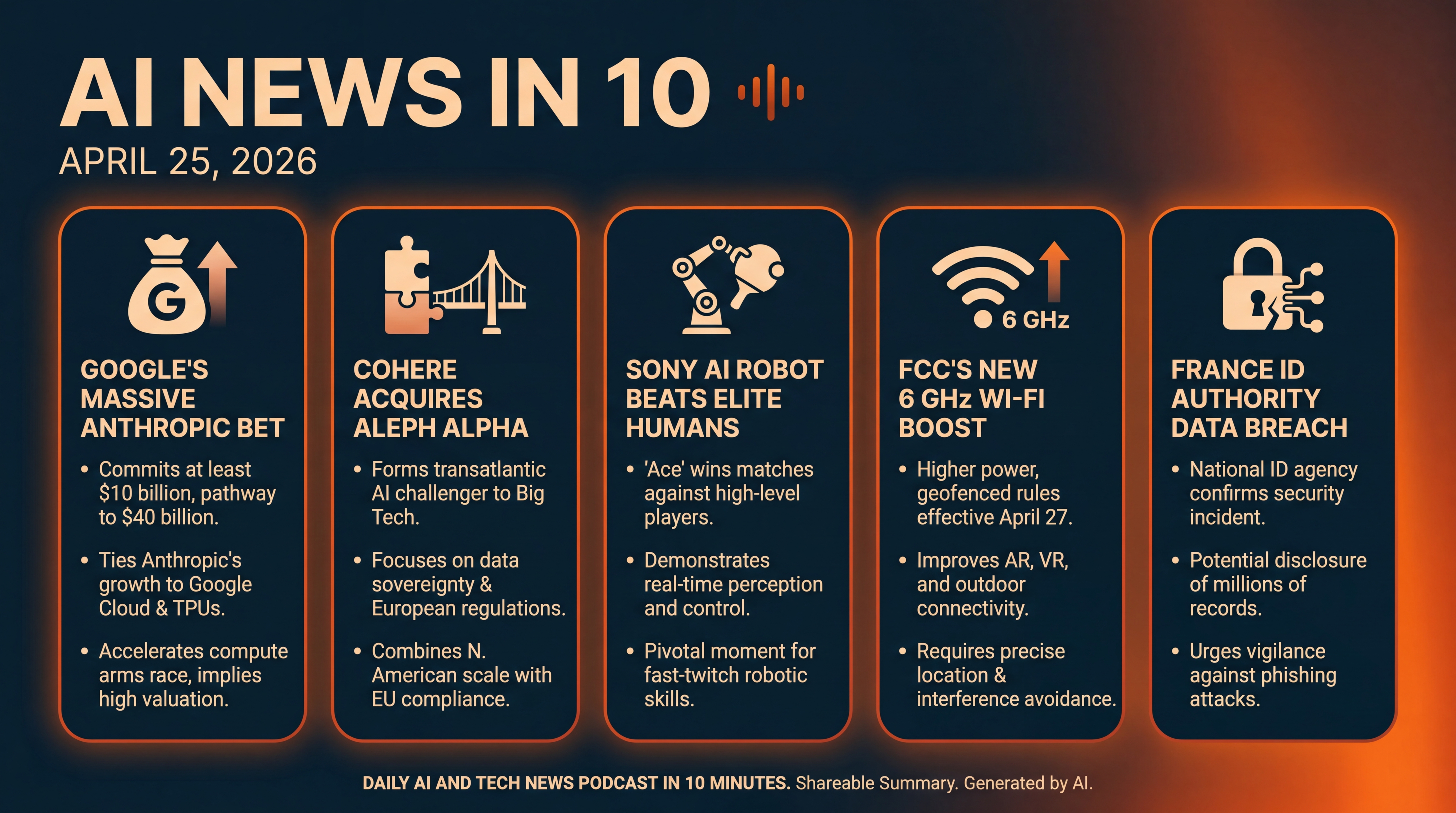
Show Notes
Welcome to AI News in 10, your top AI and tech news podcast in about 10 minutes. AI tech is amazing and is changing the world fast, for example this entire podcast is curated and generated by AI using my and my kids cloned voices...
It’s Saturday, April 25, 2026. We’ve got a weekend slate of big-ticket AI moves, a robotics milestone that sounds like science fiction, and a Wi‑Fi rule change that could make your next headset or hotspot a lot faster.
Here’s what’s on deck… Google is reportedly committing at least $10 billion — with a pathway up to $40 billion — to Anthropic as the compute arms race escalates. Cohere is snapping up Germany’s Aleph Alpha to build a transatlantic alternative to Big Tech AI. Sony AI’s ping‑pong robot, “Ace,” just proved it can beat elite human players — yes, really. The FCC’s new 6 gigahertz geofenced variable power rules kick in on Monday, opening the door to higher‑power Wi‑Fi for AR and VR. And France’s identity‑document authority confirms a data breach that may affect millions. Let’s dive in.
[BEGINNING_SPONSORS]
Story 1: Google deepens its Anthropic bet
Google is set to invest at least $10 billion in Anthropic — and as much as $40 billion over time — according to reporting first flagged by Bloomberg and echoed by outlets like Ars Technica and TechCrunch.
Here’s the structure… an initial cash tranche now, with additional capital and compute credits tied to milestones. Several reports say the initial $10 billion implies a roughly $350 billion valuation, in line with a February round — a sign that enterprise adoption is translating into sky‑high private marks.
Why it matters: this deal binds Anthropic’s growth more tightly to Google’s cloud and custom TPU roadmap, even as Amazon pursues its own massive compute commitment with the lab. In short, Anthropic’s capacity — and competitive trajectory — are increasingly shaped by hyperscaler pipelines. Multiple reports say Google’s commitment can scale toward $40 billion if targets are met, with financing delivered in stages.
What to watch next — procurement. If you’re an enterprise deciding where to place workloads, Anthropic’s model roadmap now comes bundled with clearer visibility on Google Cloud capacity… TPUs today, multi‑gigawatt expansions tomorrow. Expect pricing and priority‑access perks to emerge as differentiators against rivals.
Story 2: Cohere + Aleph Alpha = a transatlantic AI challenger
Canada’s Cohere is acquiring — some call it merging with — Germany’s Aleph Alpha to form what they pitch as a transatlantic AI powerhouse. The target customer: regulated enterprises and governments that want strong data‑sovereignty guardrails and European credentials, without defaulting to the usual Big Tech stacks.
Regulatory angles will matter. Aleph Alpha brings European certifications, public‑sector relationships, and models tuned to EU languages and compliance needs. Cohere contributes scale in North America and a broader model‑ops and retrieval toolchain. Terms weren’t disclosed — so treat any price tags you hear as speculative until the companies publish them.
Why this is interesting now… In the same week Google’s potential $40 billion commitment tightens one hyperscaler‑lab pairing, this cross‑border tie‑up bets on sovereignty, domain trust, and model controllability as buying criteria — not just raw benchmark scores. Expect tighter alignment with EU AI Act compliance, sector‑specific evaluations, and on‑prem or sovereign‑cloud options front and center in the joint pitch.
Story 3: A robot just beat elite humans at table tennis
Sony AI’s “Ace” isn’t a gimmick. It’s a high‑speed robotic arm with perception, decision‑making, and control fused tightly enough to rally — and win — under official rules. A peer‑reviewed paper in Nature details the results: Ace won three of five matches against high‑level amateurs, and even took a game off Japanese‑league pros. The analysis shows its edge wasn’t brute force, but control — it successfully returned roughly three‑quarters of incoming shots.
A Sony AI lead calls it “a pivotal moment” for real‑world AI that must perceive, reason, and act at human‑expert speeds. If you want the headlines in plain English, weekend features from major tech outlets have solid summaries.
Zoom out: competitive robotics has long used table tennis as a benchmark because it stress‑tests everything — sensing spin and trajectory, inference latency, and precise motor control — on sub‑second timescales. The leap from lab demos to match play, even with caveats about pro‑level consistency, signals spillover potential for manufacturing, rehab, sports training… and human‑robot collaboration on tasks where milliseconds matter.
[MIDPOINT_SPONSORS]
Story 4: U.S. Wi‑Fi gets a power boost — new 6 GHz rules take effect Monday
Heads up for device makers, network planners, and anyone dreaming up AR, VR, or campus‑scale wireless: the FCC’s new category of geofenced variable power devices in the 6 GHz band becomes effective Monday, April 27, 2026.
These GVP devices can operate — indoors and outdoors — at higher power than before, provided they enforce dynamic geofences to protect incumbent services like fixed microwave links and radio astronomy. The Commission’s order, published in the Federal Register on February 25, sets technical limits such as up to 11 dBm per megahertz power spectral density and 24 dBm EIRP, and ties operation to precise interference‑avoidance criteria and geolocation requirements.
In plain terms: better throughput and range for next‑gen Wi‑Fi experiences. Think high‑bandwidth AR training on outdoor job sites… temporary pop‑up hotspots for events… and robotics fleets or sensor meshes that need more link budget without jumping to licensed spectrum. Compliance will be the gating factor — GVPs rely on accurate location, geofence databases, and coordination logic — but the performance headroom is real.
Story 5: France’s identity‑document authority confirms a major data breach
France Titres — the agency that processes national ID cards, passports, and vehicle documents — confirmed it detected a security incident on April 15 and has been notifying affected users. Officials warn of potential disclosure of account‑level personal data from individuals and professionals who use the portal, and the Interior Ministry has urged heightened vigilance for phishing.
Independent reporting diverges on scope. Authorities haven’t given a definitive figure yet… while one threat actor claims up to 19 million records for sale, and some French media have cited estimates around 12 million accounts potentially impacted. If you have an account, rotate passwords, enable two‑factor authentication, monitor for suspicious messages — and be wary of targeted phishing that uses accurate personal details.
Before we go, a quick recap…
Google’s multi‑stage investment could tie Anthropic’s destiny even closer to Google Cloud. Cohere’s move on Aleph Alpha signals a sovereignty‑first alternative for governments and regulated industries. Sony AI’s “Ace” shows a robot can win at an elite, fast‑twitch sport. The FCC’s 6 GHz rules — effective Monday, April 27 — should make future Wi‑Fi devices faster and more flexible. And France’s identity agency breach is a fresh reminder to rotate passwords and watch for phish.
Enjoy the rest of your weekend… see you tomorrow.
Thanks for listening and a quick disclaimer, this podcast was generated and curated by AI using my and my kids' cloned voices, if you want to know how I do it or want to do something similar, reach out to me at emad at ai news in 10 dot com that's ai news in one zero dot com. See you all tomorrow.
