
Pilots to Profits: AI’s Pressure Test
Two major AI conferences open as Big Tech readies its biggest earnings week and Europe calibrates timelines for the AI Act. We connect the dots on deals, monetization, and regulation shaping the week ahead.
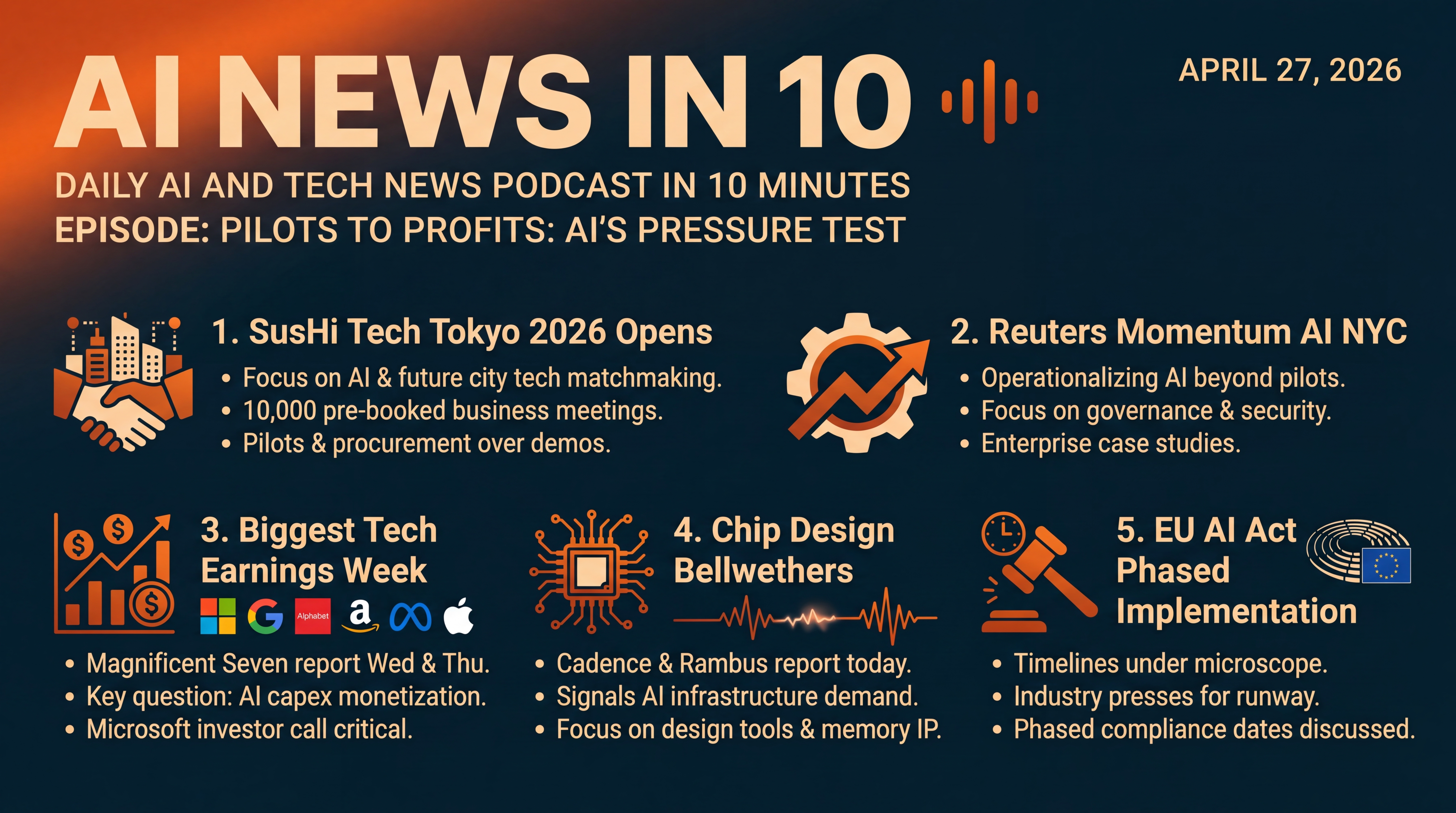
Episode Infographic
Show Notes
Welcome to AI News in 10, your top AI and tech news podcast in about 10 minutes. AI tech is amazing and is changing the world fast, for example this entire podcast is curated and generated by AI using my and my kids cloned voices...
It’s Monday, April 27, 2026. We’ve got a global AI doubleheader opening today, a massive week of tech earnings on deck, chip design bellwethers reporting after the bell, and lawmakers in Europe sliding back into Strasbourg with AI implementation timelines under the microscope... so let’s get into it.
First up, Tokyo.
SusHi Tech Tokyo 2026 opens today at Tokyo Big Sight. Organizers are pitching it less like a sit and watch conference and more like a matchmaking deal room for AI and future city tech — sixty thousand attendees, seven hundred fifty startup exhibitors, one hundred fifty-one sessions, city leaders from forty-nine countries... and, notably, ten thousand pre booked business meetings to push pilot projects and procurement over the finish line.
Business days are today and tomorrow, with a public day on Wednesday. There’s even a telepresence option where on site staff walk the floor with your face on a screen, so remote participants can interact in real time. Sony, Google, Microsoft, and Mizuho are among the corporate partners courting startups this week. If your team is hunting for pilots or municipal partners for AI deployments — think traffic optimization, disaster resilience, robotics, and digital twins — this is a high signal stop.
The positioning is deliberate. One preview framed it as the opposite of the usual fly in, collect business cards, fly out cycle — here, the official app acts like a matchmaking engine, and the metric that matters isn’t badge scans... it’s the ten thousand structured meetings already on the books. That’s the kind of infrastructure you need when AI solutions move from slideware to city scale rollouts.
[BEGINNING_SPONSORS]
From Tokyo to New York — Reuters’ Momentum AI conference also kicks off today, running through tomorrow in Manhattan. It’s built for executives trying to operationalize AI beyond pilot purgatory: governance, security, and industry specific use cases. Speakers include Wayfair CTO Fiona Tan and Johnson & Johnson CIO Jim Swanson — a pairing that signals how fast retail and life sciences are industrializing AI at scale. If you need a barometer for where enterprise decision makers are allocating budgets in Q2, two days of case studies and hallway chatter here will provide it.
There’s also a price tag that tells a story. Passes list in the high four figures — the bracket where buyers and operators, not just vendors, tend to dominate attendance. For startups eyeing design partners, and for Fortune 500 teams wrestling with model governance, data residency, or agentic workflows, this is a heads down, what works now forum rather than a hype parade.
Now, onto markets — this is the single biggest tech earnings week of 2026 so far. Four members of the Magnificent Seven — Microsoft, Alphabet, Amazon, and Meta — report on Wednesday, April 29, with Apple following on Thursday. Wall Street’s baseline heading into the prints: Alphabet is pegged for roughly $2.63 in earnings per share on $106.9 billion in revenue; Microsoft around $4.07 on $81.4 billion; Amazon about $177.2 billion on the top line; and Meta near $55.6 billion. Expectations center on one question... did all that eye watering AI capex translate into monetization and margin, or are we still in build the runway mode?
For Microsoft specifically, circle the date — its investor call is set for Wednesday, April 29 after the close. After months of headlines about AI infrastructure spend and the Copilot push across Windows and Microsoft 365, several analysts have called this the most consequential tech call of the year. If Azure AI growth, Copilot seat expansion, and AI adjacent tailwinds for GitHub and Security don’t show clear monetization vectors, investors will start asking harder questions about payback periods on that capex curve.
That earnings drumbeat starts today on the picks and shovels side. After the bell, Cadence Design Systems reports first quarter results. Cadence sits upstream of the AI boom, providing electronic design automation software and increasingly AI inflected tools that help design the chips running in today’s data centers. The company closed 2025 touting a record $7.8 billion backlog and double digit growth. Today’s update will show whether AI driven design complexity is a multi year tailwind — or whether foundry capacity and customer tape out timing are adding some lumpiness.
Also after the bell: Rambus. If you’ve followed the memory bandwidth arms race — HBM stacks, DDR5 controllers, and GDDR variants feeding GPU clusters — Rambus’s licensing and chips are one of the quieter but pivotal stories in AI infrastructure. A clean beat, plus color on memory interface demand heading into the back half, would support the thesis that AI compute remains supply constrained not just by GPUs, but by the plumbing around them. The call is slated for late afternoon Eastern time.
[MIDPOINT_SPONSORS]
Let’s pivot to policy. The European Parliament’s April plenary session opens today in Strasbourg and runs through Thursday — one of the last full slates before campaigning fully consumes the 2026 calendar. Even when AI isn’t the headline item on the day’s voting docket, the chamber’s work this week sits against the live backdrop of how, and how fast, the EU’s landmark AI Act phases in. Industry has been pressing hard on timing — particularly on watermarking and high risk system obligations — arguing that supply chains and tooling need a little more runway.
In fact, Parliament signaled support last month for pushing some compliance dates. Members backed giving providers until November 2, 2026 to meet watermarking requirements, with additional proposals to extend certain high risk deadlines out to December 2027 — and even August 2028 where overlapping sector rules apply. Regulators say the aim is pragmatic sequencing. Critics warn that each delay risks normalizing move fast practices before guardrails are in place. Watch committee briefings and floor statements this week for hints on how much flexibility the final implementation calendar will really allow.
Taken together, today’s agenda sketches a useful map of where AI stands as April closes. In Tokyo and New York, the pitch is less about demos and more about deployment — pre scheduled deal tables, governance frameworks, and tight, vertical use cases. In the markets, investors want hard evidence that last year’s GPU orders and this year’s data center buildouts are flowing through to revenue and durable margins. In Brussels and Strasbourg, lawmakers are calibrating the tempo — how quickly to demand watermarking, how broadly to define high risk, and how to staff up the AI Office to actually enforce the rules.
Here’s how I’d connect the dots as you start your week. If you’re building AI products, the conferences launching today are a reminder to optimize for proof of value that clears procurement — not just clever features. If you’re a buyer, the smartest play this week is to listen for total cost of ownership signals in Wednesday’s earnings calls — pricing, unit economics on seats or tokens, and any details on how vendors plan to shoulder power, networking, and memory supply constraints so they don’t become your problem. And if you’re navigating regulation, Europe’s debate over phased compliance is a preview of the global posture — move toward enforcement, yes, but stagger the deadlines to keep innovation moving.
Quick recap. SusHi Tech Tokyo 2026 opens with a deliberate deal room design to move AI from talk to contracts. Reuters’ Momentum AI New York convenes operators for two days of case study heavy sessions. The biggest earnings week of the year looms midweek, with Microsoft, Alphabet, Amazon, Meta, and Apple under the microscope. Cadence and Rambus kick off the chip design and memory IP angle after today’s close. And in Strasbourg, the European Parliament’s plenary puts AI implementation timing back in focus as industry and regulators negotiate the runway. We’ll keep tracking the signals — and the surprises — as the week unfolds.
Thanks for listening and a quick disclaimer, this podcast was generated and curated by AI using my and my kids' cloned voices, if you want to know how I do it or want to do something similar, reach out to me at emad at ai news in 10 dot com that's ai news in one zero dot com. See you all tomorrow.
