
From Battlefield Bots to Conversational Commerce
Scout AI’s $100M raise, YouTube’s answer-first search, Amazon’s chatty shopping, Snap’s conversational ads, and Europe’s stalled AI rules—here’s what matters and why. Fast, clear insights on how AI is reshaping discovery, commerce, and policy.
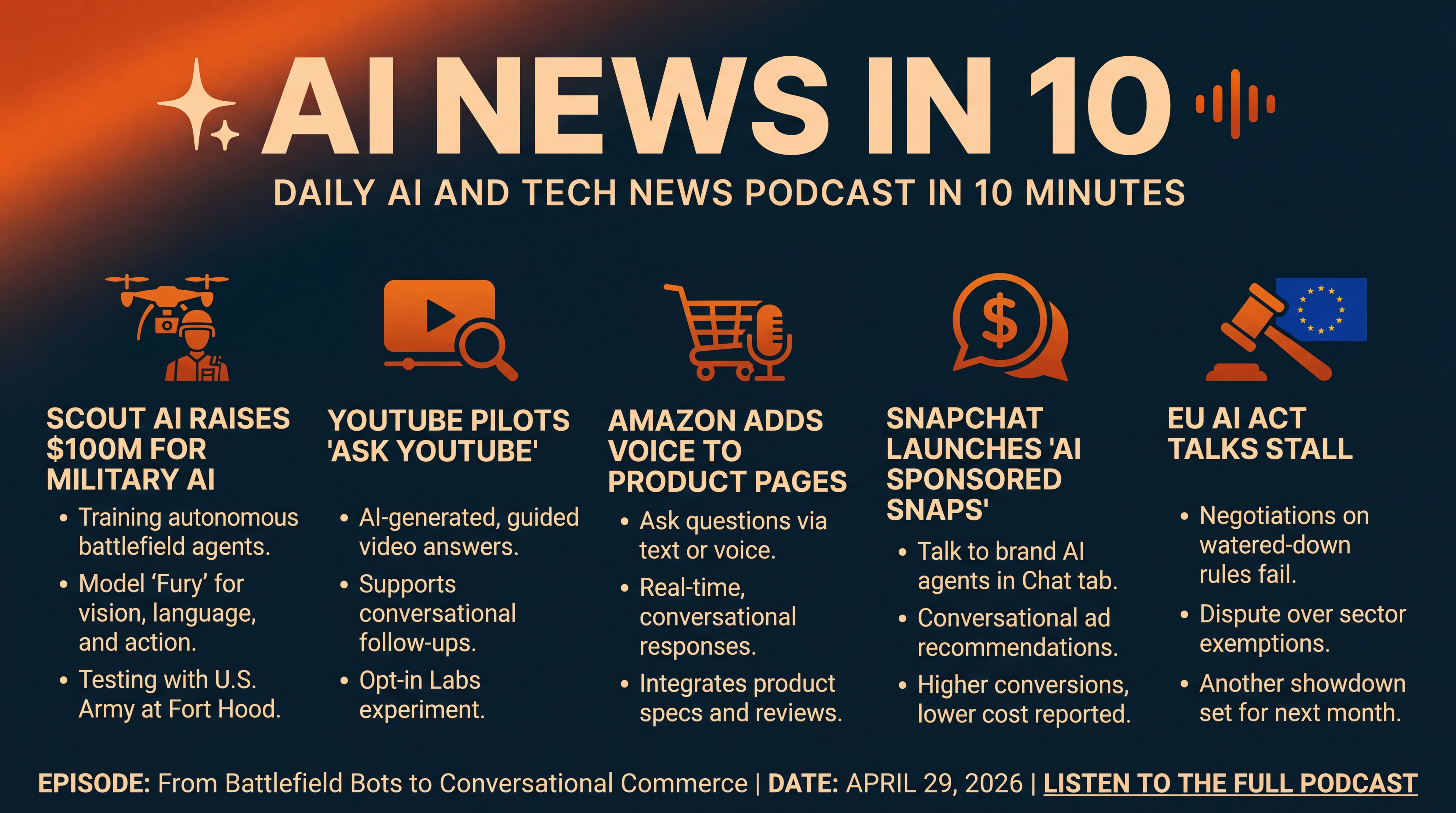
Episode Infographic
Show Notes
Welcome to AI News in 10, your top AI and tech news podcast in about 10 minutes. AI tech is amazing and is changing the world fast, for example this entire podcast is curated and generated by AI using my and my kids cloned voices...
It’s Wednesday, April 29, 2026, and we’ve got five big stories in AI and tech you should know.
First, a defense tech startup called Scout AI just raised a $100 million Series A to train autonomous battlefield agents... yes, you heard that right.
Then, YouTube is piloting an Ask YouTube feature that serves guided, AI-generated answers with videos. Amazon is adding a Join the chat experience to product pages so you can ask questions and get spoken responses in real time. Snapchat is turning brand ads into actual conversations inside your Chat tab. And in Brussels, a twelve-hour negotiation round on a watered-down version of the EU’s AI rules ended without a deal — setting up another showdown next month.
Let’s get into it.
[BEGINNING_SPONSORS]
Story one — Soldiering up the stack. Scout AI’s $100 million Series A.
TechCrunch reports the startup invited a reporter to a training range at a U.S. military base in central California, where four-seat all-terrain vehicles are helping train its models to navigate rugged, unmarked terrain — think off-road autonomy, not city streets.
The round is led by Align Ventures and Draper Associates, and follows a $15 million seed in January 2025.
Scout says it’s building a model called Fury — a vision, language, and action system meant to operate and command military assets. It will start with resupply and reconnaissance, but the ambition extends to autonomous weapons under strict controls.
The company points to roughly $11 million in defense R&D contracts with DARPA and the Army Applications Laboratory, and says parts of its tech are being tested with the U.S. Army’s First Cavalry Division at Fort Hood.
Beyond Fury, Scout’s Ox command-and-control software aims to orchestrate multiple drones and ground vehicles with prompt-like instructions — go here, watch for enemy forces — while keeping agents compartmentalized for security.
It’s a window into where military autonomy is headed: fewer brittle rules, more reasoning under uncertainty... and louder debates about safety, oversight, and international law. TechCrunch has the on-the-ground details.
Story two — YouTube tries answer-first search.
The company is testing Ask YouTube as an opt-in Labs experiment for U.S. Premium users who are 18 and over. Instead of a simple list of videos, you might ask it to plan a three-day road trip from San Francisco to Santa Barbara — and get a guided, step-by-step answer that blends text with both short and long videos.
Crucially, it supports follow-ups — so your next question, like coffee stops along the route, keeps the conversation going with fresh suggested clips. It’s part of Google’s broader push toward conversational discovery... and a sign that answers with citations may become the default bridge from broad queries to creator content. The test is live now for eligible Premium users via Labs and is slated to run for a limited time.
Why it matters — if YouTube’s answers reliably point viewers to deeper videos, not just summaries, creators could see a new funnel for evergreen and educational content. But familiar platform questions remain: who gets surfaced, can smaller channels break through, and how will ads and sponsorships fit into an answer-led experience?
Story three — Amazon brings a voice to product pages.
The company’s Hear the highlights feature — which already offers short AI-generated audio summaries on millions of listings — now lets you join the chat.
Ask by text or voice:
Is this coffee maker good for beginners?
Does this sweater feel itchy?
You’ll get a real-time, conversational answer, then the audio host resumes where it left off.
Amazon says the experience stitches together product specs, customer reviews, and other public info. It builds on shopping AIs like Rufus and Help me decide. It’s available in the Amazon Shopping app on iOS and Android in the U.S., with audio continuing to play while you browse. It’s part customer service, part guided selling... and a clear nudge toward conversational commerce at scale. Amazon’s announcement and product walk-through are worth a listen.
[MIDPOINT_SPONSORS]
Story four — Snapchat wants you to talk to ads.
The company is rolling out AI Sponsored Snaps in the main Chat tab — so instead of tapping a static placement, you can ask a brand’s AI agent questions and get recommendations in the flow of conversation. Snap pitches this as the future of ads is conversational, backed by some telling stats: nearly one billion monthly active users, over 950 billion chats sent in Q1 2026, and more than half a billion users who’ve messaged its My AI chatbot since 2023.
Snap says Sponsored Snaps have already delivered 22% more conversions with nearly 20% lower cost per action. This new format aims to push those metrics by making ads native to how people already talk. An alpha partner is Experian — pointing to financial education and credit tools as early use cases. Snap’s newsroom has the details, with additional context from the tech press.
What to watch — authenticity and guardrails. Conversational ads can feel helpful... or creepy — depending on disclosure, data use, and how well brand agents handle edge cases. Expect advertisers to measure not just clicks, but sustained back-and-forth engagement and downstream purchases.
Story five — Europe’s AI rule rewrite hits a wall.
After roughly twelve hours of talks, EU countries and European Parliament negotiators failed to agree on a watered-down package of changes that would tweak the AI Act and several adjacent digital laws. The dispute centers on whether heavily regulated sectors — like product safety — should be exempt from parts of the AI regime, among other carve-outs.
A Cypriot official representing the EU Council presidency confirmed there was no deal. Dutch MEP Kim van Sparrentak criticized the stalemate as a win for Big Tech and regulatory chaos for firms that invested in compliance. Talks are expected to resume in about two weeks.
For now, companies deploying AI in high-risk areas — such as biometric identification, utilities, health, creditworthiness, and law enforcement — still face a complex compliance runway as enforcement phases in. That means procurement decisions and risk teams stay in limbo a little longer. Reuters has the latest.
Quick takeaways — and threads to pull.
Defense autonomy is moving fast from research tracks to field exercises, backed by nine-figure venture rounds... expect more vision-language-action for robotics stories ahead.
On the consumer side, platforms are racing to make search and shopping conversational — YouTube’s guided answers could reshape content discovery, while Amazon and Snap are turning browsing and ads into dialogues.
And regulators are still wrestling with how to scope rules without freezing innovation — Europe’s next negotiation round will be one to watch.
That’s your wrap for Wednesday, April 29, 2026 — Scout’s military AI, YouTube’s answer-led search, Amazon’s audio Q&A, Snap’s conversational ads, and the EU’s policy pause. We’ll keep tracking how these play out in the real world... and what they mean for builders, buyers, and anyone trying to make AI practical at work and at home.
Thanks for listening and a quick disclaimer, this podcast was generated and curated by AI using my and my kids' cloned voices, if you want to know how I do it or want to do something similar, reach out to me at emad at ai news in 10 dot com that's ai news in one zero dot com. See you all tomorrow.
