
GameStop’s eBay Gambit, AI Guardrails Tighten
GameStop stuns with a $55.5B proposal to acquire eBay as OpenAI rolls out hardened security for high‑risk users and Five Eyes warns on agentic AI. Plus, an alleged Instructure mega‑breach, a Chinese ruling on AI‑related firings, and a farewell to Ask.com.
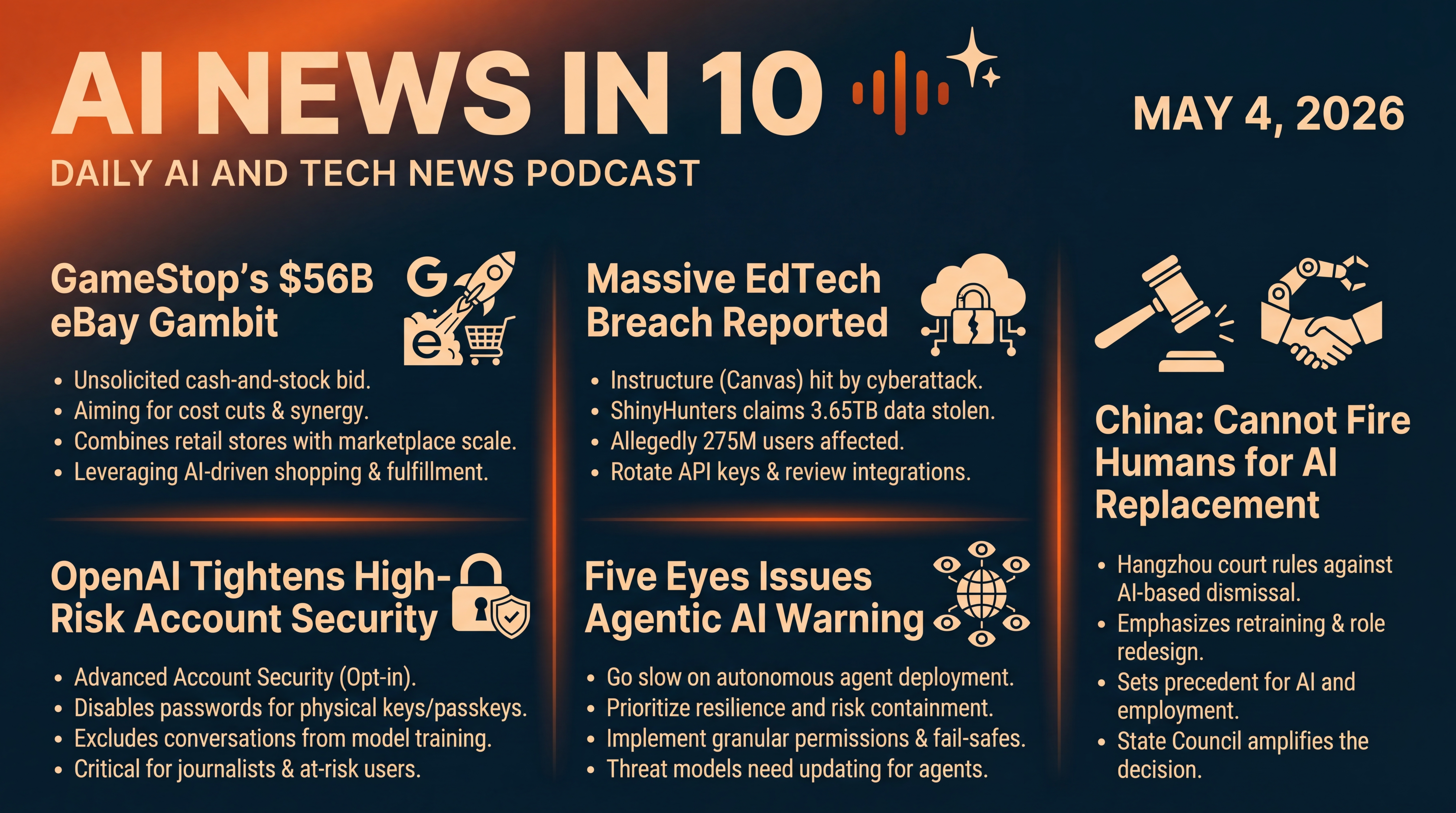
Episode Infographic
Show Notes
Welcome to AI News in 10, your top AI and tech news podcast in about 10 minutes. AI tech is amazing and is changing the world fast, for example this entire podcast is curated and generated by AI using my and my kids cloned voices...
It’s Monday, May 4th, 2026, and here’s what’s on deck... a surprise $56 billion play to reshape online retail, new high‑risk protections for your ChatGPT account, a major edtech breach with huge—if unverified—numbers, a global warning from the Five Eyes alliance on agentic AI rollouts, and a headline‑grabbing labor ruling out of China that says you can’t sack someone just because AI can do parts of their job. Let’s get into it...
[BEGINNING_SPONSORS]
First up, that blockbuster bid. GameStop says it wants to buy eBay for $125 per share in a cash‑and‑stock deal—about $55.5 billion in equity value. In a Sunday news release, GameStop said it has already built roughly a 5% economic stake in eBay and is filing a Schedule 13D.
The pitch to investors is a blend of cost cuts and synergy: $2 billion in annualized reductions within a year—$1.2 billion from sales and marketing, $300 million from product development, and $500 million from G and A—general and administrative—plus using GameStop’s 1,600 U.S. stores for authentication, intake, fulfillment, and live commerce.
Financing? GameStop cites $9.4 billion in cash and liquid investments on hand as of January 31, plus a ‘highly confident’ letter from TD Securities for up to $20 billion. Ryan Cohen would run the combined company.
eBay hasn’t agreed to anything—this is a proposal, not a signed deal—and it still needs board engagement, financing, regulatory clearances... the works. Still, it’s a bold attempt to mash brick‑and‑mortar reach with marketplace scale in a world where AI‑driven search and agentic shopping are changing how we buy online. Source: GameStop investor press release, May 3.
On to security—and this one’s for journalists, researchers, public officials, dissidents, or anyone at higher risk who uses ChatGPT. OpenAI rolled out something it’s calling Advanced Account Security. It’s opt‑in, and when enabled it disables password logins in favor of physical security keys or passkeys, shortens session lifetimes, tightens recovery with backup passkeys and recovery keys, and—this will matter to a lot of folks—excludes your conversations from being used to train models. OpenAI has partnered with Yubico to discount YubiKeys, though any compatible key works.
The trade‑off: if you turn on those hardened recovery options, OpenAI support can’t help you get back in later... so it’s a measure‑twice, cut‑once situation. Source: SecurityWeek coverage published this morning.
Speaking of security, a big edtech name had a rough weekend. Instructure—the company behind the Canvas learning platform—disclosed a cyberattack and data breach. The company says it’s restoring services and reissuing application keys, and reports no evidence so far that passwords, birth dates, government IDs, or financial data were involved.
But there’s a dramatic claim on the criminal side. The ShinyHunters extortion group added Instructure to its leak site and says it stole 3.65 terabytes of data tied to what it claims are 275 million students, teachers, and others across nearly 9,000 institutions worldwide—plus a compromise of Instructure’s Salesforce instance. Those numbers are the attackers’ assertions and haven’t been verified; Instructure says it’s investigating with outside forensics.
If you’re a university or district IT lead, today’s action list is simple: rotate third‑party integrations that used Canvas API keys, check for reauthorization prompts, and make sure any downstream data pipelines are locked down. Source: SecurityWeek, May 4, with ShinyHunters claims noted as such.
[MIDPOINT_SPONSORS]
Let’s shift to policy and governance, because the Five Eyes alliance—the U.S., U.K., Canada, Australia, and New Zealand—just dropped coordinated guidance telling governments and industry to go slow on agentic AI. The message: agentic systems can chain tools, operate semi‑autonomously, and expand your attack surface in ways you may not anticipate.
The guidance urges organizations to prioritize resilience, reversibility, and risk containment over short‑term productivity wins—and to assume agents may behave unexpectedly until evaluation methods and standards mature. There’s practical advice, too: granular permissioning so an agent can’t escalate to privileged actions; fail‑safe defaults that stop and escalate to humans in ambiguous scenarios; and a reminder that threat‑intel frameworks still skew toward LLM misuse and don’t fully capture agent‑specific vectors.
If you’re piloting code‑writing or ops agents this quarter, this is your seatbelt talk... start with low‑risk tasks, monitor closely, and design for rollback. Source: The Register’s write‑up of the Five Eyes guidance, titled ‘Careful adoption of agentic AI services,’ published today.
And a labor‑law curveball from China that’s already sparking debate across HR and tech circles. A court in Hangzhou ruled it’s illegal to replace a human with AI and use that as grounds to terminate their contract.
In the reported case, a worker hired to match user queries with large language models and filter illegal or privacy‑violating content was demoted and had pay cut after the employer adopted AI for some duties. The court sided with the worker, and China’s State Council amplified the decision right before the May 1 Labor Day holiday. The principle, as summarized in state media: adopting AI for tasks does not automatically justify firing someone.
It’s a single ruling—not a sweeping statute—but it’s notable signal‑setting as governments everywhere hash out how to handle displacement risk in the AI transition. Practically, it suggests employers should focus on retraining and role redesign—not reflex layoffs—when they automate. Source: The Register’s Asia tech roundup citing a case publicized by the State Council.
Before we wrap, a quick cultural moment in search. Ask.com—home to the original ‘Ask Jeeves’ natural‑language vibe—closed on May 1 after 25 years, just as AI chat‑based search is ascendant again. IAC’s farewell note thanks users and says Ask served 245 million global visits over its lifetime.
It’s a nostalgia hit—and a reminder that we’ve been here before. Interface shifts in search come in waves, and the winners align relevance, economics, and trust. If you’re building retrieval‑augmented agents, the lesson from Jeeves is timeless... novelty isn’t enough; the engine has to be consistently useful, fast, and reliable. Source: The Register, May 4.
Back to that mega‑deal to close the loop. If GameStop’s bid for eBay advances, expect antitrust and capital‑markets scrutiny, fierce debate over those cost‑savings targets, and big questions about how AI‑driven discovery and store‑level services could actually merge. For now, it’s only a proposal—but it’s a sign of how fast retail is consolidating around data, logistics, and AI‑assisted experiences. Source: GameStop news release.
That’s the rundown for Monday, May 4th. Key takeaways... security first: if you’re in a high‑risk group, consider OpenAI’s new Advanced Account Security; if you run Canvas integrations, rotate keys and review access; and if you’re trialing agentic AI, follow the Five Eyes’ ‘slow is smooth, smooth is fast’ mantra. In the market, watch the GameStop–eBay chess match. And for the future of work, keep an eye on China’s early signals about AI and employment. See you tomorrow.
Thanks for listening and a quick disclaimer, this podcast was generated and curated by AI using my and my kids' cloned voices, if you want to know how I do it or want to do something similar, reach out to me at emad at ai news in 10 dot com that's ai news in one zero dot com. See you all tomorrow.
