
Agents Everywhere: Policy Shifts and Big Bets
Washington eyes pre-release model reviews, IBM rolls out an agentic stack, Cisco targets machine identity security, Palantir posts a record quarter, and Haun Ventures backs the agent economy. A fast, clear walkthrough of the moves shaping how AI agents get built, secured, and monetized.
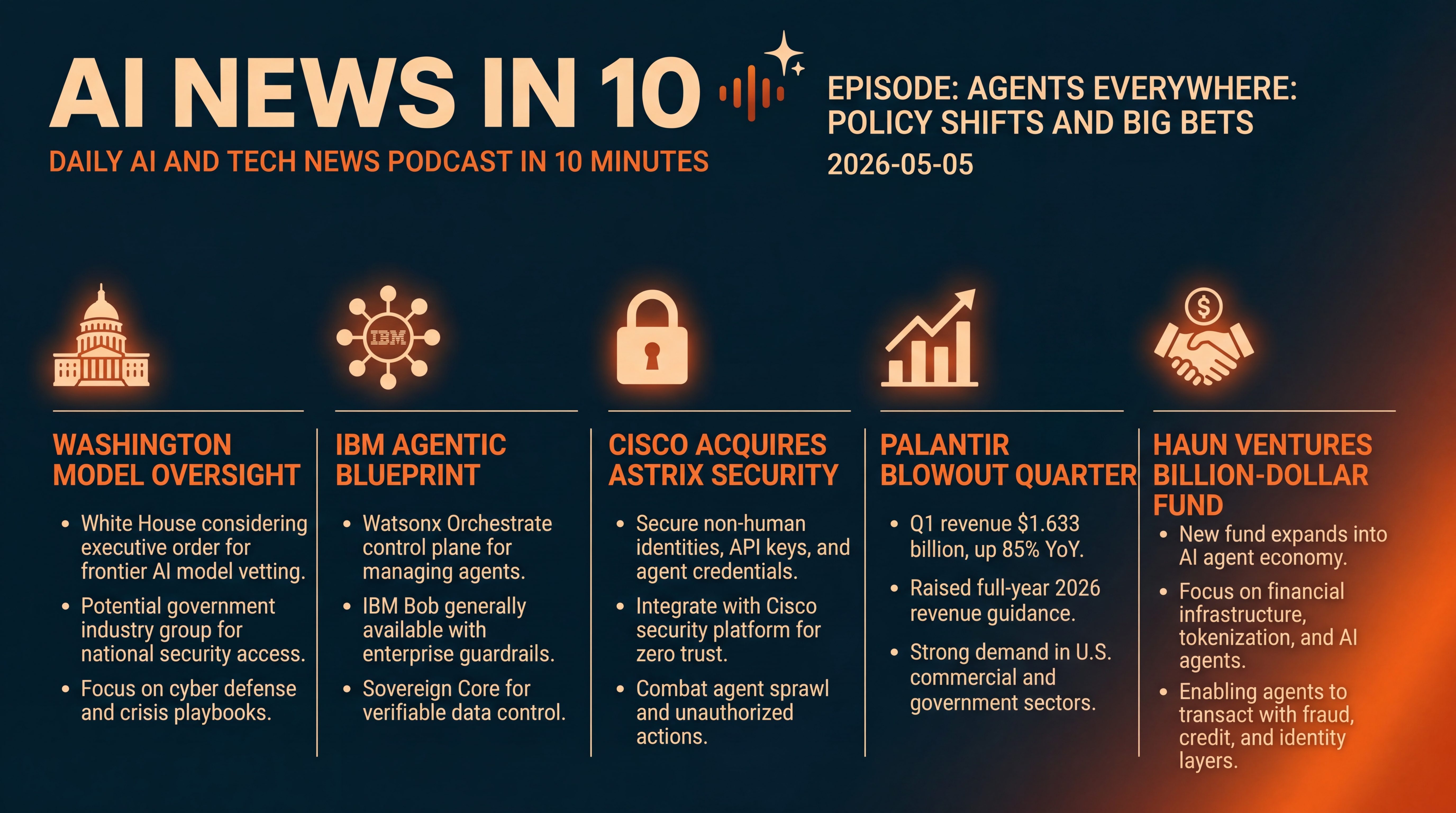
Episode Infographic
Show Notes
Welcome to AI News in 10, your top AI and tech news podcast in about 10 minutes. AI tech is amazing and is changing the world fast, for example this entire podcast is curated and generated by AI using my and my kids cloned voices...
Here’s what’s new today in AI and tech... Washington is inching toward hands-on model oversight, IBM just unveiled a sweeping agentic AI blueprint at Think in Boston, and Cisco is snapping up a startup that secures non-human identities — yes, the credentials your AI agents use. We’ll also dig into Palantir’s blowout quarter and a fresh billion-dollar fund from Haun Ventures that’s betting big on agents transacting in the real world. Let’s get into it.
[BEGINNING_SPONSORS]
First up, policy momentum in Washington. The White House is weighing an executive order that could give the federal government a formal role in reviewing new frontier-level AI models before they launch to the public. According to reporting today, officials briefed leaders at Anthropic, Google, and OpenAI on ideas that include a government–industry working group — and even first access to new models for national security purposes.
A separate effort led by the White House cyber office would require rigorous model safety testing before federal, state, or local agencies deploy AI. A spokesperson cautioned that any announcement will come directly from the president... but the direction of travel is clear. Axios calls it a sea change for an administration that initially rolled back earlier AI safety rules. Fortune notes that the U.K.’s AI Safety Institute already reviews frontier models for the government — so think of this as the U.S. eyeing its own version.
Why it matters... two reasons. First, cyber defense — new models like Anthropic’s restricted Mythos preview reportedly spot software vulnerabilities at unprecedented speed. Second, crisis playbooks — officials want first-look access so if a catastrophic AI-enabled cyberattack unfolds, the government isn’t flying blind. The message to labs is simple: cooperate now to avoid heavier regulation later.
On to Boston, where IBM kicked off Think 2026 with a product wave aimed squarely at the agentic enterprise. Highlights include a next-generation watsonx Orchestrate — a control plane for managing thousands of AI agents across teams and platforms — now in private preview. IBM Bob is now generally available as an agentic development partner with built-in enterprise guardrails. The IBM Concert platform, in public preview, correlates signals across apps, infrastructure, and networks to move from monitoring to coordinated response. And IBM Sovereign Core is generally available to help organizations run AI with verifiable control over data location, identity, and keys.
IBM also touted new real-time data context in watsonx.data, plus GPU-accelerated Presto that — in an internal proof of concept with Nestlé — delivered big cost and performance gains on a global data mart.
If you’re wondering what’s new versus marketing, listen for three themes. One, orchestration at scale — enterprises aren’t short on agents; they’re short on governance and observability when those agents start acting across sensitive systems. Two, sovereign by design — Sovereign Core bakes policy enforcement into runtime, and IBM is name-checking an ecosystem that includes AMD, Intel, Mistral, MongoDB, and Palo Alto Networks. Three, the data plane — real-time context, Confluent and Flink integrations, and a push to make retrieval and decisioning explainable over governed data. That’s the operating model IBM says separates pilots from production AI.
Cisco is moving to acquire Astrix Security, a startup focused on protecting non-human identities — API keys, service accounts, OAuth tokens — and, increasingly, the credentials AI agents need to act on your behalf. Cisco says Astrix will fold into its security platform — think Cisco Identity Intelligence, Secure Access, Duo, and Splunk — so enterprises can discover agents, govern their permissions, and detect out-of-scope actions in real time. SecurityWeek frames the deal as part of Cisco’s agentic workforce strategy, extending zero trust to machine identities that often outnumber humans inside big organizations. Terms weren’t disclosed.
The takeaway: agent sprawl is the new attack surface. If you’re piloting AI copilots that spin up background agents to fetch data, update tickets, or trigger workflows, you’ve probably already seen a maze of secrets, over-privileged tokens, and untracked automations. Expect identity, access, and runtime security to converge around agent behavior — who acted, with what authority, and whether that action complied with policy. Cisco’s shopping list points to that future.
[MIDPOINT_SPONSORS]
Palantir just posted what its CEO calls the strongest quarter in company history. Q1 revenue landed at $1.633 billion, up 85% year over year, with U.S. revenue up 104%. The company raised full-year 2026 revenue guidance to 71% growth. It’s the fastest quarterly revenue growth Palantir has ever recorded, with especially sharp gains in U.S. commercial and government segments. The shareholder letter also highlights margin strength and deal momentum as the company leans into its AI platform across defense and industry.
What to watch: the sustainability of that growth as the AI platform wave matures, hiring to keep pace with demand, and how regulatory shifts — like potential federal model vetting — could affect timelines for government AI deployments where Palantir is deeply embedded. For now, the guide-up signals confidence that enterprise and public-sector AI programs are moving from pilots to scaled rollouts.
And fresh venture fuel... Haun Ventures has raised $1 billion and is officially expanding beyond crypto into AI — especially the agentic economy, where software agents transact on our behalf. Founder Katie Haun says services will need to be re-architected for a world where computers are the customers, with native fraud, credit, identity, and provenance layers built for agents that operate 24/7. The firm’s focus areas: financial infrastructure, tokenization, and AI agents. Cointelegraph first flagged the raise this morning, framing it as part of a broader VC shift toward the AI–crypto intersection.
This matters because agent workflows don’t just need LLMs — they need rails for payments, permissions, reputation, and compliance. If agents start buying API access, subscribing to SaaS, or even negotiating inventory, we’ll see demand for attestation, escrow, and risk primitives that are programmable and auditable. Funds like this are betting those primitives go mainstream... fast.
Quick recap... The White House is considering pre-release vetting for new frontier AI models, signaling a sharper federal stance on safety and national security. IBM’s Think 2026 is all-in on agent orchestration, sovereign control, and real-time data for enterprise AI at scale. Cisco is buying Astrix to secure the identities your AI agents use. Palantir delivered a record quarter and raised guidance on surging U.S. demand. And Haun Ventures added AI to its crypto thesis with a fresh $1 billion to build the agentic economy. More tomorrow — same time, same feed.
Thanks for listening and a quick disclaimer, this podcast was generated and curated by AI using my and my kids' cloned voices, if you want to know how I do it or want to do something similar, reach out to me at emad at ai news in 10 dot com that's ai news in one zero dot com. See you all tomorrow.
