Chips Rally, GPT-5.5 Lands, Apple Settles
Samsung joins the trillion-dollar club as AMD fuels a CPU-driven AI rally. OpenAI refreshes ChatGPT's default, Apple settles over Siri marketing, and TotalEnergies orders a six-times-bigger supercomputer.
Episode Infographic
Show Notes
Welcome to AI News in 10, your top AI and tech news podcast in about 10 minutes. AI tech is amazing and is changing the world fast, for example this entire podcast is curated and generated by AI using my and my kids cloned voices...
Here's what's moving in AI and tech today — Wednesday, May 6, 2026.
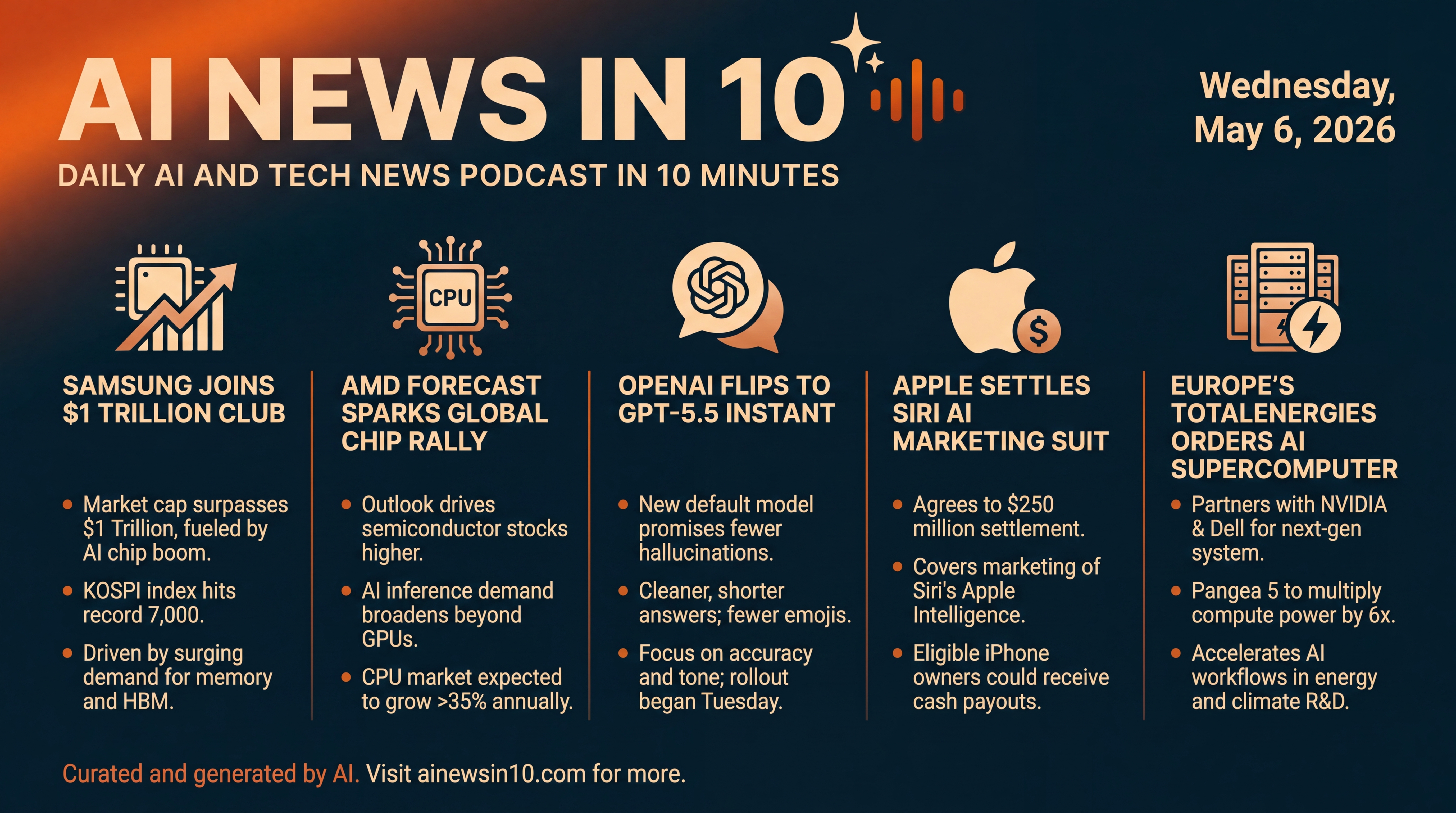
Samsung just vaulted into the one trillion dollar market cap club as Seoul's KOSPI smashed through seven thousand... AMD's outlook sparked a global chip rally — and a fresh narrative around CPUs taking a bigger slice of AI inference... OpenAI quietly flipped ChatGPT's default to a new model, promising fewer hallucinations and fewer emojis — yes, really... Apple agreed to a two hundred fifty million dollar settlement tied to marketing of Siri's Apple Intelligence, with some iPhone owners eligible for cash... and in Europe, TotalEnergies signed a deal with NVIDIA and Dell to build a next-gen supercomputer that will multiply its compute by six.
Let's dig in.
[BEGINNING_SPONSORS]
Story one — Samsung's trillion dollar moment.
Fueled by the AI chip boom, Samsung Electronics crossed the one trillion dollar market value mark as South Korea's KOSPI index surged past seven thousand for the first time. Reuters says Samsung jumped roughly fourteen percent intraday, with SK hynix up double digits as well — together they now account for nearly half of the KOSPI's value. Samsung is only the second Asian company, after TSMC, to crack the trillion dollar club — another signal that memory and HBM are shaping the AI build-out just as much as GPUs.
If you're wondering what drove the sudden spike, look to the overnight rally in U.S. chip names and a steady drumbeat of AI infrastructure spending. Local analysts also point to strong foreign inflows and a broader shift of investor attention from just GPUs to the entire AI data center stack — HBM, networking, power, and cooling — where Korean champions are entrenched. Outlets like the Japan Times echo the milestone framing, tracing the run-up to surging demand for chips used in AI.
Story two — AMD's forecast lights a fire under chip stocks... and under the CPU story for AI.
A fresh outlook from AMD sent U.S. semiconductor names higher today. In pre-market trading, AMD jumped nearly eighteen percent, Intel around six, Arm roughly eleven, and Qualcomm about four. The headline isn't just revenue — it's the mix. AMD says the inference phase of AI is broadening demand beyond GPUs, and that its server CPU addressable market is now expected to grow more than thirty five percent annually through twenty thirty — up from about eighteen percent before. That's a big change in tone, and it suggests the next leg of AI spend may favor CPUs alongside GPUs as enterprises deploy agents and smaller, cheaper models at scale. Reuters also notes Super Micro guided above expectations as it ramps AI server output across Taiwan, Malaysia, and the Netherlands — another sign that systems integrators are capacity constrained but confident.
Taken together with Samsung's surge, today's tape is sending a clear message: the AI capex cycle isn't just a GPU story. If inference workloads keep spilling into CPUs — and if memory pricing stays tight — expect more volatility as investors try to price who benefits most from the AI stack's shifting bottlenecks.
Story three — OpenAI flips ChatGPT's default to GPT-5.5 Instant.
The company says the new model cuts hallucinations by roughly half on high-stakes prompts in medicine, law, and finance, while dialing back gratuitous emojis and producing shorter, cleaner answers. It replaces GPT-5.3 Instant for everyone and is available via the API as chat-latest. OpenAI's system card and blog outline the changes, and the rollout started Tuesday — so you might already be using it without realizing it.
Press and analysts are calling this an accuracy-and-tone update that also leans into personalization. ChatGPT will remember more of your context so you don't repeat yourself... which could be great for productivity but raises familiar privacy questions about what the assistant stores and when. Outlets like TechCrunch and PCWorld emphasize the reduction in hallucinations and the shift in default behavior — useful for teams trialing ChatGPT for real work, not just brainstorming.
[MIDPOINT_SPONSORS]
Story four — Apple agrees to a two hundred fifty million dollar settlement over marketing of Siri's AI features — payments could reach up to ninety five dollars per eligible device.
According to the Associated Press, the class action suit alleges Apple's 2024 iPhone marketing promoted Apple Intelligence and a revamped Siri that weren't actually available at purchase. The proposed settlement, filed in federal court in San Francisco, would cover an estimated thirty seven million devices sold in the U.S. between June 10, 2024 and March 29, 2025 — including all iPhone 16 models and iPhone 15 Pro and Pro Max. Customers would be notified to file claims on a settlement website after court approval; payouts start at twenty five dollars and scale up depending on claims volume. AP notes Apple could unveil the delayed Siri overhaul at its developer conference next month.
Practically, it's a reminder that AI as a feature can create legal and reputational risk if timelines slip. The bar for what counts as a shipped capability — especially with assistants that depend on cloud models — keeps rising. Expect rivals to contrast their own shipped AI features as Apple races to catch up on-device and with partners.
Story five — Europe's energy giant TotalEnergies orders a next-generation supercomputer with NVIDIA and Dell that multiplies its compute power by six.
Announced in Paris, the Pangea 5 system will be hosted at the company's CSTJF research center in Pau, France, with first commissioning slated for 2027. It's a more than one hundred million euro investment that pairs NVIDIA GPUs, CPUs, and InfiniBand with Dell's HPC architecture to accelerate seismic imaging, subsurface modeling, and R&D across AI workflows. TotalEnergies says Pangea 5 will cut energy consumption by about forty percent at equivalent performance, with a cooling system that reduces energy use fivefold and recycles residual heat to warm campus buildings.
This is one of the clearest examples of AI industrialization — advanced compute not just for chatbots, but for physics-rich workloads in energy, materials, and climate modeling. For vendors, it's also a proof point that AI and HPC demand is spreading beyond hyperscalers into domain-specific supercomputers with aggressive sustainability targets.
Quick recap before we go.
Samsung vaulted into the trillion dollar club as Korea's market ripped on AI chip exuberance... AMD's outlook reinforced a growing CPU-plus-GPU story for AI inference and sent chip names higher... OpenAI's GPT-5.5 Instant is now the default in ChatGPT, with fewer hallucinations and crisper answers... Apple will pay up to two hundred fifty million dollars to settle claims over Siri's AI marketing, with some iPhone owners eligible for cash... and TotalEnergies is building a six-times-bigger supercomputer with NVIDIA and Dell to push AI and HPC across its energy portfolio. We'll keep tracking how these threads — chips, models, lawsuits, and industrial AI — interlock as the AI economy scales up.
Thanks for listening and a quick disclaimer, this podcast was generated and curated by AI using my and my kids' cloned voices, if you want to know how I do it or want to do something similar, reach out to me at emad at ai news in 10 dot com that's ai news in one zero dot com. See you all tomorrow.
