
EU AI Reset, Arm Squeeze, Moonshot Surge, Beagle Backdoor
Europe streamlines AI rules and bans nudifier apps, Arm hits a supply bottleneck for its agentic CPU, and Moonshot AI raises two billion dollars at a valuation north of twenty billion. Plus, a fake Claude site drops the Beagle backdoor, and MongoDB ships features to give agents longer, more reliable memory.
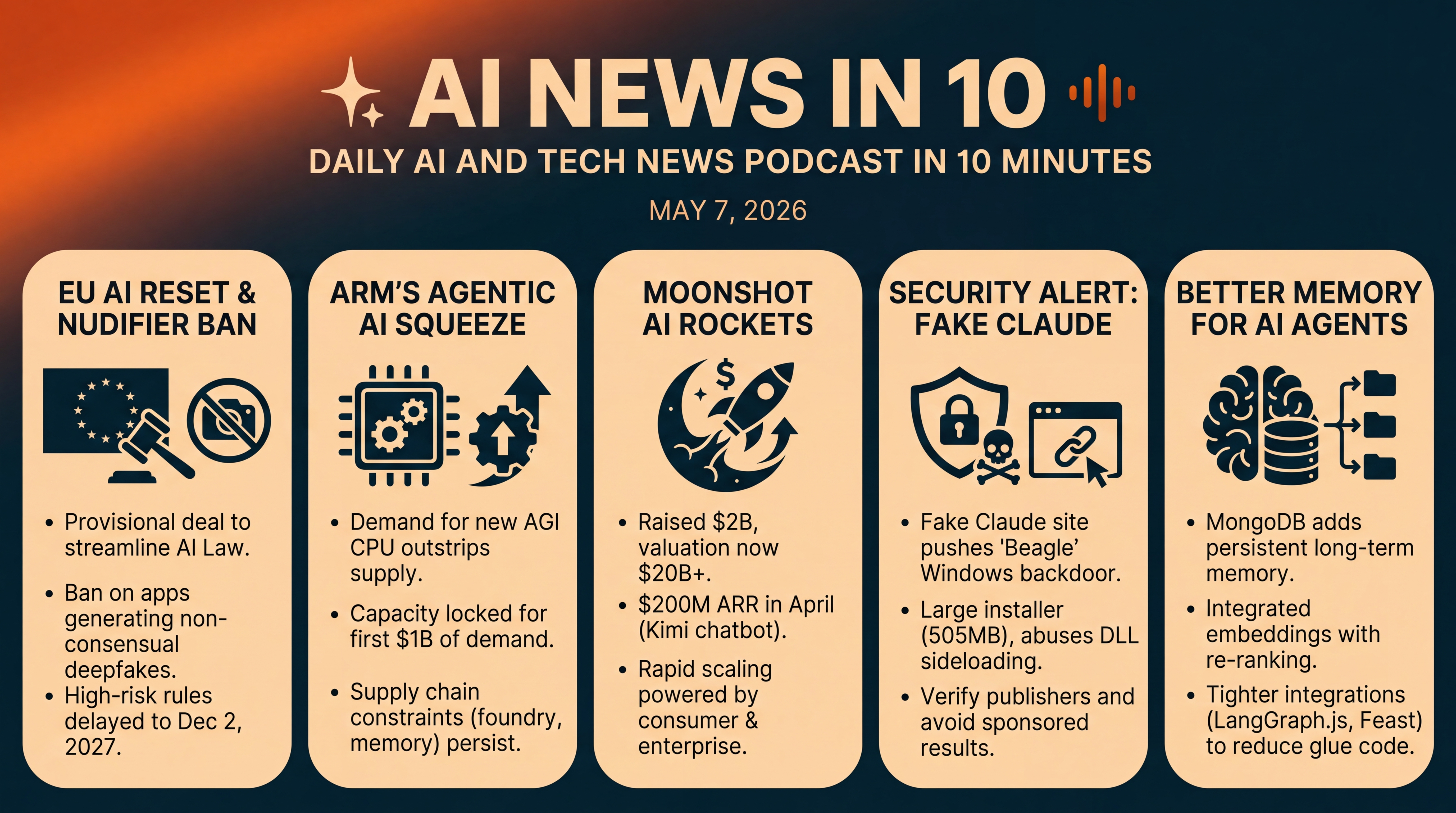
Episode Infographic
Show Notes
Welcome to AI News in 10, your top AI and tech news podcast in about 10 minutes. AI tech is amazing and is changing the world fast, for example this entire podcast is curated and generated by AI using my and my kids cloned voices...
Here’s what’s shaping the AI and tech landscape this Thursday, May 7, 2026.
Europe just struck a political deal to simplify parts of its AI law — and to ban those creepy nudifier apps that generate non-consensual deepfakes. Chip designer Arm says demand for its new agentic AI CPU is outstripping supply — and investors took notice. In China, Moonshot AI, the company behind the Kimi chatbot, has reportedly raised about two billion dollars, vaulting it past a twenty-billion-dollar valuation. Security heads-up: a fake Claude website is pushing a new Windows backdoor called Beagle. And on the tools side, MongoDB is rolling out features to give AI agents longer memory and more trustworthy retrieval. Let’s get into it.
[BEGINNING_SPONSORS]
First up — Europe’s AI reset, and a hard line on deepfake nudifiers.
After late-night talks, EU negotiators reached a provisional deal to streamline portions of the AI framework while introducing a targeted ban on apps that use AI to create sexualized images of identifiable people without consent.
Lawmakers also agreed to push back the application of certain obligations for high-risk systems — biometrics, critical infrastructure, education, employment, migration, and border management — until December 2, 2027.
The European Commission framed this as simpler, more innovation-friendly rules, with explicit protections against the nudifier phenomenon spreading across social media. For developers, the headline is clear: more time to comply for high-risk use cases, and a bright red line on non-consensual intimate imagery. We’ll watch the final text and implementation guidance — but today’s political agreement is the inflection point. Source link in the show notes.
Why it matters: Europe is trying to balance speed with safeguards. The delay to 2027 acknowledges how much work it takes to harden biometric and critical-infrastructure systems, while the nudifier ban targets an immediate harm vector that never should have reached app-store scale. If you build or deploy models in the EU, start mapping your high-risk footprints now — the countdown to December 2027 has begun. Sources in the notes.
Next — Arm’s agentic AI bet meets a supply squeeze.
In earnings chatter spilling into today’s trading, Arm said demand for its new AGI CPU — built for agentic AI workloads in data centers — is running ahead of secured supply. CEO René Haas told investors the company has capacity locked for roughly the first billion dollars of demand, but not the second billion. U.S.-listed shares fell about five and a half percent premarket, despite an upbeat revenue outlook.
The takeaway: AI demand is robust... but supply chains — foundry slots, packaging, memory — are still the gating factor.
A related nugget: Arm’s "for agentic AI" positioning dovetails with a broader wave of EDA and verification work around new CPU designs. The AI boom isn’t just GPUs — CPU and memory roadmaps are being redrawn to feed autonomous tasking and long-horizon agency in the data center. Watch how quickly hyperscalers pilot — and scale — Arm’s AGI CPU. Details in the notes.
Story three — China’s Moonshot AI rockets to a twenty-billion-dollar valuation.
Bloomberg and others report that Moonshot AI — the Beijing lab behind the Kimi chatbot — has raised roughly two billion dollars in a Meituan-led round, lifting its valuation north of twenty billion. One detail catching investor eyes: annualized recurring revenue reportedly topped two hundred million dollars in April, powered by consumer subscriptions and enterprise model services. In this market, that kind of ARR velocity explains the rapid valuation step-ups since late 2024. Sources in the notes.
Why it matters globally: China’s frontier-model scene is consolidating around a handful of well-financed players — Moonshot, DeepSeek, and a few others — with strategic money from large platforms and state-aligned funds. The competitive narrative is shifting from who has the biggest model to who can monetize fastest — consumer subscriptions, enterprise APIs, tool use, and agents. For Western devs, that means stronger cross-benchmarks and sharper price-performance pressure in the model marketplace.
[MIDPOINT_SPONSORS]
Story four — security alert.
A fake Claude site is pushing a "Claude Pro Relay" download that installs a previously undocumented Windows backdoor analysts call Beagle. Researchers say the installer abuses DLL sideloading via a signed updater, uses an in-memory injector dubbed DonutLoader, and then loads the Beagle payload — which supports file operations, directory listings, and remote shell execution.
Indicators include a large installer — around 505 megabytes — labeled Claude Pro for Windows, x64, zip, and command-and-control traffic tied to a Claude Pro look-alike domain. Bottom line for teams: train users to avoid sponsored search results for AI tools, verify publishers and hashes, and block the indicators of compromise. Full write-ups are linked in the notes.
A broader point: as mainstream AI brands become part of everyone’s daily workflow, their names turn into high-yield phishing lures. We’ve seen this movie with browser and wallet impostors — now it’s AI toolchains. Expect more fake installers, relay daemons, and agent helpers pitched at developers. Keep your EDR tuned for living-off-the-land binaries, sideloading, and suspicious persistence under Startup... and only download clients from confirmed vendor portals.
Story five — giving AI agents a better memory.
One of the biggest pain points with agentic systems is brittle memory. Multi-step agents lose context, retrieval turns noisy, and confidence collapses when the wrong chunk gets fed to the model. MongoDB announced new platform features aimed squarely at that gap: persistent long-term memory, integrated embeddings with re-ranking, and tighter integrations — like LangGraph.js Long-Term Memory Store for JavaScript and TypeScript developers, plus Atlas hooks into Feast — so teams can reduce the glue code and the synchronization tax across vector stores, caches, and data pipelines.
MongoDB also highlighted version 8.3 general availability, with architectural hardening to speed AI workloads, and PrivateLink cross-region connectivity for cleaner compliance. The pitch is simple: get accurate context to the model upfront, shrink token budgets, and make agent outputs more trustworthy.
If you’re building agents that need to remember user preferences across sessions — or coordinate retrieval-augmented generation with action planning — this kind of native embedding-plus-re-rank stack is worth a look. It won’t fix hallucinations on its own... but it can dramatically reduce garbage in, garbage out by improving what the model sees before it thinks.
Quick recap before we wrap.
Europe agreed on a political deal to simplify AI rules — and drew a bright red line against nudifier apps — while pushing high-risk obligations to December 2, 2027. Arm reminded markets that AI demand is real but supply is finite, as it races to fill orders for its agentic AI CPU. Moonshot AI’s two-billion-dollar raise at a twenty-plus-billion valuation underscored China’s rapid scaling. Security teams — beware the fake Claude site seeding the Beagle backdoor. And for builders, MongoDB is leaning into agent memory and retrieval so your bots forget less — and help more. We’ll be back tomorrow with the next wave.
Thanks for listening and a quick disclaimer, this podcast was generated and curated by AI using my and my kids' cloned voices, if you want to know how I do it or want to do something similar, reach out to me at emad at ai news in 10 dot com that's ai news in one zero dot com. See you all tomorrow.
