Instagram Encryption Sunset, DoD Scales AI, Power Crunch
Instagram shutters encrypted DMs, a DAEMON Tools supply-chain backdoor gets patched, the Pentagon multiplies a Scale AI deal, Washington vets frontier models, and the AI power race hits grid limits. Get the concise rundown with context, takeaways, and what it means for buyers, builders, and operators.
Episode Infographic
Show Notes
Welcome to AI News in 10, your top AI and tech news podcast in about 10 minutes. AI tech is amazing and is changing the world fast, for example this entire podcast is curated and generated by AI using my and my kids cloned voices...
It’s Friday, May 8. Here’s what’s ahead in AI and tech...
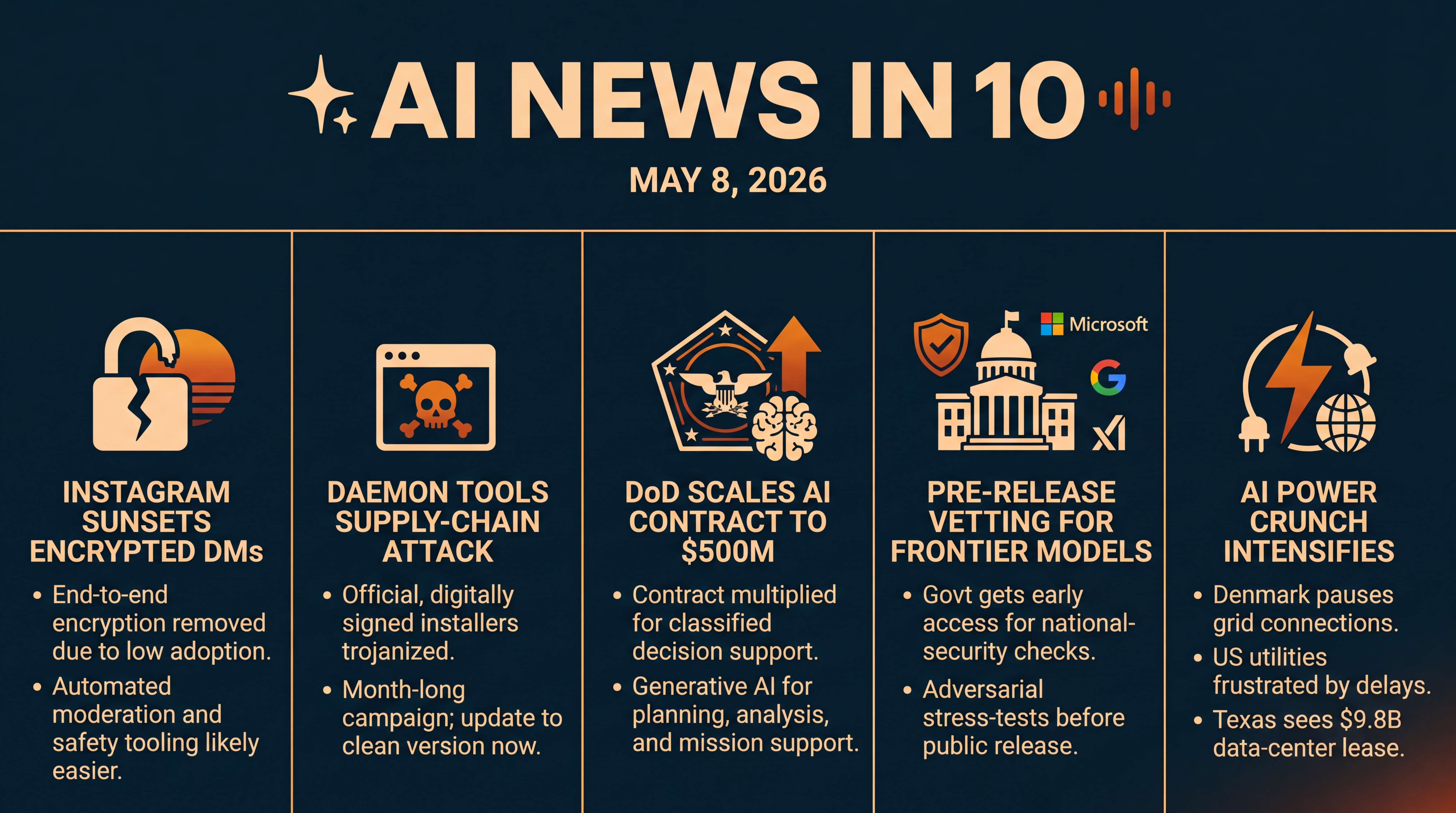
Instagram is switching off encrypted DMs — and says very few people actually used the feature. A month-long supply-chain attack on DAEMON Tools comes to light, with a fix now out. The Pentagon multiplies a Scale AI contract to half a billion dollars for classified decision support. Washington moves to vet frontier models from Microsoft, Google, and xAI before release. And the AI power crunch intensifies — from Denmark pausing new data-center grid connections to a Texas lease worth nearly ten billion dollars. Let’s get into it.
[BEGINNING_SPONSORS]
First up: Instagram is officially removing end-to-end encryption for direct messages starting today, May 8. Meta says the opt-in version just didn’t see meaningful adoption — very few people were turning it on — so the company is pulling it and notifying users who had encrypted chats to download their histories. If you want end-to-end encryption inside the Meta universe, WhatsApp remains the place where it’s enabled by default.
For everyday users, the takeaway is simple: Instagram DMs — already unencrypted for nearly everyone — will stay that way. That could make automated moderation and safety tooling easier, but at the expense of private-by-design messaging on the platform. Sources include MacRumors and industry briefings — links in the show notes.
Story two: a supply-chain backdoor hit DAEMON Tools, the long-running Windows disk-image utility. Attackers trojanized official installers on the vendor’s own site starting April 8. According to Kaspersky researchers, the compromised downloads were even digitally signed — helping the malware slip past trust checks. The campaign stayed active until disclosure, per Ars Technica. A clean DAEMON Tools Lite build is now available. Indicators point to Windows versions being affected, while macOS builds were not implicated.
If you installed DAEMON Tools Lite in April or early May, uninstall, run a full scan, then update to the newest version. The bigger lesson... even official downloads aren’t immune. When attackers get both code-signing and website access, they gain high-trust distribution. Sources: Kaspersky and Ars Technica — links in the show notes.
On to defense tech: the Pentagon just raised the ceiling on its Scale AI production agreement from 100 million dollars to 500 million — five times higher — only eight months after the initial award. The work runs through the Chief Digital and Artificial Intelligence Office and includes tools like Scale’s Donovan — a generative-AI decision support system for operators — plus an end-to-end platform for fine-tuning and evaluating models on classified networks.
Put simply, there’s more money and more scope to push generative AI into planning, analysis, and mission support at Impact Levels 6 and 7. It’s also a signal that defense procurement is maturing — moving from small pilots to large, multi-vendor production programs for AI. Sources include Bloomberg Law, Washington Technology, and Scale AI’s program brief — links in the show notes.
[MIDPOINT_SPONSORS]
Fourth: pre-release vetting for frontier AI steps up. The U.S. Commerce Department’s Center for AI Standards and Innovation — CAISI — says Microsoft, Google, and Elon Musk’s xAI will give the government early access to new models for national-security checks before those models go public. Officials want to stress-test adversarial use cases — think cyber capabilities and other sensitive behaviors — prior to broad deployment.
This approach builds on earlier voluntary commitments, and it shows how model evaluations are moving from lab-driven red-teaming to formal, government-coordinated test regimes. If you’re an enterprise buyer, this could become part of the assurance story you ask vendors about during due diligence. Sources include Reuters coverage carried by Investing.com and Moneycontrol, plus reporting on the CAISI announcement — links in the show notes.
And finally, the power story — because none of this AI boom happens without electrons. In Europe, Denmark has pressed pause on new data-center grid connections after requests reportedly hit a staggering 60 gigawatts — nearly an order of magnitude over the country’s peak demand. It’s a stark mismatch between AI build-out plans and near-term grid capacity.
In the United States, American Electric Power — one of the nation’s largest utilities — is so frustrated with interconnection delays that it’s threatening to exit two major regional grids. That’s a sign of how tense the relationship between utilities and data-center developers has become as megaprojects line up.
And in Texas, Bitcoin-miner-turned-AI-operator Hut 8 signed a 15-year, 9.8-billion-dollar lease to deliver AI data-center capacity at its Beacon Point campus, with thousands of megawatts more in its pipeline — pairing speed-to-power with NVIDIA-spec builds as its go-to-market. Net — demand is real, financing is flowing, but the limiting reagent is grid infrastructure and time to energize. Sources: Tom’s Hardware on Denmark’s pause, Bloomberg on AEP’s warning, and Bloomberg Law and Decrypt on Hut 8’s Texas deal — links in the show notes.
Quick reality check to bring these together... On privacy, Instagram’s move shows how product defaults and adoption curves can decide the fate of security features as much as policy debates do. In cybersecurity, the DAEMON Tools incident reminds us that signed supply chains are high-value targets — patch management can’t just mean OS updates anymore... it has to include vendor provenance and website integrity.
In defense, a five-hundred-million-dollar ceiling expansion tells us AI in classified environments is now a procurement category, not a pilot. And on governance, pre-release checks coordinated by CAISI could become a norm alongside SOC 2 and ISO certifications in enterprise buying. Finally, the AI power gap is widening — grid queues, transformers, and siting are the new bottlenecks — driving everything from utility politics to novel build-outs in Texas.
That’s the rundown for Friday, May 8... encrypted Instagram DMs sunset, a backdoor we can learn from, half a billion dollars’ worth of DoD AI, a new layer of pre-release scrutiny for frontier models, and a power race that may define who actually ships AI capacity over the next 24 months. See you tomorrow.
Thanks for listening and a quick disclaimer, this podcast was generated and curated by AI using my and my kids' cloned voices, if you want to know how I do it or want to do something similar, reach out to me at emad at ai news in 10 dot com that's ai news in one zero dot com. See you all tomorrow.
