Power, Water, and the AI Land Rush
From Michigan and Utah to Georgia, we track the hidden costs of the AI buildout — power, water, and heat — plus the UK's NHS rethinks open-source security and Meta swaps headcount for compute. A fast look at how infrastructure, policy, and Big Tech budgets are colliding in the AI era.
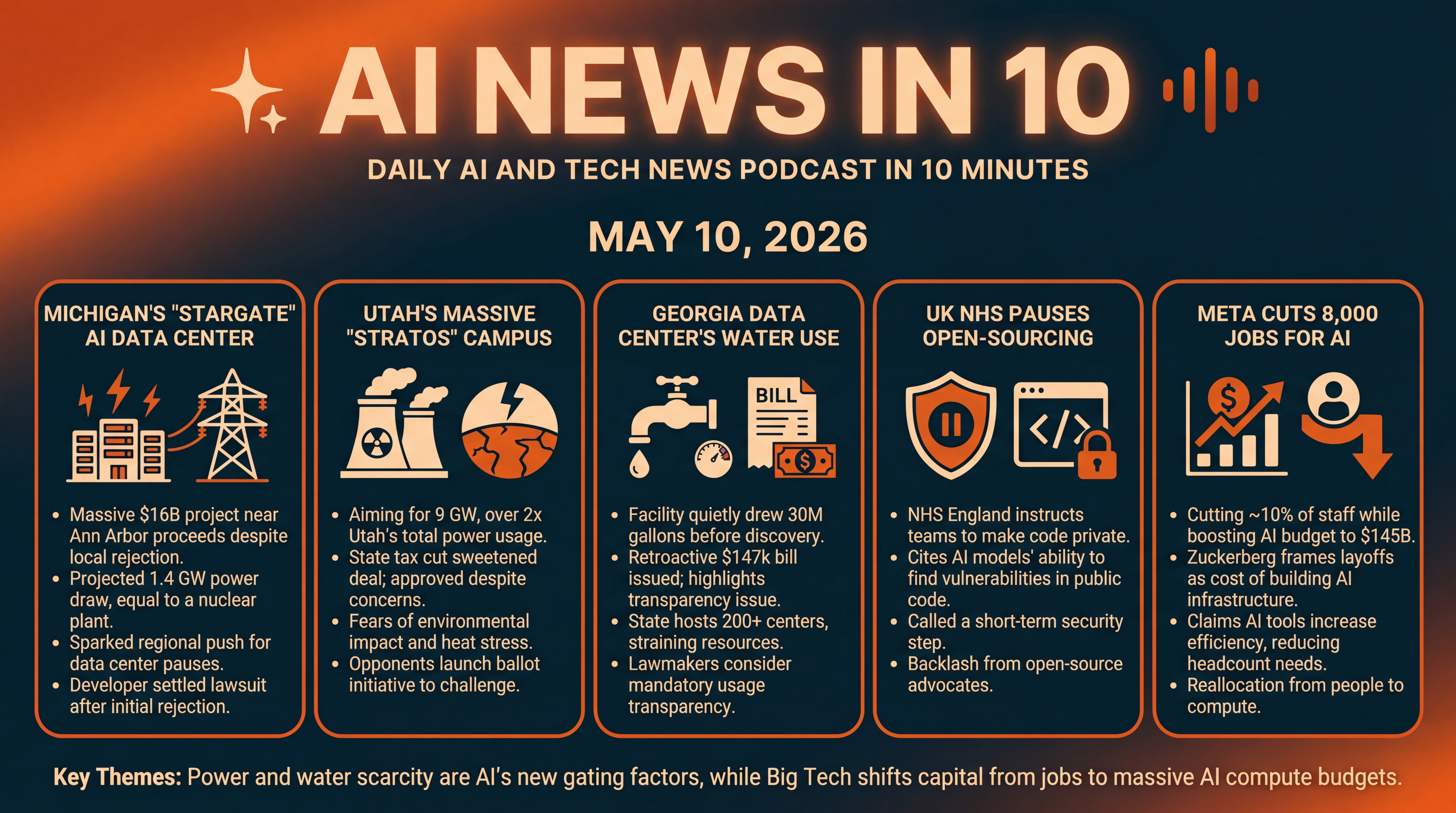
Episode Infographic
Show Notes
Welcome to AI News in 10, your top AI and tech news podcast in about 10 minutes. AI tech is amazing and is changing the world fast, for example this entire podcast is curated and generated by AI using my and my kids cloned voices...
Here's what's on deck today... Two U.S. communities are on the front lines of the AI infrastructure boom — one in Michigan, one in Utah — each wrestling with the power, water, and climate trade-offs that come with hyperscale data centers.
Then we're off to Georgia, where a data center quietly drew 30 million gallons of water before anyone noticed.
Across the Atlantic, the UK's National Health Service is taking a controversial pause on open-sourcing code over new AI security risks.
And we close with Meta, where 8,000 layoffs are being framed as a line item in an eye-watering AI budget.
[BEGINNING_SPONSORS]
Let's start in Saline Township, Michigan — just southwest of Ann Arbor... A massive, $16 billion AI data center tied to OpenAI and Oracle, nicknamed Stargate, is moving ahead despite local opposition.
Residents thought they had killed the plan when the township board voted 4–1 to reject rezoning last year. Two days later, the developer sued, arguing the township's lack of any industrial zoning was exclusionary. Within weeks, the case was settled — and construction moved forward anyway.
The township did secure roughly $14 million in community benefits, environmental restrictions, and water-use limits. The developer says cooling will be closed-loop to curb consumption.
But the grid story is tougher. The campus is expected to draw about 1.4 gigawatts — roughly the output of a nuclear plant — through utility DTE. That has sparked a regional rethink. At least 19 Michigan municipalities have moved to pause new data center projects, and lawmakers even floated a bipartisan, one-year statewide moratorium — even as state leaders pushed back.
It's a vivid snapshot of how quickly AI buildouts are outrunning local planning.
From the Midwest to the Mountain West, Utah is staring down an even bigger project. Stratos — a hyperscale AI and energy campus north of the Great Salt Lake, backed by investor Kevin O'Leary — is aiming for up to 9 gigawatts of power, more than twice Utah's current usage.
State officials, through the Military Installation Development Authority, sweetened the deal with an energy-use tax cut to about 0.5%. After a contentious delay, the Box Elder County Commission approved the project — supporters tout around 2,000 jobs.
But the energy mix and local climate impacts are flashing red. Scientists warn that dumping that much waste heat into already stressed air around the lake could amplify local warming and ecological risks. Critics also question the initial reliance on natural-gas generation.
Opponents have launched a ballot initiative to challenge approvals, while backers say the campus can transition to more renewables over time. It's now a test case for whether AI mega-projects can square jobs and national competitiveness with regional environmental limits.
Zooming out to Georgia, we've got a cautionary tale about basic utilities and oversight. In Fayette County, neighbors who noticed mysteriously low water pressure helped uncover that a large data center had pulled nearly 30 million gallons — without initially paying for it.
A retroactive bill of about $147,000 followed. But the incident poured fuel on a broader political fire in a state that now hosts more than 200 data centers — how do you balance corporate growth against shared infrastructure, especially in hot summers when evaporative cooling can guzzle water?
Some Georgia lawmakers want mandatory transparency on water and power usage for hyperscale sites. Industry leaders warn against policies that could stall investment. Either way, the bill for invisible externalities is coming due.
[MIDPOINT_SPONSORS]
Over in the UK, the National Health Service just pressed pause on one of government tech's most beloved habits — open-sourcing code. NHS England has instructed teams to make hundreds of GitHub repositories private, at least temporarily, citing rapid advances in AI models that can ingest and reason over code at scale.
Internal guidance flagged the risk that newly capable systems — explicitly naming Anthropic's Mythos — could more easily mine public repos for configuration clues, architectural decisions, and vulnerabilities. An NHS spokesperson called it a short-term cybersecurity step while safeguards are assessed, with plans to keep publishing code where there's a clear need.
The move triggered immediate backlash from open-source advocates, who argue secrecy won't fix legacy tech debt and may hinder community-driven hardening. It also signals a new policy frontier — how public institutions weigh transparency against AI-amplified attack surfaces. Expect more agencies to revisit what's safe to open-source when models can trawl, correlate, and exploit at machine speed.
And finally, to Menlo Park. Meta told employees it will cut roughly 8,000 roles — about 10% of headcount — starting May 20. At the same time, the company lifted its 2026 capital expenditure outlook to as high as $145 billion, much of it earmarked for AI data centers and model development.
In an internal meeting, Mark Zuckerberg reportedly framed the layoffs as part of the cost of building AI infrastructure — and suggested some teams that once needed 50 to 100 people may now get the same work done with 10, thanks to new AI tools.
That efficiency claim is controversial, inside and outside the company. But it reflects a broader reallocation happening across Big Tech — more dollars to compute, fewer to people. Whether the bet pays off will hinge on how fast AI products drive revenue, not just how fast they reduce payroll. Investors are watching both lines closely.
Quick takeaways before we go...
Local pushback against AI infrastructure is getting more organized — Michigan's Stargate, Utah's Stratos, and Georgia's water saga all highlight how power and water are now the gating factors for AI, not just chips.
Public agencies are starting to reassess what they expose in the age of AI code-reading, as the NHS hits pause on open repos.
And inside Big Tech, AI remains a capital‑intensive race — Meta's billions for compute and thousands of job cuts underline that the frontier is as much about budgets and buildouts as it is about breakthrough models.
That's your AI and tech roundup for Sunday, May 10, 2026. Stay curious, stay critical... and I'll see you tomorrow.
Thanks for listening and a quick disclaimer, this podcast was generated and curated by AI using my and my kids' cloned voices, if you want to know how I do it or want to do something similar, reach out to me at emad at ai news in 10 dot com that's ai news in one zero dot com. See you all tomorrow.
