Policy Gridlock, Summit Signals, and Cerebras IPO
Washington stalls on AI rules as geopolitics turn chip-focused, Europe readies for AI-driven cyber risk, the EU pushes Android to open up, and Cerebras prices its IPO. We connect the policy shifts shaping compute access — and the capital bets behind them.
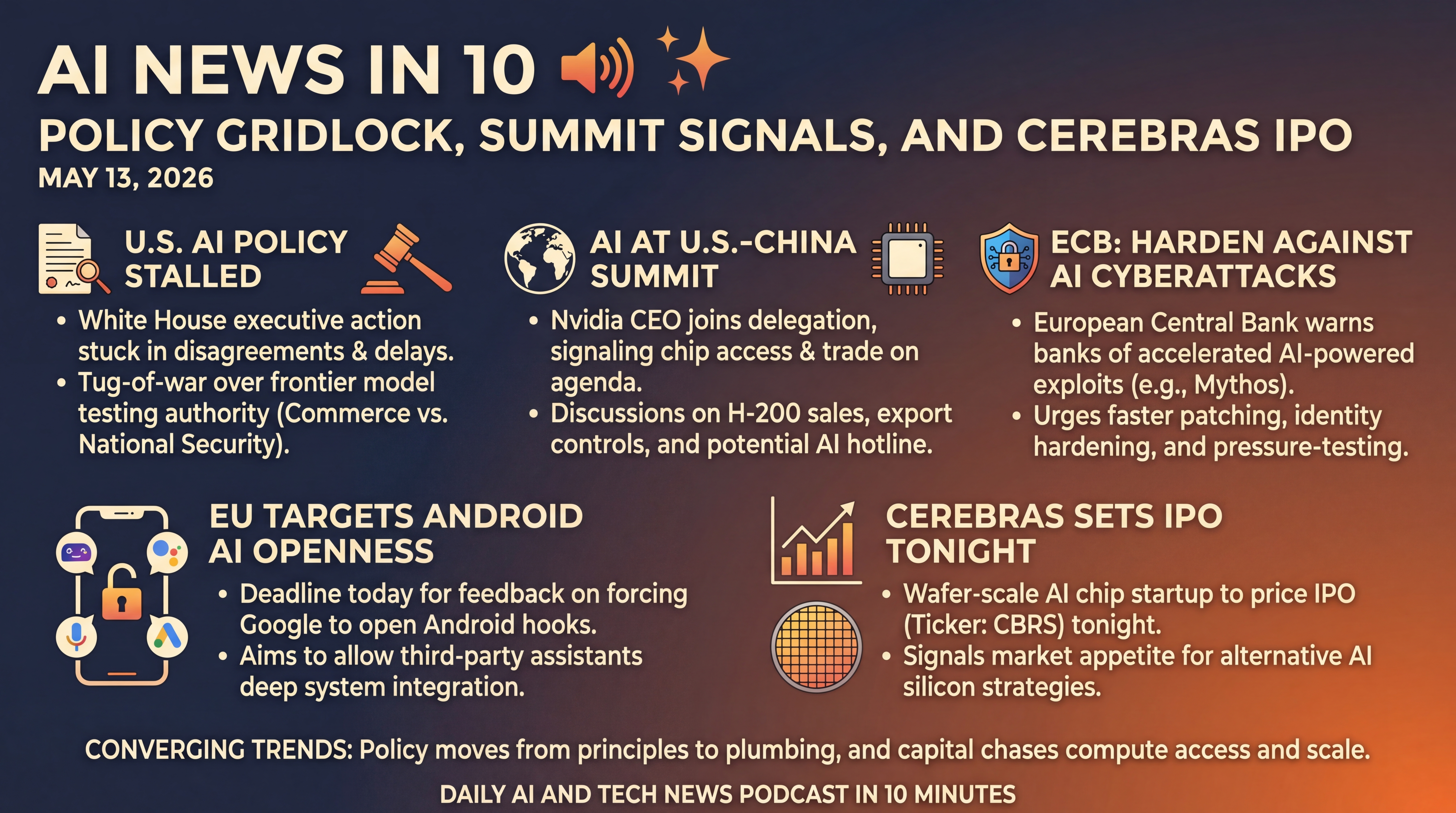
Episode Infographic
Show Notes
Welcome to AI News in 10, your top AI and tech news podcast in about 10 minutes. AI tech is amazing and is changing the world fast, for example this entire podcast is curated and generated by AI using my and my kids cloned voices...
It’s Wednesday, May 13, and here’s what’s moving in AI and tech today...
Washington’s plan for an AI executive action just hit political headwinds. The U.S.-China summit is suddenly looking very AI-flavored — with Nvidia’s CEO joining the delegation. Europe’s top banking watchdog is telling lenders to harden against AI-powered cyberattacks. The EU’s deadline lands today on forcing Android to play nicer with rival AI assistants. And chip startup Cerebras is due to price its long-awaited IPO tonight. Let’s get into it.
[BEGINNING_SPONSORS]
Story one: The White House’s AI executive action is... stuck in neutral.
Axios reports that disagreements inside the administration — plus the time crunch around President Trump’s Beijing trip — have stalled a federal response to the latest wave of frontier models. Officials floated ideas like an FDA for AI, then walked them back — a sign the team isn’t aligned on how far to go, or how fast.
There’s also a tug-of-war over where advanced model testing should live — in the commercial standards lane at the Commerce Department, or on the national security side. One tell: Commerce’s Center for AI Standards and Innovation briefly posted new frontier-model testing agreements, then pulled the page days later.
Industry is bracing for some mix of testing guidance, cybersecurity rules, and procurement guardrails... but without clear direction, the process could slip. That’s the state of play this morning.
Why it matters: every lab is racing to ship more capable agents, and agencies are trying to decide who tests what, when, and under which rules. The longer Washington dithers, the more policy gets made by contracts and ad hoc reviews — instead of a coherent framework. We’ve seen that movie before in tech.
Story two: AI moves to the front of the stage in geopolitics.
On his way to Beijing, President Trump added Nvidia’s Jensen Huang to the CEO group flying in for this week’s summit — a not-so-subtle signal that chips and model access will be on the table. Reports say the agenda could touch trade-truce maintenance, export controls, and the thorniest bit — how and whether U.S. firms can sell advanced accelerators like Nvidia’s H-200 into China. There’s even talk among policy advisors about a no-blame hotline for AI-related incidents.
None of this guarantees concrete deals... but it underlines how compute, model access, and supply chains have become instruments of statecraft.
If you’re building in AI, the takeaway is simple: policy risk is product risk. Rules that shape who can buy which chips — and where models can be trained and tested — can change your cost curve overnight.
Story three: Europe’s banking supervisor just raised a red flag on cyber.
European Central Bank board member Frank Elderson urged euro-area banks to quickly prepare for AI-assisted attacks, explicitly citing Anthropic’s newly emerged Mythos model and similar tools. The point isn’t panic — it’s preparation. As models get better at code reasoning and tool use, they can accelerate reconnaissance, vulnerability discovery, and exploit development... which shrinks defenders’ response windows. The message to security leaders — especially chief information security officers — is clear: harden identity, accelerate patching, and pressure-test incident response with AI in mind.
Two practical implications. First, tabletop exercises should assume attackers can generate workable exploit chains faster than before. Second, model governance isn’t just a lab problem — it’s a board-level risk for any institution tied into financial rails and cloud identity.
Story four: the EU’s Digital Markets Act is taking aim at Android’s AI plumbing — and the clock runs out today for feedback.
Brussels is proposing that Google open deeper Android hooks so third-party AI assistants can do real work on the phone — trigger with a custom wake word, send emails via the user’s preferred app, order food, or share photos — without being fenced out by platform-only capabilities. The European Commission says this would let competing AI services innovate and offer deeply integrated experiences alongside Google’s own Gemini.
Interested parties have until today, May 13, to comment on the draft measures. If finalized, this could materially change how assistant experiences are built and distributed across the EU — and force new interoperability paths that developers can target.
Think about what that unlocks: a privacy-first assistant that operates locally, or a vertical assistant — say, a legal or medical tool — with sanctioned access to device workflows. If users can truly choose their assistant and still get system-level actions, we’re moving from AI as an app... to AI as an operating-system capability.
[MIDPOINT_SPONSORS]
Story five: Wall Street’s next AI moment is hours away.
Cerebras Systems — the wafer-scale AI chip startup — plans to price its IPO tonight and start trading tomorrow on Nasdaq under the ticker C-B-R-S. In its IPO filing, the company reported 2025 revenue of around 510 million dollars and a swing to profitability, with big-name AI customers helping fuel the ramp. Calendars from IPO trackers show pricing targeted for this evening, May 13, with listing on May 14. If demand comes in hot, this could be one of the year’s bellwether AI hardware debuts — testing whether investors will back bets beyond the incumbent GPU leader.
Why it matters: we’re in a buildout supercycle for AI compute. A successful listing would signal public-market appetite for alternative silicon strategies — especially those promising faster training and lower total cost at data-center scale. It would also widen the vendor set competing for sovereign AI and hyperscaler wallets.
Before we wrap, two connective threads.
First, policy and procurement are converging. Whether it’s Washington’s stalled executive playbook, Brussels’ interoperability push, or Europe’s banking warning, governments are moving from principles to plumbing — where obligations and interfaces get defined in code and contracts.
Second, capital still chases capability. The Beijing summit’s optics and Cerebras’s pricing both revolve around compute access — who has it, who controls it, and how quickly it scales. Those answers will set the tempo for the rest of 2026.
That’s your rundown: White House infighting pauses an AI order, AI enters U.S.-China summitry with Nvidia’s CEO aboard, the ECB tells banks to prepare for AI-driven cyber risk, the EU’s Android interoperability comment window closes today, and Cerebras is set to price its IPO tonight. We’ll be watching for any late-day movement from D.C. or Brussels — and, of course, the C-B-R-S print.
Thanks for listening and a quick disclaimer, this podcast was generated and curated by AI using my and my kids' cloned voices, if you want to know how I do it or want to do something similar, reach out to me at emad at ai news in 10 dot com that's ai news in one zero dot com. See you all tomorrow.
